
Category: AI Search | SEO Analytics | Digital Marketing
Read time: 9 min
Every brand wants to know: “Do we show up in AI answers for the topics that matter to us?” It is a fair and important question. However, the tools most teams are using to answer it are only giving them part of the picture — and in some cases, a misleading one.
AI search visibility is genuinely harder to measure than traditional search rankings. The outputs are unstable, the platforms are fragmented, and no universal measurement layer exists across ChatGPT, Google AI Overviews, Perplexity, and Microsoft Copilot, the way that search engine results pages did for traditional SEO.
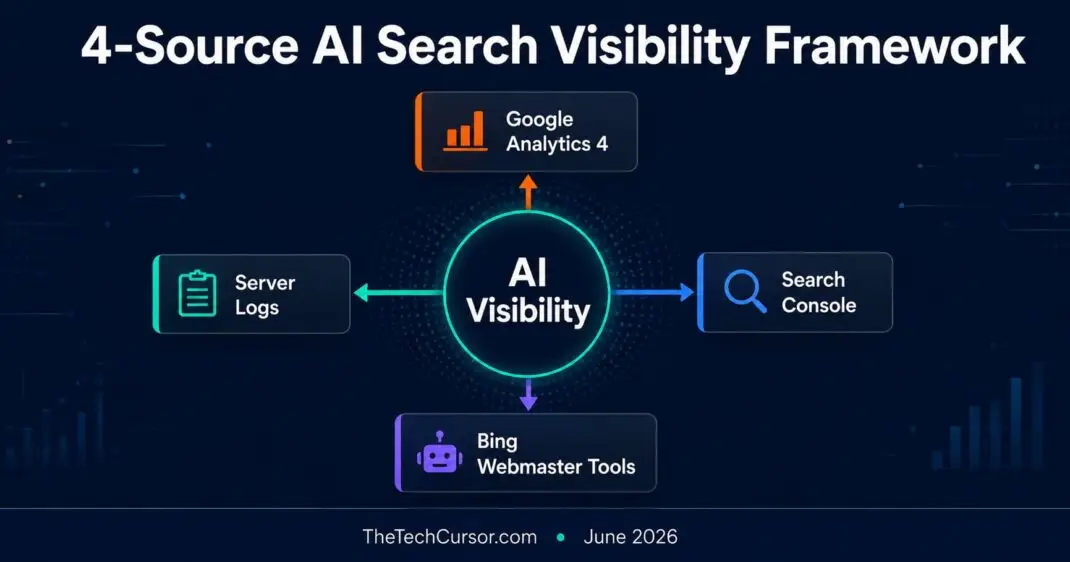
This guide explains where current prompt tracking breaks down, what it is still useful for, and how to build a multi-source measurement framework that gives you a genuinely accurate view of your AI search visibility.
Table of Contents
- Why Prompt Tracking Alone Is Not Enough
- The Core Problem: AI Answers Are Unstable
- The 4-Source Measurement Framework
- Source 1: Google Analytics 4 — Actual AI Traffic
- Source 2: Google Search Console — Prompt-Like Queries
- Source 3: Bing Webmaster Tools — Native AI Citation Data
- Source 4: Server Logs — Crawler Activity
- Tips for Better Prompt Monitoring
- Competitive Benchmarking in AI Search
- Bottom Line
1. Why Prompt Tracking Alone Is Not Enough
Prompt tracking tools have become popular quickly — and for good reason. They offer something brands have been asking for:
Evidence that their brand appears in AI-generated answers for commercially relevant queries.
However, prompt monitoring works best as one layer in a broader measurement stack, not as a standalone source of truth. The reason is structural: AI search does not behave like a traditional search results page.
With traditional rank tracking, you measure against a relatively structured environment. A position is a position. A page either ranks or it does not. With generative AI, you are measuring against systems that can change the answer format, cited sources, wording, and brand recommendations from one run to the next.
The challenge is not that prompt tracking tools are flawed. It is that they are measuring a genuinely noisier environment, and treating directional data as definitive data leads to decisions built on a shaky foundation.
2. The Core Problem: AI Answers Are Unstable
The most important limitation to understand about prompt tracking is that AI-generated outputs are highly variable. A brand can appear in one run of a prompt, be omitted in the next run of the identical prompt minutes later, and reappear with a different context in the run after that.
Research from SparkToro in January 2026 reinforced this point: repeated tests across major AI platforms produced highly inconsistent recommendation lists. This means point-in-time AI visibility snapshots can be noisy and easy to misinterpret.
Furthermore, there is no universal index to query for AI results. ChatGPT, Gemini, Claude, Perplexity, Copilot, Google AI Overviews, and AI Mode all have different interfaces, retrieval behaviours, access restrictions, and answer formats. Prompt monitoring tools often have to simulate sessions, standardize messy outputs, and compare results across platforms that were never designed to be measured the same way.
The practical implication: treat prompt tracking data as directional evidence — useful for spotting patterns and identifying where to investigate further — not as a precise ranking system equivalent to keyword position tracking.
3. The 4-Source Measurement Framework
A more accurate picture of AI search visibility comes from combining prompt tracking with three additional first-party data sources:
| Source | What It Tells You |
|---|---|
| Prompt tracking tools | Whether your brand appears in AI answers for target queries |
| Google Analytics 4 | Whether AI visibility generates actual traffic and conversions |
| Google Search Console | Query patterns that suggest AI-assisted search behaviour |
| Bing Webmaster Tools | Native citation data from Microsoft’s AI-powered search |
| Server logs | Which AI crawlers are accessing your content |
No single source gives you the complete picture. Together, they let you separate visibility from business impact, identify which content AI systems are actually consuming, and spot patterns that prompt tools alone would miss.
4. Source 1: Google Analytics 4 — Actual AI Traffic
GA4 will not show you every prompt where your brand appears. However, it shows you something more important: whether AI visibility is translating into actual sessions, engagement, and conversions.
How to use GA4 for AI visibility measurement:
Group referral traffic from AI platforms — ChatGPT, Perplexity, Copilot, Grok, and other AI answer engines — into a dedicated channel grouping. Then compare these users against other traffic sources using:
- Engaged session rate
- Conversion rate
- Assisted conversions
- Landing pages attracting disproportionate AI referral traffic
Pages that attract significant AI referral traffic are particularly valuable — they often reveal the content formats, entity coverage, and page structures that AI systems are most likely to cite. Understanding what these pages have in common should directly inform your content strategy for improving AI visibility elsewhere.
The Google AI Overviews traffic signal: For AI Overviews specifically, tracking visits that include the#:~:text= URL fragment can add supporting context. It is not a complete solution, but paired with a landing page and query analysis, it can help identify where AI Overview citations are driving clicks.
5. Source 2: Google Search Console — Prompt-Like Queries
Google Search Console does not label queries as “came from an AI Overview” — but it can help you identify prompt-like search behaviour that suggests AI-assisted discovery is influencing your traffic.
The long-query filter technique:
Many AI-assisted searches involve conversational, detailed queries longer than classic head terms. In Search Console, you can filter for these using a custom regex:
- Go to Performance > Search Results
- Set the date range to 12 months
- Click Add filter > Query
- Change the dropdown to Custom (regex)
- Paste:
^(?:S+s+){9,}S+$ - Click Apply
This filters for queries of 10 or more words — a strong signal of conversational, AI-assisted search behaviour. Compare long-form query growth over time, which landing pages they reach, and how click patterns are changing to build a picture of where AI-assisted discovery may be increasing.
Start by reviewing queries with six, eight, or ten or more words and identify which threshold produces the most useful patterns for your specific site.
6. Source 3: Bing Webmaster Tools — Native AI Citation Data
Bing Webmaster Tools has become one of the most valuable direct data sources for AI citation tracking — and it is frequently underused by SEO teams focused primarily on Google.
As covered in TheTechCursor’s detailed breakdown of Bing Webmaster Tools’ AI reporting features, Microsoft introduced AI Performance reporting in February 2026 — four months ahead of Google’s equivalent reporting in Search Console.
The Bing AI Performance report shows:
- When your site is cited in supported AI-generated answers
- Which specific pages are being cited
- Which grounding queries triggered those citations
- Intent classification, topic clustering, citation share, and time-based comparison
For any audience that uses Copilot or Bing’s AI-generated summaries, this platform-native data should be a core part of your measurement stack. Unlike prompt tracking simulations, this is real citation data tied to actual AI answer experiences.
7. Source 4: Server Logs — Crawler Activity
Server logs give you a fundamentally different type of insight: direct evidence of whether AI crawlers are accessing your content at all.
User agents associated with major AI platforms include GPTBot (OpenAI), ClaudeBot (Anthropic), PerplexityBot, and others. Analyzing which pages these crawlers are hitting — and how frequently — answers early operational questions:
- Are key pages being crawled by AI-related bots?
- Which sections of the site attract the most AI crawler activity?
- Are new pages being discovered quickly by AI crawlers?
- Are AI crawlers concentrating on a narrow subset of pages rather than your full content library?
Log file analysis does not confirm that your content is being cited. However, it can help you understand whether AI systems are consuming your content at a much higher rate than they are sending referral traffic back — a pattern worth investigating when it appears.
8. Tips for Better Prompt Monitoring
If you are using prompt tracking tools, these practices will significantly improve the quality and reliability of the data you get:
Test across multiple AI platforms. Different AI systems have different retrieval behaviours, citation patterns, and brand selection logic. A prompt set that shows strong visibility on one platform can look weak on another. Monitoring a focused prompt library across multiple platforms gives you a more accurate ecosystem view than any single platform can provide.
Use API access where available. API-based testing provides cleaner, more comparable data than manual testing or interface scraping. With API access, you can log the exact prompt, timestamp, model version, and structured response output for every run — making it far easier to spot patterns and separate genuine visibility changes from model update noise.
Log model version changes.LLM behaviour changes with model updates. When your visibility shifts, the cause may be a model update rather than anything about your content. Tracking the model name, version, and test date for every recurring prompt run lets you separate platform-level changes from page-level or brand-level changes.
Focus on a disciplined prompt library. For most brands, monitoring 20-30 high-value prompts across core product, comparison, and category themes is more actionable than tracking hundreds of prompt variations. Smaller, intentional tracking produces data you can actually act on — rather than a large volume of noise.
Analyze mention sentiment, not just presence. Appearing in an AI answer and being recommended positively are not the same thing. Review the actual AI response text — not just dashboard summaries — to understand how your brand is framed, which competitors appear alongside you, and whether your mention is central to the recommendation or incidental.
9. Competitive Benchmarking in AI Search
Competitive analysis is where prompt monitoring often becomes most actionable. Rather than tracking your brand in isolation, compare the same prompt set across your brand and a small group of key competitors.
AI share of voice: Track how often your brand appears versus two or three competitors across the same prompts. This builds a directional AI share of voice view — not a precise market share metric, but useful for competitive positioning and spotting gaps.
Prompt gap analysis: Identify prompts where competitors are cited or recommended, but your brand is not. For each gap, ask:
- Do we have content covering this topic?
- If yes, does it attract any AI referral traffic or citation evidence?
- Is this a content gap, a distribution gap, or a credibility gap?
This framework prevents jumping straight to content production when the real issue may be weak off-page visibility, poor citation presence in trusted sources, or insufficient brand-topic association in AI training data.
Source opportunities: Separate missing visibility into two buckets — topics you have not covered adequately, and sources (publications, forums, communities) where you are absent but competitors are being cited. Strengthening your presence in the sources AI systems already trust for your topic is often faster than publishing additional content.
10. Bottom Line
AI search visibility measurement in 2026 is genuinely hard — and anyone claiming they have fully solved it is overstating the case. The outputs are unstable, the platforms are fragmented, and the available tools are still maturing.
However, a multi-source measurement stack — combining prompt tracking with GA4 AI referral analysis, Search Console long-query patterns, Bing Webmaster Tools citation data, and server log crawler analysis — gives you a significantly more accurate picture than any single source alone.
Stop searching for one perfect AI visibility number. Build a reporting framework that combines directional visibility data with actual business impact data — and use that combined view to make better decisions about content, distribution, and brand authority investment.
Pingback: Google AI Mode SEO 2026: Gemini 3.5 Flash Model Update Changes Everything — Why You Must Log the Model Name in Every Test - The Tech Cursor
Pingback: Freshpet's GEO Playbook: How They Earned AI's Trust - The Tech Cursor
Pingback: MIT, Anthropic & OpenAI's Warning: What Marketers Do Now - The Tech Cursor