Published: July 17, 2026
Read time: 6 min
Google AI Mode has dominated the AI search conversation in 2026. However, Microsoft has been quietly building its own answer — and Bing AI Mode has now reached a level of maturity that deserves serious attention from marketers and SEO professionals.
Bing AI Mode is Microsoft’s generative search experience — a conversational, AI-powered search interface that generates synthesized answers with citations, handles multi-turn conversations, and increasingly handles the kind of complex queries that users previously had to research manually.
Here is how it works, how it compares to Google AI Mode, and what it means for your content and SEO strategy.
Table of Contents
- What Is Bing AI Mode?
- How Bing AI Mode Works
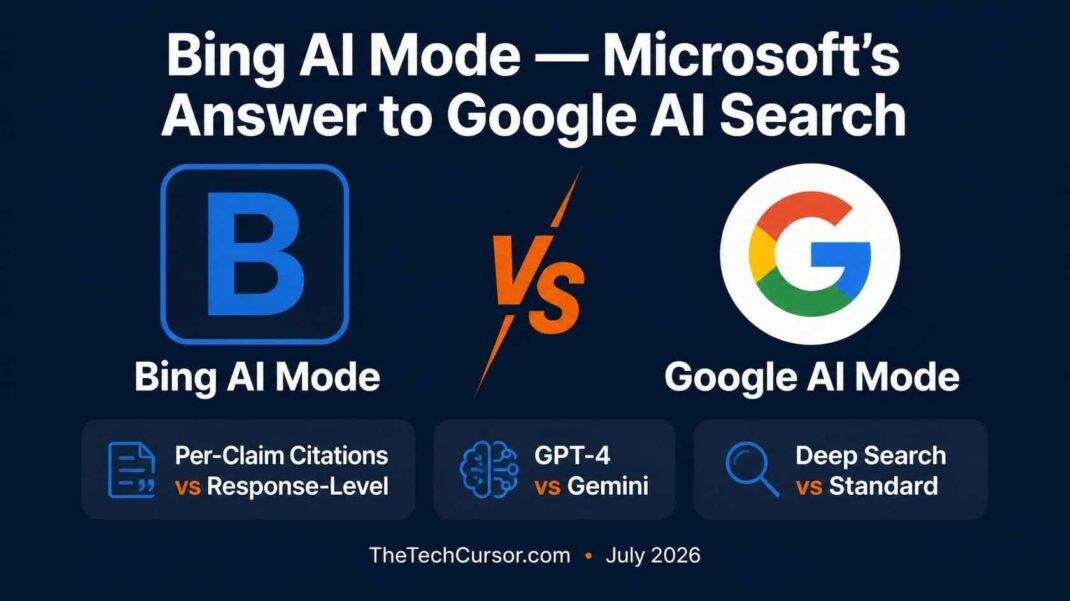
- Bing AI Mode vs Google AI Mode — Key Differences
- Deep Search — Bing’s Standout Feature
- Citations and Source Transparency
- What This Means for SEO and Content Strategy
- How to Check If You Appear in Bing AI Mode
- Should Marketers Care About Bing AI Mode?
- Bottom Line
1. What Is Bing AI Mode?
Bing AI Mode is a dedicated search experience within Bing that uses large language models — powered by OpenAI’s GPT models — to generate conversational, synthesized responses to search queries rather than returning a traditional list of ranked links.
Unlike the standard Bing results page, AI Mode presents a primary generated answer with inline citations, follow-up question suggestions, and a persistent conversation interface that lets users refine their query without starting over.
Microsoft has been building toward this experience since the initial Bing Chat launch in early 2023. The current AI Mode represents a significantly more mature version — with better citation quality, broader topic coverage, and tighter integration with Bing’s search index and Microsoft’s broader product ecosystem, including Copilot, Edge, and Microsoft 365.
2. How Bing AI Mode Works
When a user submits a query in Bing AI Mode, the system follows a process similar in structure to Google AI Mode but with several important differences in implementation:
Query understanding Bing AI Mode analyzes the query to understand intent — not just keywords. Multi-part questions, comparative queries, and research-oriented prompts are handled conversationally rather than matched to individual result pages.
Web retrieval: The system retrieves relevant web pages from Bing’s search index — the same index that powers standard Bing search results. This means pages that rank well in standard Bing search are more likely to appear as sources in AI Mode responses.
GPT-powered synthesis: Retrieved content is processed through OpenAI’s GPT models to generate a synthesized response. Unlike a simple summary, the synthesis identifies key points across multiple sources, resolves contradictions where possible, and organizes information to directly address the user’s question.
Citation generation: Every factual claim in the AI Mode response is linked to a specific source — displayed as numbered inline citations that users can click to visit the original page. This citation model is more granular than Google AI Overviews, which typically cite 3-6 sources at the response level rather than at the claim level.
Conversation continuation: Users can ask follow-up questions that build on the previous exchange — maintaining context across multiple turns without repeating earlier parts of the query.
3. Bing AI Mode vs Google AI Mode — Key Differences
Both products are generative AI search experiences — but they differ in meaningful ways that affect both user experience and content strategy:
| Bing AI Mode | Google AI Mode | |
|---|---|---|
| AI model | OpenAI GPT (via Microsoft partnership) | Google Gemini |
| Citation style | Inline per-claim citations | Response-level source citations |
| Search index | Bing index | Google index |
| Integration | Microsoft 365, Copilot, Edge | Google Workspace, Gemini app, Chrome |
| Deep Search | Yes — extended research mode | Limited equivalent |
| Image generation | DALL-E integration | Gemini Omni integration |
| Advertising | Bing Ads in AI responses | Google Ads in AI Mode |
| Market share | ~12% global search | ~88% global search |
The most practically significant difference for content strategy is the citation style. Bing AI Mode’s per-claim inline citations mean that specific sentences or paragraphs from your content can be cited individually — making content that contains clearly attributable factual claims more likely to receive citation credit than content that makes general arguments without discrete factual anchors.
4. Deep Search — Bing’s Standout Feature
One feature that distinguishes Bing AI Mode from its competitors is Deep Search — an optional extended research mode that takes significantly longer to complete but produces more comprehensive results.
When activated, Deep Search:
- Expands the query into a broader set of sub-queries
- Retrieves a larger number of sources than standard AI Mode
- Performs more iterative synthesis passes before generating the response
- Produces longer, more structured responses with more granular citations
Deep Search is designed for queries that require genuine research depth — competitive analysis, market landscape questions, regulatory research, technical documentation review. It is not optimized for quick factual lookups.
For marketers, Deep Search is relevant in two ways. First, as a research tool, it functions similarly to Perplexity Deep Research and ChatGPT Deep Research, providing a capable alternative within the Bing ecosystem. Second, as a content strategy signal — the queries that users activate Deep Search for represent high-value research intent that comprehensive, well-cited content is best positioned to serve.
5. Citations and Source Transparency
Bing AI Mode’s citation model is one of its most distinctive characteristics — and one of the most practically relevant for SEO professionals.
Standard Bing AI Mode responses include numbered inline citations linked to specific source pages. Users can hover over citations to preview the source and click through to visit the original page. This model provides more granular source attribution than Google AI Overviews — where citation links typically appear as a grouped set at the bottom or side of the response rather than attached to specific claims.
The practical implications for content strategy:
Discrete factual claims get cited. Content structured around clear, attributable facts — “X% of Y do Z” — is more likely to receive citation credit than content that makes general arguments. Original research and data are particularly valuable in this context.
Structured content performs better. Content with clear headings, short paragraphs, and well-organised information is easier for Bing’s AI to extract specific claims from — increasing citation probability.
Source credibility matters. Bing AI Mode prioritizes sources that Bing’s index already considers authoritative for the relevant topic. Pages that rank well in standard Bing search for related queries have a structural advantage in AI Mode citation probability.
6. What This Means for SEO and Content Strategy
For SEO professionals and content teams, Bing AI Mode introduces several strategic considerations:
Bing SEO is now also AI Mode optimisation. Because Bing AI Mode draws from Bing’s search index, improving your Bing search rankings directly improves your AI Mode citation probability. Traditional Bing SEO — crawlability, indexability, on-page optimization, link building — remains the foundation of Bing AI Mode visibility.
Bing Webmaster Tools is essential. As covered in TheTechCursor’s detailed breakdown of Bing Webmaster Tools’ AI reporting features, Microsoft launched dedicated AI Performance reporting in February 2026 — months before Google Search Console’s equivalent. These reports show which of your pages are being cited in Bing’s AI responses and for which queries — making them directly actionable for both Bing SEO and AI Mode optimization.
Per-claim citation style rewards structured content. The inline citation model rewards content that contains clearly attributable, discrete factual claims. Review your highest-value content and identify whether key claims are stated clearly enough to be extracted and cited individually — or whether they are embedded in general arguments that are harder for AI to attribute to a specific source.
Copilot integration extends reach; Bing AI Mode content also surfaces within Microsoft Copilot — integrated into Windows, Edge, Microsoft 365, and the Copilot standalone interface. Content that performs well in Bing AI Mode, therefore, has compounding reach across Microsoft’s entire AI ecosystem.
7. How to Check If You Appear in Bing AI Mode
Unlike Google AI Overviews, Bing AI Mode does not yet have an equivalent to Google Search Console’s AI Performance Reports for comprehensive visibility tracking. However, several approaches provide a useful signal:
Manual prompt testing: Run your most important target queries through Bing AI Mode directly and check whether your brand or content appears as a cited source. Systematic prompt testing across your core topic queries provides a directional view of your current AI Mode visibility.
Bing Webmaster Tools AI Performance Report: Connect your site to Bing Webmaster Tools and review the AI Performance Report — which shows citation data for your domain across Bing’s AI-powered responses. This is the most reliable native data source for Bing AI Mode visibility.
Server log analysis: Review your server logs for visits from Bing’s AI crawlers — BingBot and related user agents. Pages receiving high crawler activity are candidates for AI Mode citation; pages with minimal crawler activity may have indexability issues affecting AI Mode visibility.
8. Should Marketers Care About Bing AI Mode?
The honest answer depends on your audience.
Bing holds approximately 12% of the global search market share — a fraction of Google’s dominance. For most brands, Bing-specific optimization is a secondary priority at best.
However, several factors make Bing AI Mode worth considering:
Microsoft 365 integration. Bing AI Mode content surfaces across the Microsoft productivity ecosystem — including Copilot embedded in Word, Excel, and Teams. For B2B brands whose audiences work heavily in Microsoft environments, this integration extends AI Mode reach significantly beyond Bing’s search market share.
Copilot’s growing user base. Microsoft Copilot is one of the most widely deployed AI assistants in enterprise environments. Visibility in Bing AI Mode translates directly into Copilot visibility — a meaningful channel for B2B and enterprise-focused brands.
Lower competition. Far fewer brands are actively optimizing for Bing AI Mode than for Google AI Overviews. For brands in competitive verticals, Bing AI Mode may represent a lower-competition visibility opportunity with meaningful audience reach.
Cross-platform strategy. As covered in TheTechCursor’s AI search visibility measurement guide, multi-platform AI visibility tracking — across Google, Bing, ChatGPT, and Perplexity — provides a more complete picture of AI search presence than Google-only monitoring.
9. Bottom Line
Bing AI Mode is a mature, capable generative search experience that deserves more attention from marketers than it typically receives. Its per-claim citation model, Deep Search capability, and deep integration with Microsoft’s product ecosystem make it strategically relevant — particularly for B2B brands and those targeting audiences heavily embedded in Microsoft environments.
For content strategy, the key takeaway is that the same fundamentals that drive Google AI Mode visibility — structured content, discrete factual claims, strong Bing index presence, and topical authority — also drive Bing AI Mode citation probability. Optimizing for one benefits the other.
Set up Bing Webmaster Tools if you have not already. Review the AI Performance Reports. Run your core queries through Bing AI Mode. The competitive landscape for AI search is not just Google — and the brands that build visibility across multiple AI search surfaces will have more durable and diversified audience reach as the AI search era matures.
Pingback: How to Track Your Brand's Visibility in AI Search A Practical Measurement Framework for 2026 - The Tech Cursor