
Category: Google Ads | PPC | Digital Marketing
Published: June 24, 2026
Read time: 5 min
Site: TheTechCursor
If your Google Ads campaigns are currently outperforming their Target CPA or Target ROAS goals, you need to read this carefully. An update taking effect on August 17, 2026, could quietly reduce that outperformance — and if you do not act before then, you may see performance shift in ways you did not expect or plan for.
Google has announced a significant change to how target-based bid strategies behave when campaigns are constrained by budget. Here is exactly what is changing, who it affects, and what to do before the deadline.
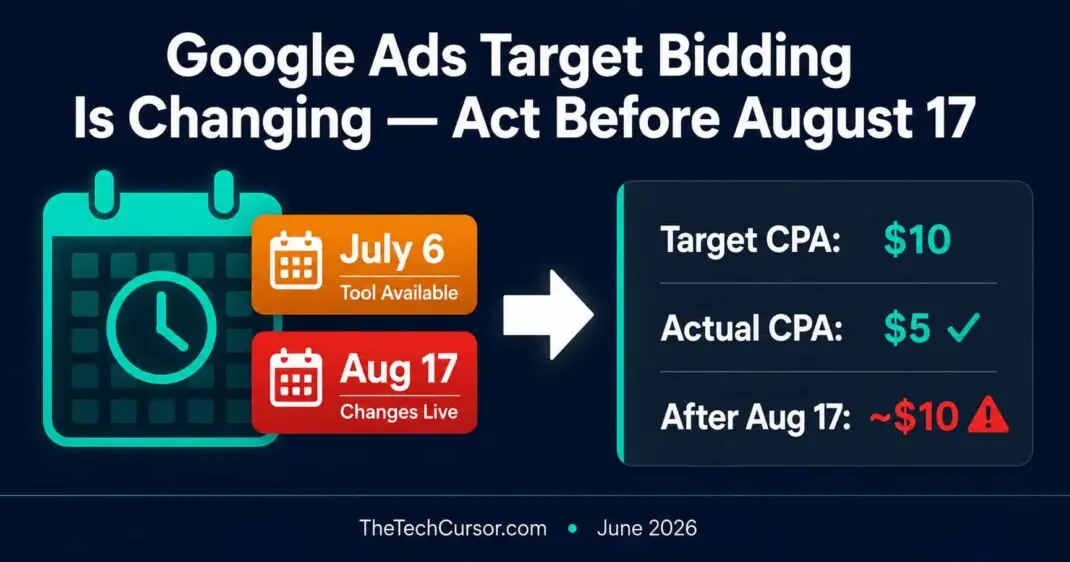
Table of Contents
- What Is Actually Changing
- The $5 CPA Problem — Why This Matters
- The New Bid Target Adjustment Tool
- Key Dates You Cannot Miss
- Which Campaigns Are Most at Risk
- What You Should Do Right Now
- Why Google Is Making This Change
- Bottom Line
1. What Is Actually Changing
Google is updating how campaigns using target-based bidding strategies — including Target CPA and Target ROAS — behave when they are running under budget constraints.
Currently, budget-limited campaigns can continue performing above or below their stated targets depending on how Google’s algorithm optimizes within the available budget. After August 17, Google is tightening this relationship. Budget-constrained campaigns will more closely adhere to their configured targets — meaning the gap between your stated target and your actual performance will narrow.
The intended benefit is more predictable performance when budgets fluctuate. However, for advertisers whose campaigns have been outperforming their targets, this change could reduce that outperformance unless targets are proactively updated.
2. The $5 CPA Problem — Why This Matters
Here is the scenario that illustrates why this update is so significant.
Imagine you have a campaign with a Target CPA of $10, but the campaign has been consistently achieving a $5 CPA because of efficient algorithm optimization. Under the current system, this is a win — you are getting conversions at half your stated target cost.
After August 17, this campaign will be pushed toward performing closer to the $10 Target CPA — not the $5 actual CPA you have been enjoying. Unless you update the target to $5 before the rollout, you could effectively be paying twice as much per conversion without making any intentional change to your campaign settings.
This is the core issue: campaigns that have been outperforming their targets may automatically perform worse after the update — not because of anything the advertiser did wrong, but because Google’s system will enforce closer adherence to stated targets.
3. The New Bid Target Adjustment Tool
To help advertisers prepare, Google is launching a Bid Target Adjustment Tool on July 6, 2026 — six weeks before the August 17 enforcement date.
This tool will allow advertisers to:
- Review which campaigns are affected by the upcoming change
- Identify the gap between current stated targets and historical actual performance
- Modify targets proactively before enforcement begins
- Align bidding goals more closely with actual business objectives
Google is also sending notifications directly to affected Google Ads accounts before the rollout, so advertisers should watch for these alerts in their accounts and email.
4. Key Dates You Cannot Miss
| Date | What Happens |
|---|---|
| July 6, 2026 | Bid Target Adjustment Tool becomes available |
| August 17, 2026 | Target bidding changes take effect for budget-limited campaigns |
The six-week window between tool availability and enforcement gives advertisers time to review, adjust, and test — but only if they act during that window. Waiting until after August 17 means dealing with performance shifts reactively rather than preventing them proactively.
5. Which Campaigns Are Most at Risk
Not every campaign will be affected equally. The campaigns most at risk of seeing performance shifts after August 17 are:
Campaigns consistently outperforming Target CPA. If your actual CPA is significantly below your stated Target CPA, the update will push performance toward the stated target — potentially increasing your cost per conversion.
Campaigns consistently outperforming Target ROAS. Similarly, if your actual ROAS exceeds your Target ROAS, the update could reduce returns unless you update the target to reflect your actual performance.
Budget-limited campaigns specifically. This update applies to campaigns that Google identifies as budget-constrained. If your campaigns are rarely limited by budget, the impact may be less significant. However, if budget constraints are common — particularly during high-traffic periods — the effect could be meaningful.
Campaigns with outdated targets. Targets set months or years ago may no longer reflect current business conditions, conversion values, or cost structures. The update is a strong signal to audit these systematically rather than leaving them unchanged.
6. What You Should Do Right Now
Step 1: Audit your current Target CPA and Target ROAS settings. Pull a report of all campaigns using target-based bidding strategies. Compare stated targets against actual recent performance (last 30-90 days). Identify campaigns where actual performance significantly differs from stated targets.
Step 2: Flag campaigns where actual performance beats stated targets. These are your highest-risk campaigns. If your $10 Target CPA campaign is actually achieving $5-6 CPA, you need to update the target to reflect that real performance before August 17.
Step 3: Use the Bid Target Adjustment Tool from July 6. When the tool becomes available, use it to validate your audit findings and make adjustments directly. Google has designed it specifically to help advertisers review and update targets before enforcement begins.
Step 4: Watch for account notifications. Google is sending notifications to affected accounts. Ensure your notification settings in Google Ads are configured to reach the right people on your team — not just the account admin.
Step 5: Revisit targets after the August rollout. Even with proactive adjustments, monitor performance closely in the weeks following August 17. The relationship between targets and actual performance may need further refinement as the new system behavior stabilizes.
7. Why Google Is Making This Change
Google’s stated rationale is to reduce volatility and create more predictable performance when advertisers adjust campaign budgets up or down.
When budgets fluctuate — during seasonal campaigns, testing periods, or business-driven spend changes — target-based bidding can behave inconsistently under the current system. The update is designed to make the relationship between stated targets and actual performance more reliable and consistent, regardless of budget changes.
This is part of a broader pattern in Google Ads throughout 2026 — moving toward more predictable, target-adherent AI-powered bidding across all campaign types. As covered in TheTechCursor’s earlier coverage of AI Max for Search campaigns, Google is systematically tightening the connection between advertiser-declared objectives and campaign behaviour.
8. Bottom Line
The August 17 bidding update is not a penalty — but it will penalize advertisers who ignore it. Campaigns that have been quietly outperforming their stated targets will move toward those targets, potentially increasing cost per conversion or reducing returns.
The fix is straightforward: audit your targets now, update them before August 17, and use the Bid Target Adjustment Tool when it launches on July 6. Advertisers who act in this window will maintain control. Those who do not may find themselves explaining unexpected performance shifts to clients or stakeholders after the fact.
Review your campaigns today.
Pingback: SEO and PPC Are Sitting on Each Other's Best Insights — Here's How to Fix That - The Tech Cursor