
Category: AI Tools | SEO Strategy | Digital Marketing
Published: June 25, 2026
Read time: 7 min
Site: TheTechCursor
AI has made SEO teams dangerously optimistic about automation. Tasks that previously required engineering support can now be prototyped with Claude or ChatGPT in an afternoon. That is genuinely exciting — and it has led many teams straight into a trap.
Uber blew through its entire annual AI budget in four months. Companies across industries are experiencing what Reuters has called “corporate AI sticker shock” — discovering that AI costs are far harder to forecast and control than they initially appeared.
For SEO teams making decisions about which tools to build internally and which to buy from vendors, the stakes have never been higher — or the decisions more complex. Here is a practical framework for getting it right.
Why “Just Build It” Is Now a Dangerous Assumption
AI has genuinely lowered the barrier to building. Without writing a single line of code, you can create a custom GPT, build a multi-step workflow, connect data sources, and automate repetitive tasks. Teams that are not using these capabilities are falling behind.
However, the same AI capabilities that make building easier also create a hidden cost problem. Internally built tools are frequently treated as free because the invoice does not land on the SEO team’s budget. However, the costs are real:
- API token usage — which scales directly with how much the tool is used
- Engineering time for setup, fixes, and maintenance
- Security reviews when sensitive data is involved
- Infrastructure costs for any hosted components
- Ongoing maintenance when external APIs or AI models change
When a custom GPT or Claude workflow breaks because an underlying model update changed its behaviour — which happens — someone has to fix it. If that person is an engineer, the cost is real even if it never appears in your budget.
The Four Types of AI Tools — and Why Mixing Them Up Causes Problems
Before deciding whether to build or buy, it is critical to understand exactly what kind of solution you actually need. Most teams group these, but they differ significantly in cost, complexity, and maintenance requirements:
Custom tool — A more complex internal system requiring engineering support. Often primarily automation-focused, sometimes with an AI layer on top.
Custom workflow — A repeatable process built across multiple tools — a Claude project, a spreadsheet, a reporting template, a scheduled task. Lower engineering overhead than a full custom tool, but still requires maintenance.
Custom layer on top of SaaS — Using data from existing platforms and shaping it into your own reporting, prioritization, or recommendation workflow. Often the highest-value, lowest-risk option for SEO teams.
True AI agent — A system that takes autonomous actions with minimal human input — for example, monitoring Slack for follow-up items and proactively chasing responses. Highest capability ceiling, highest risk of unexpected behaviour or cost spikes.
Calling everything an “AI agent” creates confusion and consistently leads to wrong estimates about both cost and complexity. Being precise about which type of solution you are actually building changes the entire decision.
When to Build
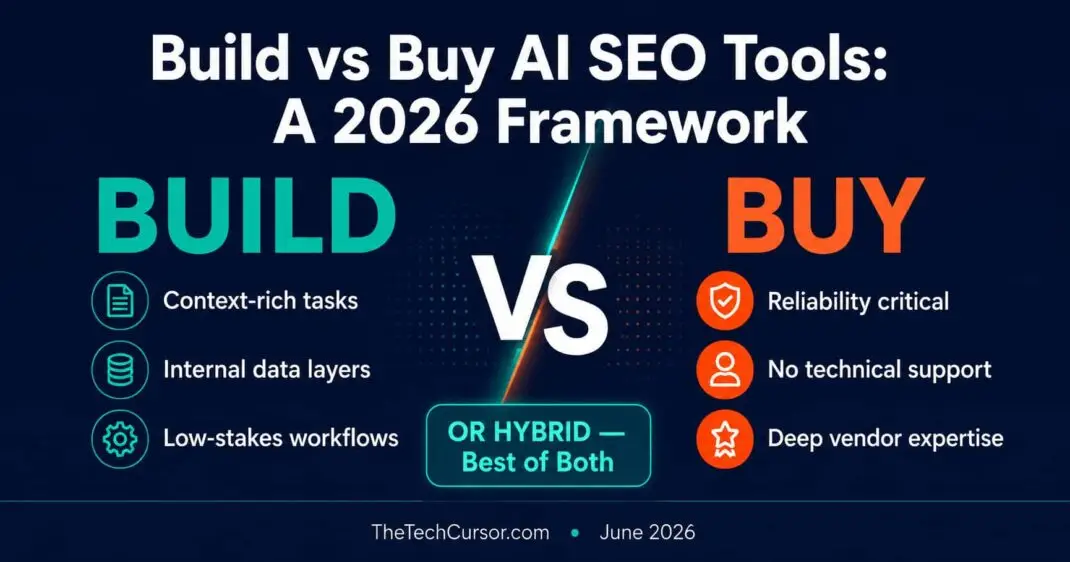
Building internal tools or workflows makes sense when:
The task is repetitive, context-rich, and internal. Tasks that rely heavily on your organization’s specific knowledge — your personas, your content standards, your internal processes — are strong candidates for custom workflows. A SaaS tool built for generic users will never understand your specific context as well as the workflow you have trained on your own data.
The workflow combines internal and external data. If you need to merge data from your CRM, your GA4, your GSC, and your internal content calendar into a single prioritization view, no off-the-shelf tool will do this exactly right. A custom layer connecting these sources is often the highest-ROI build.
The task is low-stakes and highly repetitive. Translation workflows, monthly reporting templates, meeting summary tools, and content brief generators — these are all strong build candidates because the failure risk is low and the time savings compound quickly.
You are trying to understand a problem before buying a solution. Building a basic version of something you might eventually buy from a vendor is a legitimate strategy. It forces you to understand the problem deeply, identify what features you actually need, and evaluate vendor solutions from an informed position rather than a demo.
When to Buy
Buying a SaaS solution makes sense when:
Reliability is non-negotiable. For data that drives critical decisions — rank tracking, crawl analysis, AI visibility monitoring — a specialized platform with dedicated engineering, uptime guarantees, and professional support is almost always worth the cost. When your decision-making depends on the data, reliability is your primary selection criterion.
Maintenance overhead would distract from the actual work. One team built a prompt tracking tool internally that worked well initially. However, every time an external LLM changed its API or output format, the tool required engineering fixes. The cost of maintaining it eventually exceeded the cost of a specialized vendor solution — and the team switched.
You lack dedicated technical support. Small SEO teams without in-house engineers should be particularly cautious about building business-critical tools from scratch. The initial build is rarely the problem — the ongoing maintenance is.
The vendor solves a problem at a depth you cannot match. A dedicated crawler or AI visibility platform has years of engineering investment behind its data collection, normalization, and presentation. Replicating that depth internally is rarely worth the effort when a quality vendor solution exists.
The Hybrid Approach — Often the Best Answer
For most SEO teams, the strongest approach combines buying core infrastructure with building custom layers on top of it.
Buy the infrastructure: Crawler, rank tracker, AI visibility platform, Search Console integration. These require reliability and depth that vendor solutions provide the best.
Build the intelligence layer: Custom reports that combine vendor data with your CRM data, your content calendar, and your internal business metrics. Prioritization frameworks trained on your specific strategy. Recommendation workflows built around your team’s decision-making process.
This approach concentrates on custom building where your specific context creates a genuine advantage — and relies on vendors where depth and reliability matter most.
Furthermore, MCP (Model Context Protocol) integrations are making this hybrid approach increasingly powerful. With MCP servers, you can connect AI tools like Claude directly to your existing platforms — analyzing data from your rank tracker, Search Console, or CRM using AI without building a separate data pipeline from scratch.
A Framework for Making the Decision
Before requesting any new tool — built or bought — SEO teams should be able to answer five questions:
1. What is the specific workflow problem? Not “we need a tool” but “here is the exact task that is consuming X hours per week and creating Y risk of error.”
2. What is the expected value? Time saved, decisions improved, revenue influenced. If you cannot articulate the value, the case for either building or buying will not survive leadership review.
3. What have we already tested? Testing what exists in the market before deciding to build is not optional — it is how you learn what you actually need. Most teams think they need ten features and discover they use three.
4. What is the true cost of building and of buying? Custom tools are not free. API usage, engineering time, security reviews, and maintenance all have real costs even when they do not appear in your budget directly. Get honest estimates for both paths.
5. Who maintains it after launch? If the answer is “nobody specifically, — that is a strong signal to buy rather than build. Tools without clear ownership decay predictably.
Prioritizing What to Build First
When multiple build opportunities exist simultaneously, two categories should take priority:
Revenue-connected workflows — tools that directly support content opportunity identification, AI visibility improvement, conversion optimization, or competitive intelligence. These are easiest to justify to leadership because the business case is clear.
High-repetition manual work — workflows that save significant time on tasks your team does daily or weekly. These do not always generate revenue directly, but they free up capacity for higher-value strategic work.
Additionally, cross-team value should factor into prioritization. A competitive intelligence workflow that benefits SEO, paid search, product marketing, and sales simultaneously has a much stronger business case than one that benefits only the SEO team — and is far more likely to get the engineering and budget support it needs.
What to Tell Leadership
The strongest requests for new tools — built or bought — do not start with “we need this tool.” They start with a structured problem statement:
- Here is the specific problem and why it matters to the business
- Here is what we have already tested to understand the problem
- Here is our estimate of what building costs versus buying costs are
- Here is what happens if we do nothing
- Here is who will own and maintain this if we proceed
Teams that present this way get resources. Teams that show up with a demo link and enthusiasm typically do not.
Bottom Line
AI has made building SEO tools more accessible than ever — and more expensive to maintain than many teams anticipated. The build-versus-buy decision in 2026 is not about whether AI can help you build something. It almost certainly can. The question is whether what you build will still be reliable, maintainable, and valuable six months from now.
Buy the infrastructure where reliability matters. Build the intelligence layer where your specific context creates a genuine advantage. And always scope properly before deciding — because the most expensive mistakes in this space come from building the wrong thing, not from choosing the wrong vendor.