
Category: SEO | PPC | Integrated Search | Digital Marketing Strategy
Read time: 8 min
Table of Contents
- The Data That Each Team Has — And Is Not Sharing
- Why the Silos Persist Despite Everyone Knowing Better
- Insight 1: PPC Conversion Data Should Drive Organic Content Priorities
- Insight 2: SEO Query Data Should Inform Negative Keyword Lists
- Insight 3: Organic Click-Through Rate Tells PPC Which Messages Work
- Insight 4: PPC Audience Data Should Shape Organic Content Strategy
- Insight 5: Ranking Overlap Analysis Eliminates Cannibalization
- Insight 6: Landing Page Performance Data Should Flow Both Ways
- The Practical Setup — One Shared Dashboard, One Weekly Meeting
- The AI Search Layer — Why Integration Matters Even More Now
- Bottom Line
Both teams are doing good work. Both teams have data the other team desperately needs. Neither team is sharing it.
This is the SEO–PPC silo problem in one sentence — and it is one of the most expensive inefficiencies in digital marketing in 2026. The solution is not an organizational restructure or a new technology investment. It is six specific data exchanges that can start this week.
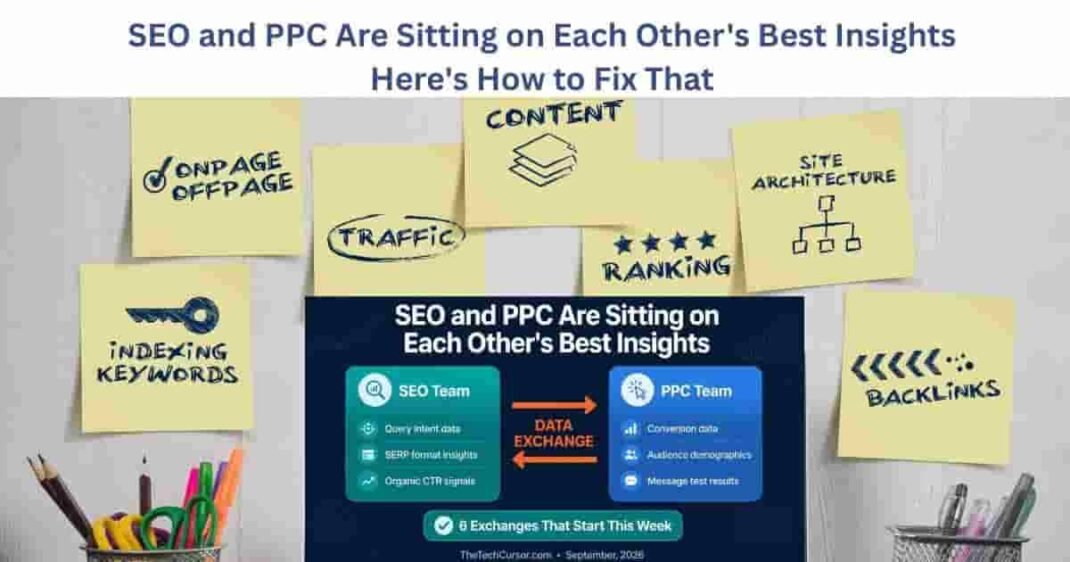
(cite index=”8-1″>Your SEO and PPC teams probably don’t share data. That’s problematic. Organic traffic is slipping. CPCs are climbing. And conversions aren’t keeping pace.</cite>
Here are the six insights each team is sitting on — and exactly how to start sharing them.
1. The Data That Each Team Has — And Is Not Sharing
Before fixing the problem, it helps to be specific about what each team actually has.
What the PPC team has that SEO needs:
- Conversion rate data by keyword — which queries actually produce customers, not just clicks
- Audience demographic data — which age groups, locations, and device types convert for which offers
- Message testing results — which headlines and descriptions earned the highest click-through rates in A/B tests
- Competitor ad intelligence — what competitors are promising in their ads and at what likely bid levels
- Seasonal demand patterns — when specific queries spike and what conversion rates look like at peak
What the SEO team has that PPC needs:
- Full search query data — the complete range of queries driving organic traffic, including long-tail queries that never appear in PPC search term reports
- SERP format intelligence — which queries trigger AI Overviews, local packs, featured snippets, or video carousels
- Content engagement data — which pages earn long dwell times, low bounce rates, and high return visit rates
- Organic ranking overlap — which queries the brand already ranks for organically that PPC is bidding on
- Topical authority mapping — where the site has established credibility versus where it is competing from a weaker position
(cite index=”12-1″>SEO insights, such as high-performing keywords and audience behaviour, can inform PPC targeting, while PPC data can highlight quick-win opportunities for organic optimization.</cite>
The problem is not that this data does not exist. It is that it lives in separate tools, is reviewed in separate meetings, and informs separate decisions — despite describing the same searchers making the same decisions about the same brand.
2. Why the Silos Persist Despite Everyone Knowing Better
The SEO-PPC silo is not a knowledge problem. Most practitioners know that sharing data between channels would improve performance. The persistence of the silo is structural.
(cite index=”10-1″>SEO and PPC move at different speeds, follow different rules, and compete for the same real estate. Sharing keyword data between SEO and PPC sounds straightforward, but it rarely happens in practice. Organizational silos get in the way.</cite>
Three structural factors maintain the silo:
Different reporting lines: SEO typically reports to content or organic marketing. PPC typically reports to performance or paid media. When teams report to different managers with different KPIs, data sharing requires crossing organizational boundaries that have no natural incentive structure.
Different tool ecosystems: SEO teams live in Google Search Console, Ahrefs, Semrush, and GA4. PPC teams live in Google Ads, SA360, and attribution platforms. The data exists in both — but retrieving it, formatting it compatibly, and sharing it requires deliberate effort that neither team has built into their workflow.
Different time horizons: PPC decisions happen in days or weeks. SEO decisions compound over months. When teams operate on different cadences, synchronization requires explicit calendar coordination that typically gets skipped in favour of within-channel optimization.
The fix is not eliminating these structural differences. It is establishing the six specific data exchanges that bridge them — with minimal workflow overhead on either side.
3. Insight 1: PPC Conversion Data Should Drive Organic Content Priorities
This is the most valuable single data exchange available — and the one most consistently absent from SEO content strategy.
PPC search term reports contain something organic keyword research cannot produce: direct evidence of which queries lead to conversions. Not which queries drive clicks. Not which queries have high volume. Which queries produce customers.
(cite index=”14-1″>Export the previous 7 days of search terms from Google Ads. Filter by “Conversions = 0, CTR > 6%.” These are high-interest but low-conversion queries — gold for content gap analysis.</cite>
However, the more directly valuable export is the inverse: queries with conversions. These are the exact search terms that drove actual customer acquisition through paid. Every query in that list is a confirmed signal that someone searching those words buys what you sell.
The exchange process:
- PPC team exports search term report filtered for conversions — monthly, or more frequently in high-volume accounts
- SEO team cross-references against current organic rankings — which converting queries rank well organically? Which have no organic presence?
- Gaps become content priorities — queries that convert in paid but have no organic presence are the highest-ROI organic content investments available
As covered in our breakdown of the new search journey loop, being cited in AI Overviews for the same queries where paid ads are converting creates a compounding visibility advantage — the brand appears in both the AI answer and the paid slot below it, with the AI citation providing an implicit trust signal that lifts paid click-through rates.
4. Insight 2: SEO Query Data Should Inform Negative Keyword Lists
The PPC team’s keyword strategy is built from keyword research tools and conversion data. What it is missing is the full picture of organic search behaviour — specifically, the queries that drive traffic without driving conversions.
SEO query data from Google Search Console reveals the complete range of search terms bringing visitors to your site — including the long-tail, navigational, and informational queries that never convert but consume impression budget when they match paid ads.
The exchange process:
- SEO team exports Search Console query data — specifically queries with high impressions, decent clicks, and low or zero conversions (requires connecting Search Console to GA4 for conversion data)
- PPC team reviews against current keyword match types — which of these low-converting queries are likely triggering paid ads?
- Non-converting, non-relevant query patterns become negative keyword additions
(cite index=”13-1″>By using PPC data to de-risk your SEO and claiming more space on the first page, you protect your brand and lower your lead costs.</cite>
Furthermore, SEO query data reveals intent patterns that PPC keyword research misses. Informational queries — “how does X work,” “what is X,” “X vs Y” — drive significant organic traffic but rarely convert directly. When these queries are triggering paid ads through broad match or phrase match, they represent budget waste that SEO’s query visibility can prevent.
5. Insight 3: Organic Click-Through Rate Tells PPC Which Messages Work
Google Search Console shows organic click-through rates by query and by page. That CTR data contains message-market fit signals that PPC teams typically pay to test.
When an organic title tag earns significantly above-average CTR for a specific query cluster, it is demonstrating that the framing — the specific combination of words and value proposition in the title — resonates with searchers on that query. That same framing, adapted for ad copy, will typically outperform generic alternatives.
The exchange process:
- SEO team identifies pages and title tags with significantly above-average CTR in Search Console — sorted by query cluster
- PPC team extracts the structural patterns from high-CTR titles — what specific words, promises, or framings are earning clicks?
- PPC team tests those patterns as ad headline variations against current control ads
(cite index=”8-1″>SEO’s read of the SERPs tells PPC teams which formats, keywords, and messages resonate.</cite>
The inverse also applies: PPC A/B test results on ad copy reveal which messages win head-to-head — information that SEO can use to improve title tags and meta descriptions without running the test organically (which would take months to accumulate statistical significance).
6. Insight 4: PPC Audience Data Should Shape Organic Content Strategy
PPC campaigns generate demographic and audience data that organic analytics rarely captures at the same granularity. Google Ads audience insights reveal which age groups, genders, household income brackets, and interest categories are converting — not just clicking.
(cite index=”8-1″>PPC demographic data can show how the same keyword lands differently with different groups. An “enterprise website builder” query might skew older, while “startup website” attracts younger searchers. PPC geo reports often show which cities or regions deliver stronger conversion rates.</cite>
The exchange process:
- PPC team exports audience performance data — specifically conversion rates and CPA by demographic segment and geography
- SEO team uses this to calibrate organic content strategy:
- Geographic segments with strong paid conversion rates warrant local SEO content investment
- Demographic segments with high conversion rates inform content tone, complexity level, and example selection
- Interest categories that over-index among converters reveal adjacent topic areas worth developing topical authority in
This exchange is particularly valuable for content briefs — as covered in our guide to audience situation-based content briefs, knowing which demographic actually converts for which offers makes situation briefs more precise and the content they generate more relevant.
7. Insight 5: Ranking Overlap Analysis Eliminates Cannibalization
One of the most direct wastes in integrated search is bidding on queries where organic rankings are already strong enough to capture the click at zero marginal cost.
(cite index=”13-1″>Why are you still paying an average of $5.26 per click for keywords that you already rank for organically? It is a frustrating reality for many businesses where marketing budgets are often wasted on redundant traffic.</cite>
The exchange process:
- SEO team provides a list of queries where organic rankings are in positions 1-3 with strong CTR
- PPC team cross-references against active keyword bids — identifying overlap
- Joint decision on overlap queries:
- High-competition, high-value: Maintain both channels — the combined SERP presence increases total click share significantly
- Low-competition, stable organic: Pause or reduce paid bids — reallocate budget to queries where organic is weak
- Brand queries: Typically worth maintaining paid even with strong organic — brand protection value
The overlap analysis should happen quarterly — more frequently in fast-moving categories where organic rankings shift regularly.
8. Insight 6: Landing Page Performance Data Should Flow Both Ways
Landing page performance data is often treated as a channel-specific metric — PPC teams optimize their landing pages for conversion rate, SEO teams optimize their pages for rankings and organic engagement. The data generated by each rarely informs the other.
However, organic landing page data contains signals that PPC landing page optimization consistently misses:
What organic landing page data reveals for PPC:
- Which page sections drive the highest scroll depth — indicating where value is most clearly communicated
- Which content formats (video, comparison tables, case studies) reduce bounce rate — indicating the formats that engage visitors across all sources
- Which pages earn the highest return visit rates — indicating content that builds genuine trust rather than converting on first visit
What PPC landing page data reveals for SEO:
- Which page variants drive higher form fill rates — indicating which value proposition and CTA placement works best
- Which pages have the highest conversion rates despite lower engagement metrics — indicating that some content optimized for SEO engagement is over-explaining to users ready to convert
(cite index=”16-1″>For PPC, ensure those same pages make strong landing pages — fast, relevant, and conversion-oriented. SEO provides the authority while PPC delivers the amplification.</cite>
As covered in our analysis of the SEO blind spot — what happens after the click, the post-click experience signals that feed back into rankings are the same signals that determine PPC Quality Score. A shared landing page optimization program that improves both ranking signals and conversion rates is the most efficient use of development and CRO resources available.
9. The Practical Setup — One Shared Dashboard, One Weekly Meeting
The six data exchanges above produce results proportional to the consistency with which they happen. The minimum viable infrastructure for consistent data sharing is straightforward.
The shared dashboard:
(cite index=”14-1″>Key blended metrics to track every Monday: Total SERP Share (organic clicks + paid clicks / total SERP impressions for priority keyword set). Overlap Revenue (assisted conversions where path contains at least one organic click and one paid click).</cite>
Build a Looker Studio dashboard that combines:
- Google Search Console organic performance data
- Google Ads paid performance data
- GA4 conversion attribution by channel
The dashboard should show combined search visibility — not just organic impressions and paid impressions separately. The most important metric is total SERP share: what percentage of total available search clicks is the brand capturing across both organic and paid?
The weekly meeting:
(cite index=”16-1″>SEO and PPC teams should meet regularly to share insights. SEOs can surface emerging queries. PPC teams can report on top-performing ads. Continuous experimentation across the combined funnel enables small, data-driven tweaks that yield outsized results.</cite>
A 30-minute weekly sync between one SEO lead and one PPC lead — reviewing the shared dashboard and identifying the one or two data exchanges most relevant to current priorities — is sufficient to sustain the integration. The meeting should follow a simple agenda:
- What did paid search show this week that organic should know? (5 minutes)
- What did organic search show this week that paid should know? (5 minutes)
- What is the overlap opportunity or cannibalization risk this week? (5 minutes)
- What is one joint test or exchange to run this week? (5 minutes)
The remaining 10 minutes handle anything else. The discipline of the agenda prevents the meeting from becoming a general marketing review.
10. The AI Search Layer — Why Integration Matters Even More Now
(cite index=”9-1″>2026 is the year SEO and PPC convergence stops being a talking point and becomes an operational reality. The AI era makes it harder than ever to justify separate SEO and PPC silos. Smart brands will design unified search strategies in which paid and organic work together to own as much real estate as possible within AI answers — not just above or below them.</cite>
The six data exchanges above were valuable before AI search. They are more valuable now — because AI Overviews have created a new dynamic where organic citation status affects paid performance.
As covered in our analysis of the new search journey loop, brands cited in AI Overviews earn 91% more paid clicks and 35% more organic clicks than uncited brands on the same queries. That citation status is earned through organic signals — content quality, topical authority, entity clarity — but its benefit accrues across both organic and paid simultaneously.
This means the SEO investment that earns an AI Overview citation is also improving paid search performance — a connection that only becomes visible when SEO and PPC teams are sharing data and measuring total SERP share rather than channel-specific metrics.
(cite index=”11-1″>SEO and PPC are now stages in one system that searchers loop through: an AI answer that shapes the shortlist, ads that capture the filtered demand, organic that reinforces the decision, and follow-up queries that restart it. A team that keeps budgeting, measuring, and staffing around individual channels will keep optimizing isolated pieces of a journey that now operates as a single connected system.</cite>
11. Bottom Line
The six data exchanges are not complex. They do not require organizational restructuring, new technology investment, or months of planning. They require one shared dashboard, one weekly 30-minute meeting, and the discipline to actually share the data that each team is already generating.
Start this week:
- PPC team: Export last 30 days of converting search terms and share with SEO team
- SEO team: Export Search Console queries with high impressions but low conversions and share with PPC team
- Both teams: Build a shared Looker Studio dashboard combining Search Console and Google Ads data
- Schedule a recurring 30-minute weekly sync
Start this month:
- Complete a ranking overlap analysis — identify queries to double down on and queries where paid budget can be reallocated
- Run one PPC A/B test based on high-CTR organic title tag patterns
- Identify three content gaps from PPC converting query data and add them to the organic content calendar
The teams already have the insights. The only thing missing is the exchange.