
Read time: 7 min
Table of Contents
- What Google DeepMind Just Published
- How Search Ranking Currently Works — Plain English
- What Autoregressive Ranking Changes
- The SToICaL Training Method
- What the Test Results Actually Show
- The Key Limitation — Theory vs Reality
- What This Means for SEO — If It Ships
- How Far Away Is This?
- Bottom Line
Google DeepMind researchers have published a paper proposing a fundamental change to how search ranking works at its technical core — one that, if adopted, would have profound implications for SEO and AI search visibility.
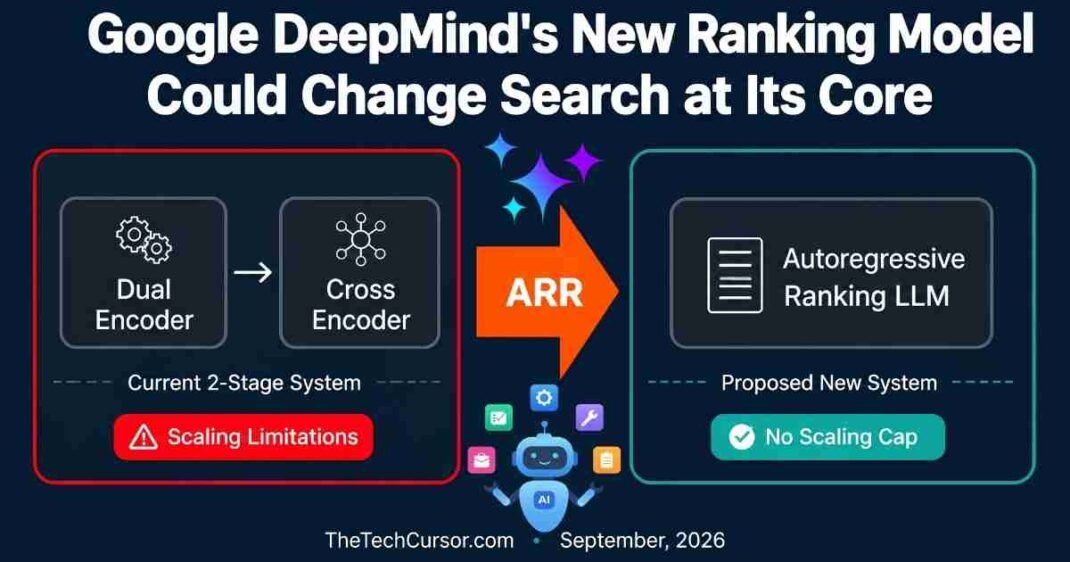
The paper, titled Autoregressive Ranking: Bridging the Gap Between Dual and Cross Encoders, proposes replacing the standard two-stage document ranking architecture that has powered search systems for years with a single large language model capable of ranking documents directly.
This is not a feature update or a UI change. It is a proposal to replace the underlying machinery of how search decides which documents are relevant — and how they are ordered.
1. What Google DeepMind Just Published
<cite index=”8-1″>The research paper comes from researchers at Google DeepMind, the University of Massachusetts Amherst, and the University of Texas at Austin. It proposes using Autoregressive Ranking (ARR) as a replacement for the current two-stage ranking systems used in search.</cite>
The PDF paper was published in September 2026 and represents a significant research investment in rethinking how ranking works — not just how AI is layered on top of existing ranking, but how ranking itself functions at the infrastructure level.
Understanding why this matters requires understanding what the current system does — and what its limitations are.
2. How Search Ranking Currently Works — Plain English
Current search ranking systems use a two-stage architecture. Each stage has a specific job — and specific limitations.
Stage 1: The Dual Encoder (DE)
<cite index=”8-1″>The Dual Encoder converts queries and documents into vectors and uses them to quickly retrieve likely documents. Dual Encoders are relatively computationally inexpensive and fast.</cite>
Think of the Dual Encoder as a fast filter. When you search for something, it rapidly scans billions of documents and pulls out a candidate set — the pages that are probably relevant — based on mathematical similarity between your query and document representations.
The Dual Encoder is fast because it pre-computes document vectors. However, that speed comes with a cost: the vectors have to represent every possible query in advance, which limits how precisely they can capture relevance for complex or ambiguous queries.
Stage 2: The Cross Encoder (CE)
<cite index=”8-1″>The Cross Encoder reviews and ranks the candidate pages the Dual Encoder had selected. Cross Encoders are more powerful but too computationally expensive for large-scale retrieval, which is why they are used in the second stage for ranking the candidate documents.</cite>
The Cross Encoder looks at your query and each candidate document together — understanding the relationship between them directly. It is more accurate than the Dual Encoder but far too slow and expensive to apply to billions of documents. So it only sees the shortlist the Dual Encoder already produced.
This two-stage design is an engineering compromise. The fast system handles scale; the powerful system handles precision. The limitation is that the fast system’s imprecision constrains what the powerful system can work with.
3. What Autoregressive Ranking Changes
<cite index=”8-1″>What the researchers propose is replacing the two-stage search retrieval back-end with a new system called Autoregressive Ranking (ARR). It is a fairly radical change to replace the standard two-stage ranking system with a single LLM that produces the ranked list of documents.</cite>
Instead of a fast-then-precise pipeline, ARR uses a single large language model that generates the ranked list of relevant documents directly — the way an LLM generates text, token by token, but producing document identifiers instead of words.
The key theoretical advantage is scale. <cite index=”8-1″>The researchers provide a theoretical foundation showing that for a Dual Encoder to achieve any ordering of k documents, its embedding dimension must grow linearly with k. In contrast, an ARR model with constant hidden dimension is theoretically sufficient to rank an arbitrary number of documents.</cite>
In plain terms: the current Dual Encoder becomes less precise as the number of documents grows, because its vector representations have to accommodate more and more possible rankings. ARR does not have this limitation in theory — it can rank any number of documents without the precision degrading as the corpus scales.
4. The SToICaL Training Method
Training an LLM to rank documents well requires a specific approach — because ranking is different from generating text. The researchers developed a method called SToICaL to handle this.
<cite index=”8-1″>SToICaL stands for Simple Token-Item Calibrated Loss. The training teaches the LLM which documents should rank higher and lower in two ways: first, documents that should rank higher are given more weight, and those that should rank lower are given less; second, the ranking provided by the training data is used to give more probability to token choices that lead toward higher-ranked documents.</cite>
<cite index=”8-1″>The result is an LLM that learns which documents are relevant and can suppress ranking of irrelevant ones.</cite>
The SToICaL approach is important because it addresses a specific failure mode in LLM-based ranking: without rank-aware training, an LLM might generate document IDs that are plausible-looking but not actually relevant — similar to hallucination in text generation. SToICaL is designed to make the model learn genuine relevance rather than just plausible output.
5. What the Test Results Actually Show
The researchers tested ARR with SToICaL training against both Dual Encoders and Cross Encoders using two datasets — WordNet and ESCI Shopping Queries.
<cite index=”8-1″>The results showed that ARR performed strongly but not across all metrics. SToICaL improved ARR’s ranking ability significantly beyond top-1 retrieval. In the WordNet experiments, the rank-aware methods drastically reduced ranking errors where irrelevant documents appeared above relevant ones. In the WordNet comparison, ARR performed similarly to the Cross Encoder — the computationally expensive one — and significantly better than the Dual Encoder.</cite>
Matching Cross Encoder performance is a significant result. The Cross Encoder is the precise-but-expensive component of current systems. If ARR can match its accuracy while potentially being more scalable, it represents a genuine architectural improvement.
However, the results were not uniformly positive. <cite index=”8-1″>In the shopping-search test, one version of the method became worse at ranking the most relevant result first, even though it improved the overall ranking of the results.</cite>
That finding matters practically. For e-commerce search — where the most relevant result appearing first directly affects conversion rates — degraded top-1 precision is a meaningful limitation, not just a statistical footnote.
6. The Key Limitation — Theory vs Reality
The paper’s most important caveat is easy to miss in the technical detail — but it is the sentence that determines how much weight to give these findings.
<cite index=”8-1″>The theoretical result that ARR can rank an arbitrary number of documents with a constant hidden dimension does not necessarily establish that ARR will perform this way in real-world search systems.</cite>
This distinction between theoretical capacity and real-world performance is critical. The mathematical proof shows that ARR is not inherently constrained the way Dual Encoders are — but it does not prove that a real deployed ARR system would outperform current production systems at Google’s scale.
Search at Google involves billions of documents, hundreds of languages, multiple content types, real-time indexing, and query volumes that are orders of magnitude larger than any academic benchmark dataset. The gap between what works on WordNet and what works in production Google Search is significant — and the researchers are honest about acknowledging it.
<cite index=”8-1″>As SEO observers have noted, this paper makes clear that for the ranking part, Dual Encoders and Cross Encoders still play a role in current systems. We have not yet reached the point where “everything has changed” — but this research shows that Google may be getting closer to a day when search really does change in a profound way.</cite>
7. What This Means for SEO — If It Ships
The conditional is important: if ARR moves from research paper to production search system, its SEO implications would be significant.
Keyword-based relevance becomes less central. Current ranking systems rely heavily on the vector representations that Dual Encoders produce — representations that are significantly shaped by keyword signals. An ARR system that understands documents and queries more holistically, the way an LLM understands text, would potentially weight semantic meaning and contextual relevance more heavily than surface-level keyword matching.
This is directionally consistent with changes already visible in Google Search — the shift toward intent-based matching that AI Max and Gemini-powered systems represent. ARR would push that direction significantly further at the infrastructure level.
Document quality signals become more important. An LLM-based ranking system trained on human relevance judgments would be better at evaluating the genuine quality of documents — not just their keyword density or link count. Content that genuinely answers the query well, with depth and specificity, would have a structural advantage — consistent with what query templates and topical authority building already deliver.
This aligns with everything Google has said about its quality evaluation direction — and with what the helpful content system and core algorithm updates have been moving toward. ARR would represent the infrastructure catching up with the quality signals Google has been emphasizing.
Entity and contextual understanding improve. ARR’s ability to understand the relationship between a query and a document directly — rather than through pre-computed vector similarity — would improve Google’s ability to understand entity relationships, contextual relevance, and semantic connections that current systems handle imperfectly.
For brands investing in entity SEO and topical authority, this is directionally positive. The signals they are building — clear brand entity understanding, comprehensive topic coverage, contextual relevance — are exactly the signals an LLM-based ranking system would evaluate more accurately.
8. How Far Away Is This?
The honest answer is: unknown — and probably farther than the excitement around the paper suggests.
Moving from a research paper to a production change in Google Search involves challenges that are not addressed in the paper: computational cost at Google’s scale, latency requirements for real-time search, interaction with hundreds of other ranking signals, safety and quality testing, and the engineering work of integrating a new system with existing infrastructure.
Google has a history of publishing research papers years before the described approaches appear in production — if they appear at all. The paper represents a genuine research contribution and a signal of Google’s architectural direction. It does not represent an imminent change to how your pages rank.
What it does represent is a continued investment in moving search ranking toward LLM-based understanding — a direction that has been visible in Google’s product decisions for several years and that the ARR paper advances at the theoretical and experimental level.
9. Bottom Line
Google DeepMind’s Autoregressive Ranking paper proposes something genuinely significant: replacing the two-stage Dual Encoder + Cross Encoder architecture that has powered search ranking for years with a single LLM that produces ranked document lists directly.
The theoretical advantage is clear — ARR is not constrained by the scaling limitations that affect Dual Encoders. The experimental results are promising — ARR matched Cross Encoder performance on WordNet. The real-world applicability remains unproven — the gap between academic benchmarks and production search at Google’s scale is substantial.
For SEO professionals, the paper’s implications point in a consistent direction: content that genuinely serves user intent, with semantic depth and contextual relevance, is better positioned in a world where LLM-based ranking becomes more central. That direction has been visible in Google’s algorithmic decisions for years — from Gemini powering AI Mode to the quality-focused core updates of 2025-2026. ARR represents research-level evidence that the infrastructure may eventually catch up with the quality signals Google has long said it wants to evaluate.
The ranking revolution is not happening today. However, the research that could enable it is being done.