
Category: Google Ads | AI Max | PPC Strategy | Digital Marketing
Read time: 5 min
Site: TheTechCursor
Table of Contents
- What Google Just Confirmed
- The Complete Migration Timeline
- What Already Happened — August 3 Cutoff
- September 2026 — Broad Match and ACA Migration
- February 2027 — Dynamic Search Ads Migration
- The API Changes Developers Must Know
- What to Do Before September 1
- Bottom Line
Google has published its official AI Max migration timeline — and for advertisers still running legacy Search campaign structures, the deadlines are closer than many realize.
<cite index=”59-1″>The transition begins in September and continues into early 2027, with Campaign-level Broad Match, Automatically Created Assets (ACA) and Dynamic Search Ads (DSAs) all moving to AI Max.</cite>
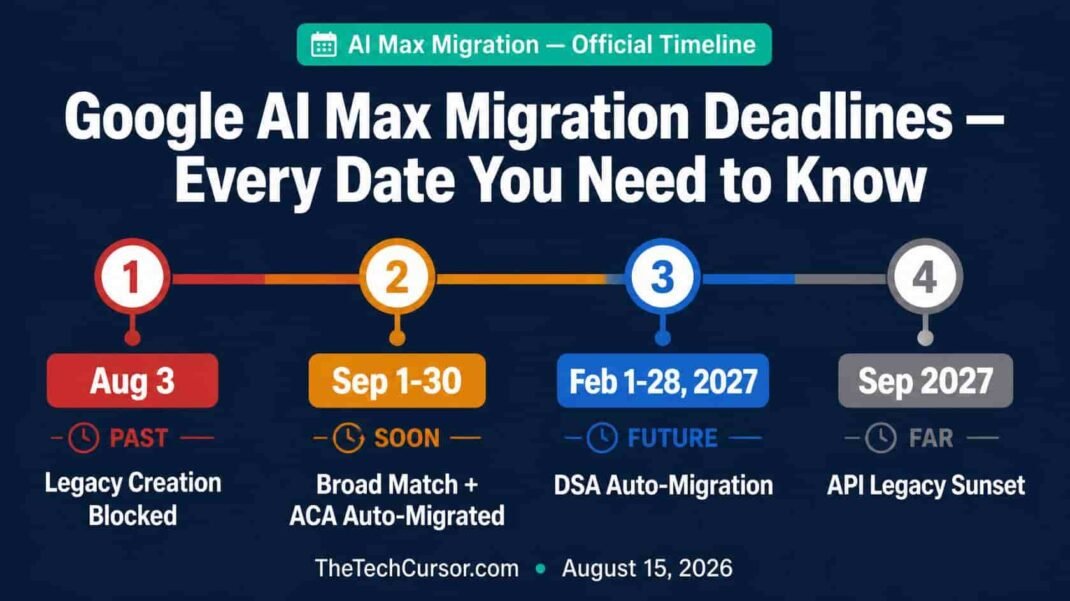
This update matters directly to any advertiser using these campaign types — and it matters to developers using the Google Ads API, who face separate sunset timelines for legacy entities.
1. What Google Just Confirmed
Google has outlined the specific dates for automatic migration of legacy Search campaign features to AI Max. The announcement removes the ambiguity that has surrounded the timeline — and makes clear that September 2026 is when the first forced migrations begin, not a future date to think about later.
<cite index=”59-1″>Campaigns will be migrated in place using equivalent AI Max settings to minimize disruption. Existing brand inclusions and exclusions will also carry over automatically.</cite>
The “migrated in place” commitment is significant. Google is not requiring advertisers to rebuild from scratch — it is converting existing structures to AI Max equivalents. However, equivalent settings are not identical settings, and the behavioural differences between legacy structures and AI Max warrant careful monitoring after migration.
2. The Complete Migration Timeline
Here is every date that matters:
| Date | What Happens |
|---|---|
| August 3, 2026 | Creation of new Campaign-level Broad Match and legacy ACA campaigns blocked across Google Ads UI, Ads Editor, and API |
| September 1–30, 2026 | Automatic migration of Campaign-level Broad Match and ACA campaigns to AI Max |
| September 2026 | In-account notices begin for DSA advertisers encouraging voluntary upgrade |
| January 15, 2027 | Google sends reminder notifications to advertisers with remaining legacy DSAs |
| February 1–28, 2027 | Automatic DSA migration begins; ability to create new DSA ad groups permanently removed |
| ~September 2027 | Older Google Ads API versions supporting legacy Broad Match and ACA entities reach scheduled sunset |
3. What Already Happened — August 3 Cutoff
<cite index=”59-1″>Google blocked the creation of these legacy structures across the Google Ads interface, Ads Editor and API on August 3, signaling the company’s continued push toward AI Max as the default Search campaign experience.</cite>
If you have not created any new Campaign-level Broad Match or legacy ACA campaigns since August 3, you are not missing anything — that capability is already gone. Any campaigns using these structures that existed before August 3 will continue running until they are automatically migrated in September.
This August 3 cutoff is the clearest signal yet that Google considers the legacy structures end-of-life. The September migration is not a question of if — it is a question of whether you control the transition or let Google handle it automatically.
4. September 2026 — Broad Match and ACA Migration
<cite index=”59-1″>Beginning September 1, Google will automatically upgrade Search campaigns using Campaign-level Broad Match or standalone Automatically Created Assets to AI Max. The migration will roll out gradually throughout the month.</cite>
What this means for Campaign-level Broad Match campaigns: These campaigns will be converted to AI Max equivalents — which use Gemini’s language understanding for query matching rather than keyword-based broad match. The intent-based matching that AI Max uses is generally broader than traditional broad match, which can change traffic volume and query mix after migration.
What this means for Automatically Created Assets (ACA) campaigns: Standalone ACA campaigns will move to AI Max’s asset generation system — which uses your landing pages, existing assets, and account context to generate ad creative automatically. The quality of AI Max’s creative outputs depends heavily on the strength of your existing asset library and landing page content.
Key protection: Your brand inclusions and exclusions carry over automatically. You do not need to re-enter them — but you should verify they transferred correctly after migration.
5. February 2027 — Dynamic Search Ads Migration
As covered in TheTechCursor’s earlier article on the DSA migration delay, Google previously pushed the DSA deadline from September 2026 to February 2027 in response to advertiser feedback. That February deadline is now confirmed and will not be delayed again.
<cite index=”59-1″>Google plans to begin warning advertisers about the upcoming transition in September through in-account notifications, followed by additional reminders in January before automatic upgrades begin next February.</cite>
The notification sequence gives DSA advertisers a full five months between the first warning (September 2026) and the automatic migration (February 2027). That window is sufficient for a controlled, tested migration — but only if it is used productively rather than waiting for the final deadline.
The case for voluntary early migration:
- You control the timing — avoiding disruption during peak trading periods
- You can run parallel tests comparing DSA and AI Max performance before committing
- You preserve historical data and campaign learnings in a way that automatic migration may not guarantee
- You can optimize AI Max settings before migration forces a cold start
6. The API Changes Developers Must Know
The migration timeline has a separate and important track for developers using the Google Ads API.
<cite index=”59-1″>Future API versions released after September 1 will remove support for legacy Campaign-level Broad Match and ACA entities altogether. Older API versions will continue supporting them until their normal sunset period — expected around September 2027 — giving developers additional time to update integrations.</cite>
What this means in practice:
If your scripts, tools, or third-party integrations use the Google Ads API to manage Campaign-level Broad Match or ACA settings, you have two options:
- Stay on older API versions — these continue supporting legacy entities until approximately September 2027, giving development teams time to update
- Migrate to newer API versions — these will not support legacy entities after September 1, 2026
Google recommends auditing scripts and tools now to identify which API version they use and whether they interact with the legacy structures being deprecated.
For agencies managing client accounts programmatically, this audit is urgent. A script that breaks after September 1 due to API deprecation could disrupt client campaigns during a period of already significant automated change.
7. What to Do Before September 1
For all advertisers:
Audit your account for affected campaign types. Identify every campaign using Campaign-level Broad Match or standalone ACA settings. Note their current performance benchmarks — impressions, clicks, conversions, ROAS, CPA — so you have a clear pre-migration baseline to compare against post-migration performance.
Set up monitoring alerts. After the September migration, set up alerts in Google Ads for significant changes in key performance metrics. The first two to four weeks post-migration are the highest-risk period — when migrated campaigns may behave differently than their legacy predecessors.
Review your asset library now. AI Max’s creative output quality depends on the strength of your existing assets. Add high-quality images, headlines, and descriptions before migration so the AI Max system has strong material to work with from day one.
For DSA advertisers specifically:
Begin voluntary migration testing now — do not wait for the September warning notifications. As covered in TheTechCursor’s earlier analysis, the case for voluntary early migration has strengthened with AI Max now out of beta and showing a 15% average conversion lift.
For developers:
Run an audit of all Google Ads API integrations that interact with Campaign-level Broad Match or ACA entities. Document which API version each integration uses and develop a migration plan for integrations that will need to move to newer API versions before September 2027.
8. Bottom Line
Google’s AI Max migration timeline is now official and non-negotiable. The key dates are September 2026 for Broad Match and ACA, February 2027 for DSAs, and approximately September 2027 for API legacy support.
The brands and agencies that manage this transition proactively — auditing affected campaigns, setting performance baselines, and testing AI Max before forced migration — will be in a far stronger position than those reacting to automatic changes after the fact.
The migration is coming regardless. The only variable is whether you control how it happens.
Pingback: Why Your Google Ads Leads Are Wasting Your Budget — And How CRM Data Fixes It - The Tech Cursor
Pingback: Google DeepMind's ARR Model Could Rewrite Search Ranking - The Tech Cursor