Read time: 4 min
Table of Contents
- What Just Rolled Out
- What Gemini 3.7 Flash Actually Improves
- How to Access It Right Now
- Who Gets It — And When Will Everyone Else?
- Why This Matters for Search
- Bottom Line
Google just brought its latest AI model to Search — and it happened faster than most expected.
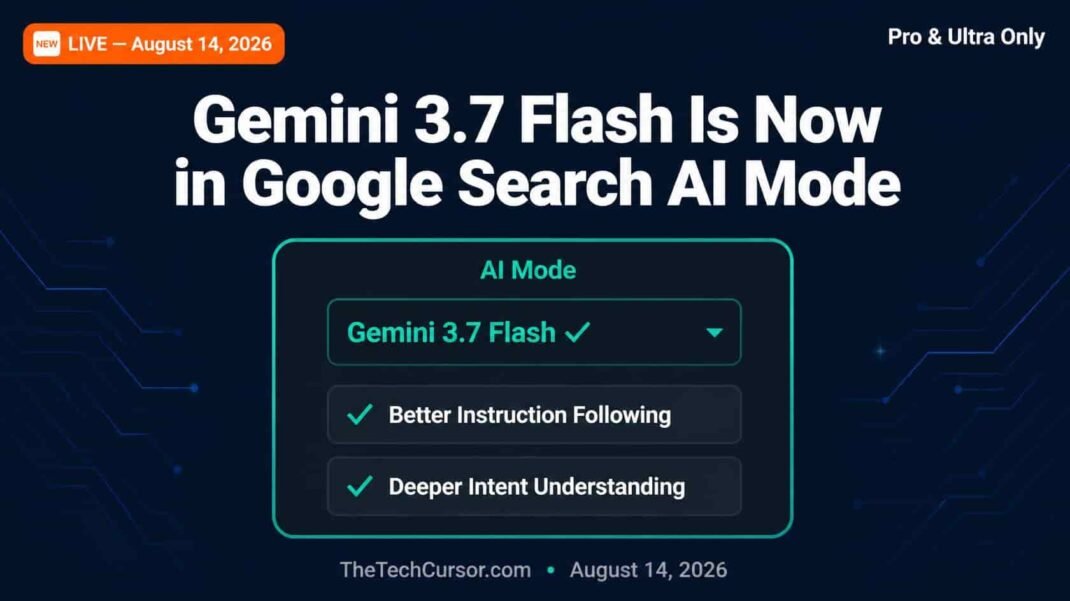
<cite index=”59-1″>Gemini 3.7 Flash is rolling out today globally in AI Mode for Google AI Pro and Ultra subscribers in English.</cite> The model was announced by Robby Stein of Google on X, confirming the rollout is live and available to paid subscribers who can select it directly within AI Mode.
This is a meaningful upgrade to the AI Mode experience — and it signals Google’s intent to keep its most capable models front and center in Search as the AI search wars intensify.
1. What Just Rolled Out
<cite index=”59-1″>Gemini 3.7 Flash was announced as Google’s “most intelligent workhorse model yet for coding and agents.”</cite> While the initial announcement focused on developer and agentic use cases, Google has now confirmed it is rolling out directly within Google Search’s AI Mode — bringing its latest model capabilities to the search experience.
The rollout is:
- Live: Starting August 14, 2026
- Scope: Global
- Surface: AI Mode within Google Search
- Language: English
- Access: Google AI Pro and Ultra subscribers
2. What Gemini 3.7 Flash Actually Improves
According to Robby Stein, Gemini 3.7 makes AI Mode better at two specific things:
Following instructions more precisely: When users give specific, detailed instructions within AI Mode — asking for a particular format, requesting a specific type of comparison, or specifying constraints on the answer — Gemini 3.7 handles these more accurately than its predecessor.
Understanding intent more deeply: Complex or ambiguous queries — where the user’s underlying goal is not immediately obvious from the words alone — are handled more effectively. This directly addresses one of the most common frustrations with AI search: getting answers that are technically responsive to the literal query but miss what the user actually needed.
Both improvements are particularly relevant for AI Mode’s conversational, multi-turn interface — where precise instruction-following and accurate intent understanding determine whether a research session is productive or frustrating.
3. How to Access It Right Now
If you are a Google AI Pro or Ultra subscriber, accessing Gemini 3.7 Flash in AI Mode is straightforward:
- Open Google Search and navigate to AI Mode
- Look for the “+” icon within the AI Mode interface
- Click it to open the model selection menu
- Select Gemini 3.7 Flash from the available options
The model selector allows you to switch between available Gemini models within AI Mode — giving subscribers direct control over which model powers their search experience.
4. Who Gets It — And When Will Everyone Else?
Currently, Gemini 3.7 Flash in AI Mode is available exclusively to Google AI Pro and Ultra subscribers — the paid tiers of Google’s AI subscription.
However, Google’s pattern with model rollouts suggests broader access is coming. <cite index=”59-1″>Google will likely roll this model out to all searchers, even free plans, in the coming weeks or months.</cite> The Pro and Ultra subscriber rollout is typically the first phase — allowing Google to gather usage data, identify issues, and refine the experience before opening it to the full Search user base.
Furthermore, this rollout connects to a broader pattern of Google progressively improving the intelligence underlying AI Mode across all tiers. Each model upgrade that starts with paid subscribers typically reaches free users within one to three months.
5. Why This Matters for Search
Gemini 3.7 Flash joining Google Search is not just a product update — it reflects something more significant about where AI search is heading.
The capability gap between AI search models is narrowing: As covered in TheTechCursor’s article on GPT-5.6 and the OpenAI government restriction, the leading AI labs are in an accelerating race to bring their most capable models to their most commercially important surfaces. For Google, Search is the most commercially important surface that exists. Bringing Gemini 3.7 Flash to AI Mode is a direct competitive response to OpenAI’s own model upgrades for ChatGPT.
Better instruction-following changes how users interact with Search: The improvement in instruction-following specifically matters for how people use AI Mode in practice. Users who have learned to craft detailed, specific prompts to get better results from AI systems will find Gemini 3.7 more reliably responsive to those prompts. This could accelerate adoption of more sophisticated AI Mode usage patterns — longer sessions, more complex queries, and more iterative research behaviour.
The model upgrade cycle is accelerating: Gemini 3.7 Flash follows Gemini 3.5 Flash, which followed Gemini 3.1 — with each generation arriving faster than the last. For SEO professionals and content strategists, this means the AI systems evaluating and citing content are continuously improving. Content that earned citations under Gemini 3.5 may perform differently under Gemini 3.7 — both because the model handles queries differently and because improved instruction-following may shift which sources get cited for specific query types.
6. Bottom Line
Gemini 3.7 Flash is live in Google Search AI Mode for Pro and Ultra subscribers — bringing improved instruction-following and deeper intent understanding to one of the world’s most-used AI search surfaces.
If you are a paid subscriber, try it today using the model selector within AI Mode. If you are on a free plan, broader access is likely coming within weeks to months based on Google’s established rollout pattern.
For marketers and SEO professionals monitoring AI search visibility, this is a reminder that the underlying models powering AI search are evolving rapidly — and that content quality, clarity, and genuine helpfulness remain the most durable signals for maintaining visibility as those models improve.