Category: AI Search | Brand Visibility | SEO Strategy
Published: July 9, 2026
Read time: 6 min
Site: TheTechCursor
Most brands tracking AI search visibility are asking one question: “Does AI cite us?” That is an important question — but it is only half the picture.
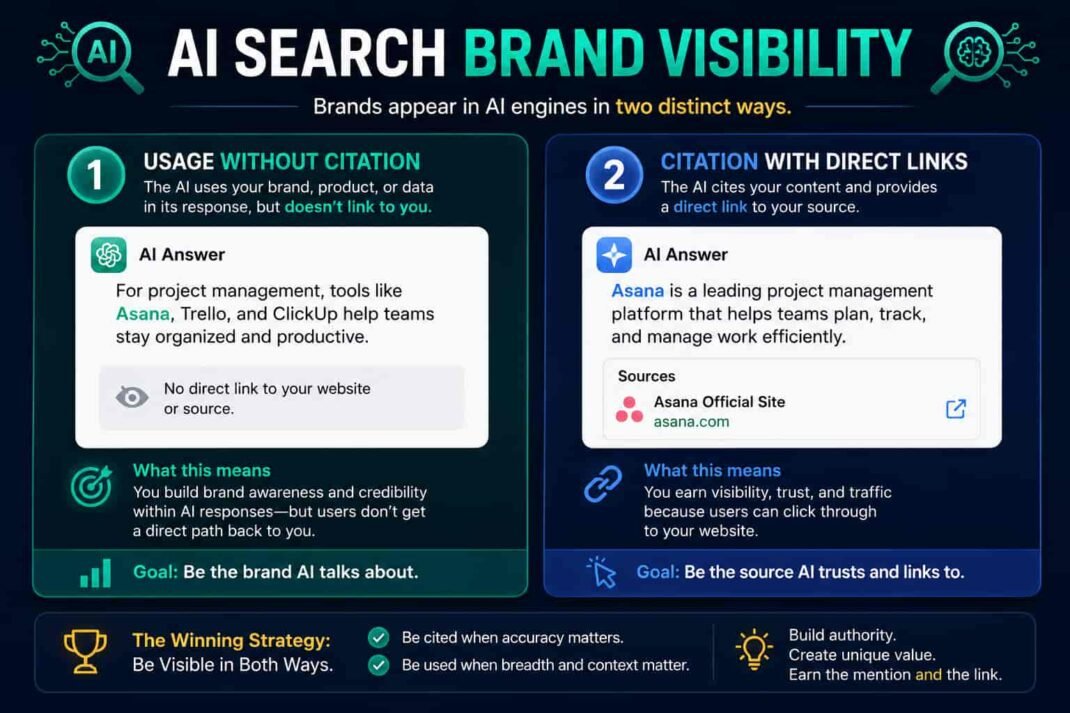
AI search systems interact with your brand in two fundamentally different ways: usage and citation. Understanding the distinction between them — and optimizing for both — is one of the most important strategic shifts in digital marketing right now.
Table of Contents
- The Click Economy Is Collapsing — Here Is the Data
- Usage vs Citation — The Critical Distinction
- Why Citations Are Only Part of the AI Visibility Equation
- Reddit’s Outsized Role in AI Answers
- How to Improve Both AI Usage and Citation
- Should You Still Pursue Traditional Search Rankings?
- The 76.1% Stat That Proves Traditional SEO Still Matters
- Bottom Line
1. The Click Economy Is Collapsing — Here Is the Data
The business case for understanding AI visibility starts with a single data point from Pew Research: when users encounter an AI-powered summary in search results, they click a blue link just 8% of the time. When they do not encounter AI summaries, the click rate is 15%.
That gap — nearly half the click-through rate — represents the click economy collapsing in real time as AI Overviews resolve more queries without requiring click-through.
However, the same data contains an important counter-signal. A Similarweb study found that AI traffic converts at 11.4% compared to 5.3% for organic search traffic. As covered in TheTechCursor’s analysis of Adobe’s AI referral data, AI-referred visitors are higher intent — they have already done more research before clicking through.
The strategic implication: losing volume of low-intent clicks while gaining share of high-intent AI referrals is not necessarily a bad trade. However, it requires actively managing your brand’s presence in AI systems — not just your organic rankings.
2. Usage vs Citation — The Critical Distinction
Brands can exist in AI systems in two distinct ways:
Usage — AI engines ingest information about your brand and use it when responding to search queries. Your brand knowledge, positioning, or product information may inform an AI answer without any visible attribution to your brand. The AI knows about you and draws on that knowledge — but the user may not see your brand mentioned at all.
Citation — AI engines directly reference your brand as a source. This may be a link to a specific web page, a link to your social profile, or a clickable contact link. Citation is visible to the user and can drive direct traffic and brand discovery.
This distinction has practical technical implications. Within OpenAI’s systems, usage and citation rely on separate technical mechanisms — with OAI-SearchBot (for web search and citation) and GPTBot (for training data and usage) deployed separately as distinct user agents. Other major AI systems have similar separate controls.
This means that being blocked to one crawler but not the other affects whether your brand is used or cited — or both — in AI responses. Most brands are not managing these separately because they did not know the distinction existed.
3. Why Citations Are Only Part of the AI Visibility Equation
A critical insight from Ahrefs research: ChatGPT retrieves almost the same number of cited URLs (~16.57) and uncited URLs (~16.58) to generate an average response.
Read that again. For every URL ChatGPT visibly cites, it is drawing on approximately one additional URL that the user never sees. The AI is using twice as much source material as it acknowledges.
This means optimizing exclusively for citation — the visible link in the AI response — captures only half of the opportunity. Being used by AI systems without citation still influences the quality, accuracy, and framing of AI answers about your topic. Furthermore, it contributes to the AI’s underlying understanding of your brand, which influences future usage and citation probability.
AI visibility strategy needs to account for both surfaces: the visible citation and the invisible usage layer beneath it.
4. Reddit’s Outsized Role in AI Answers
Here is one of the most striking findings in recent AI search research: Reddit accounts for more than 67.8% of the uncited URLs ChatGPT retrieves when generating responses.
That number reframes the entire discussion about where AI systems get their information. When AI engines draw on sources they do not visibly cite, they are drawing overwhelmingly on Reddit discussions — authentic user sentiment, community recommendations, and organic peer-to-peer conversation.
As covered in TheTechCursor’s article on SEO priorities to rethink, unlinked brand mentions in community platforms like Reddit now carry significant weight precisely because AI systems treat them as authentic signals. A brand that is discussed positively and accurately in relevant Reddit communities is influencing AI answers without those discussions ever appearing as visible citations.
The practical implication: community presence is not a “nice to have” for brand awareness. It is infrastructure for AI usage — the invisible layer that shapes how AI systems understand and represent your brand.
5. How to Improve Both AI Usage and Citation
For AI usage: Get your brand into the sources each AI model relies on most heavily. For ChatGPT, that means Reddit and community platforms. For Google AI Overviews, that means authoritative web pages. For Perplexity, that means being crawlable and appearing in search results for relevant queries.
Read AI vendor and research studies actively — they reveal which sources AI engines prioritize. The composition of those source sets changes as models are updated, so monitoring matters. A brand that understood Reddit’s role in ChatGPT answers six months ago has had six months to build that community presence.
For AI citation: Stay crawlable. Rank organically for relevant queries. Produce content that adds something original — a unique perspective, proprietary data, first-hand experience — rather than restating what other sources already say.
Research from Semrush found that AI engines rarely cite generic content that restates what other sources say. Content that earns citations adds unique value. This aligns directly with Google’s helpful content guidance — and with the E-E-A-T signals covered in TheTechCursor’s E-E-A-T 2026 article.
Track both separately: Use an AI visibility platform to run representative prompts and examine citation sources over time. The tracking is more expensive than traditional rank tracking — AI prompt monitoring relies on API calls — but the data is richer and more directional.
Established platforms like Semrush and Ahrefs have integrated AI tracking features. As covered in TheTechCursor’s LLM prompt tracking guide, the most reliable approach combines platform tracking with GA4 AI referral analysis, Search Console long-query patterns, and server log crawler activity.
6. Should You Still Pursue Traditional Search Rankings?
Yes — but the reason why has shifted.
The direct relationship between organic ranking positions and traffic is weakening as AI Overviews resolve more queries without click-through. However, Ahrefs research shows a strong correlation between AI citations and Google ranking positions — which creates an indirect reason why traditional rankings still matter.
Furthermore, many of the tactics that earn higher organic rankings also earn AI citations: publishing original research, building topical authority, earning genuine backlinks from relevant sources, and maintaining strong E-E-A-T signals. These efforts are not zero-sum between traditional SEO and AI visibility — they compound across both.
The strategies worth deprioritizing are those that improve rankings without contributing to AI citation probability: thin keyword-targeted content, low-quality link volume, and CTR micro-optimization for queries AI is resolving without clicks. As covered in TheTechCursor’s recent SEO priorities article, these represent the clearest areas of diminishing return.
7. The 76.1% Stat That Proves Traditional SEO Still Matters
An Ahrefs study from July 2025 found that 76.1% of pages cited in Google AI Overviews ranked in Google’s top 10 organic search results.
This is the clearest evidence that traditional SEO and AI visibility are not separate strategies requiring separate investments. For Google AI Overviews specifically — which may become the dominant AI search format given Google’s scale — traditional organic rankings remain one of the strongest predictors of AI citation.
The implication is direct: rather than choosing between traditional SEO and AI search optimization, the most efficient strategy invests in the work that moves both simultaneously — original content, topical authority, entity building, and genuine third-party validation.
8. Bottom Line
AI search creates two distinct visibility surfaces for every brand: usage (the invisible layer where AI draws on your content without attribution) and citation (the visible layer where AI directly references your brand as a source).
Most brands are tracking only the visible citations — missing the significant influence of the invisible usage layer, dominated by community platforms like Reddit.
A complete AI visibility strategy accounts for both:
- For usage: community presence, entity consistency across platforms, and being in the sources AI systems trust most
- For citation: crawlability, organic rankings, original content, and genuine third-party authority
Traditional SEO is not dead — 76.1% of AI Overview citations come from pages ranking in the top 10. However, the return is increasingly concentrated in work that also builds AI visibility, not in work that only optimizes for traditional metrics.
Keep ranking. Start tracking both usage and citation. And build the community presence that shapes the invisible layer most brands are completely ignoring.
Pingback: 81% of Marketers Still Call It SEO — What Fractl's 343-Person Survey Reveals About AI Search in 2026 - The Tech Cursor