
Category: AI Search | SEO Strategy | Digital Marketing Research
Read time: 8 min
Table of Contents
- The Survey That Settles the Naming Debate — Sort Of
- Key Findings at a Glance
- Finding 1: 81% Still Call It SEO — And That Is Not a Problem
- Finding 2: Half the Industry Is Still Looking Up the Vocabulary
- Finding 3: 24% of Budgets Are Now Allocated to AI Search Visibility
- Finding 4: ChatGPT Leads, Perplexity Is Overrated by Industry Insiders
- Finding 5: Case Studies Beat Acronym Fluency 4 to 1
- Finding 6: 66% Use AI Tools to Research Vendors — Including You
- What This Means for SEO Professionals and Agencies
- Bottom Line
The SEO industry has been arguing about what to call AI search optimization for two years. GEO. AEO. LLM optimization. AI search optimization. The debate fills LinkedIn, conference sessions, and agency pitch decks.
Fractl surveyed 343 U.S. marketing decision-makers to find out what buyers actually think — how they define AI search, where they are putting budget, and what vendors need to prove to earn their trust.
The findings are clarifying — and in some cases, humbling for the industry.
1. The Survey That Settles the Naming Debate — Sort Of
< cite index=”34-1″>There’s a difference between the language the industry uses to signal expertise and the language buyers use to solve a problem.</cite>
This is the central tension the Fractl survey reveals. Within SEO and digital marketing communities, GEO, AEO, and LLM optimization are established terms. However, among the marketing decision-makers actually buying these services and allocating budgets, the vocabulary has not caught up — and may never fully do so.
The survey covered 343 U.S. marketing decision-makers across company sizes, roles, and industries. The findings represent the buyer perspective on AI search — not the industry insider perspective — which makes them significantly more useful for understanding how to communicate, sell, and position AI search work in 2026.
2. Key Findings at a Glance
| Finding | Data |
|---|---|
| Marketers who still call AI search “SEO” internally | 81% |
| Marketers who search “AI search optimization” or “SEO” when looking for help | 70% |
| C-suite executives using GEO or AEO terminology | 28% and 17% |
| Individual contributors using GEO or AEO terminology | 9% and 3% |
| Top vendor red flag | Buzzwords without explanation — 36% |
| Marketers using AI tools to research vendors | 66% |
| Average budget share allocated to AI search visibility | 24% |
| Top credibility signal for vendors | Case studies with verifiable results — 34% |
| Terminology fluency as a credibility signal | Only 9% |
| Marketers who have adopted a term beyond SEO | Only 27% |
3. Finding 1: 81% Still Call It SEO — And That Is Not a Problem
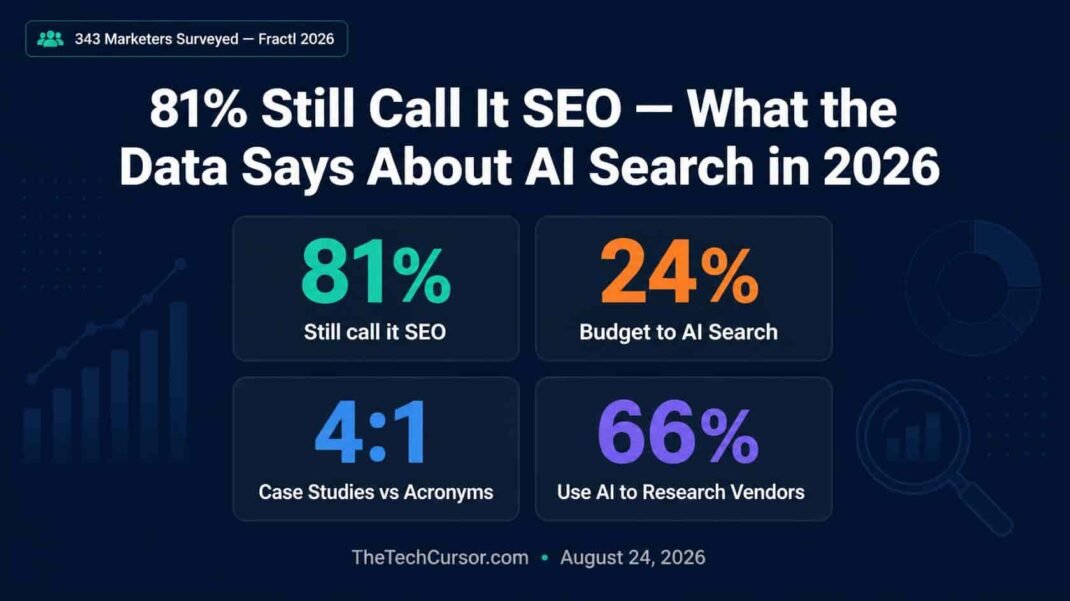
< cite index=”34-1″>81% of marketers still refer to their internal AI search visibility strategy as SEO.</cite>
The most important interpretation of this finding is that it does not represent ignorance of AI search — it represents a pragmatic choice about internal language. Most marketing teams have existing SEO frameworks, reporting structures, stakeholder relationships, and budget categories built around the word “SEO.” Adopting a new acronym requires not just learning new terminology but re-educating every stakeholder who asks what the team is working on.
For practitioners, this has a direct implication: when pitching AI search work internally or to clients, starting with “SEO” as the entry point and framing AI search as an evolution of existing practice — rather than a completely new discipline — reduces resistance and accelerates buy-in.
< cite index=”34-1″>The findings suggest that AI search is changing the mechanics of visibility faster than it is changing the vocabulary of the buyers funding it.</cite>
This is not a problem to solve. It is a reality to work with.
4. Finding 2: Half the Industry Is Still Looking Up the Vocabulary
< cite index=”34-1″>Half of marketers said they’ve researched a term they didn’t know after seeing it used by a peer or competitor.</cite>
The AI search vocabulary may feel settled within industry circles — but half of the marketing decision-makers surveyed are still actively learning what the new acronyms mean. Only 27% have formally adopted a term beyond SEO. 42% have decided against it. 31% are still undecided.
Furthermore, the survey reveals a C-suite versus practitioner vocabulary gap that is significant for how agencies and vendors should calibrate their communications:
- C-suite executives use “GEO” at 28% — roughly three times the rate of individual contributors at 9%
- C-suite executives use “AEO” at 17% — versus 3% of individual contributors
< cite index=”34-1″>Many executives are interested in the category before their organizations have a shared operating model for it. They may be asking about GEO because they saw it in a board deck, while the SEO, content, PR, and analytics teams are still figuring out what changes in execution.</cite>
The practical implication: use the terminology your audience already uses. In executive presentations, GEO and AEO may signal familiarity with the category. In practitioner conversations, SEO framing reduces friction without sacrificing accuracy.
5. Finding 3: 24% of Budgets Are Now Allocated to AI Search Visibility
< cite index=”34-1″>On average, marketers are now allocating 24% of their total search or content budget to AI search visibility. Up to 82% have committed at least some budget, and 43% are allocating more than 20%.</cite>
This is the clearest evidence that AI search has moved from experimentation to planning. Almost two-thirds of marketing teams have formally allocated budget to AI search visibility. The average allocation of 24% represents a significant share of total search investment — and suggests that AI search is being treated as a genuine channel rather than a speculative experiment.
The teams investing the most are those closest to performance measurement — SEO and performance marketing teams allocate more to AI search visibility than content and brand teams. This makes sense: these teams notice changes in impressions, traffic quality, and attribution paths first.
The top challenge is not measurement — it is keeping pace:
- 28% — keeping up with how quickly the landscape is changing
- 17% — measuring performance or visibility in AI-generated results
- 15% — identifying which AI search platforms to prioritize
- 13% — absence of industry standards or best practices
For agencies and consultants, this ranking is important. Clients do not primarily need new measurement dashboards. They need strategic direction on how to prioritize and adapt as the landscape evolves — which requires more judgment and less tooling than much of the industry is currently offering.
6. Finding 4: ChatGPT Leads, Perplexity Is Overrated by Industry Insiders
< cite index=”34-1″>ChatGPT leads at 34% of marketers prioritizing it for AI search visibility, followed by Gemini at 16%, Claude at 6%, and Copilot or Bing AI at 5%. Only 1% named Perplexity, despite the attention it gets within SEO and AI circles.</cite>
The Perplexity gap is striking. Within SEO and digital marketing communities, Perplexity consistently gets significant attention as an AI search platform — it is regularly mentioned in articles, conference talks, and practitioner discussions. However, only 1% of actual marketing decision-makers named it as their priority platform.
This does not mean Perplexity is unimportant for AI citation strategy — as covered in TheTechCursor’s article on used vs cited in AI search, Perplexity draws on different source sets than ChatGPT and Google AI Overviews, and has a concentrated, high-intent user base. However, it does suggest that industry insiders should be cautious about assuming their platform priorities align with those of the clients and stakeholders they serve.
< cite index=”34-1″>A platform-by-platform strategy may be useful for advanced teams, but many companies are still one step earlier. They need to know which sources AI systems are pulling from in their category and which of those sources they can realistically influence.</cite>
Furthermore, 14% of marketers said their team has not yet picked a target platform. For agencies, this represents an opportunity: helping clients identify which AI platforms are most relevant to their specific category and audience — rather than assuming a generic ChatGPT-first strategy applies universally.
7. Finding 5: Case Studies Beat Acronym Fluency 4 to 1
This is the most practically important finding for agencies and consultants selling AI search services.
< cite index=”34-1″>Case studies with measurable, verifiable results were the top credibility signal, selected by 34% of marketers. Clear methodology followed at 22%, and team expertise or a demonstrated track record came in at 15%. Combined, 71% of decision-makers ranked case studies, methodology, or team track record as their top credibility signal. Terminology fluency ranked at just 9%.</cite>
The red-flag data tells the same story from the opposite direction:
< cite index=”34-1″>The biggest turnoff was heavy use of buzzwords without a clear explanation, cited by 36% of marketers. Another 21% pointed to a lack of case studies or trackable results, while 20% flagged vague or unsubstantiated performance claims. Repackaged SEO services with new AI branding also raised concerns for 16%.</cite>
The clear message: acronym fluency is not a competitive advantage — it is a potential liability if it comes at the expense of demonstrable results. The agencies and consultants winning AI search business are those that can show a proof chain: what changed, why it changed, what the impact was, and how it was measured.
As covered in TheTechCursor’s 5-phase AI citation framework, the methodology question is increasingly important — clients want to understand the work, not just see the outcome.
8. Finding 6: 66% Use AI Tools to Research Vendors — Including You
< cite index=”34-1″>Two-thirds of marketers said they’ve personally used an AI search tool such as ChatGPT, Perplexity, or Gemini to research or evaluate a marketing vendor or agency.</cite>
Adoption is highest among the groups most likely to influence search investment:
- SEO specialists: 89%
- Performance marketers: 84%
- C-suite leaders: 81%
This creates a feedback loop that every agency and consultant should understand:
< cite index=”34-1″>AI search tools and peer recommendations are now tied as marketers’ first stop when researching AI search solutions or partners, with each selected by 34% of respondents. Traditional discovery channels such as Google Search, LinkedIn, and trade media followed at 22%.</cite>
The implication is direct: the marketers being sold AI visibility services are using AI visibility to discover and evaluate the people pitching them. If your agency does not appear in ChatGPT or Gemini responses for “AI search optimization agencies” or “best SEO agency for [your specialty],” you are invisible during the discovery phase of your own sales process.
As covered in TheTechCursor’s DTC AI search case study, AI visibility is engineered — not inherited. The same strategies that build AI visibility for clients need to be applied to build AI visibility for the agency itself.
9. What This Means for SEO Professionals and Agencies
Stop leading with acronyms. Start leading with outcomes.
< cite index=”34-1″>The strongest AI search pitch isn’t “we do GEO.” It’s a clear proof chain: Here’s how AI search represents your category, here’s where your brand is missing or misrepresented, here’s what influences those answers, and here’s the work required to improve visibility.</cite>
For practitioners building their own positioning:
Use the language your audience uses. If clients call it SEO, call it SEO — at least initially. Frame AI search as an evolution of existing practice rather than a replacement that requires learning new vocabulary before getting started.
Build your case study library now. The top credibility signal is case studies with measurable, verifiable results. Every AI search engagement should be documented with before/after citation data, branded search trends, AI referral traffic, and conversion metrics. These documents are your most valuable sales assets.
Audit your own AI visibility. If two-thirds of your prospects are using AI tools to research vendors, your AI visibility directly affects your pipeline. Run the same prompts your prospects are likely to use. Identify gaps. Apply your own methodology to your own agency presence.
Define your methodology explicitly. 22% of marketers cite clear methodology as the top credibility signal. Document your process — what you audit, what you prioritize, how you implement, how you measure. Make it visible on your website, in your proposals, and in your case studies.
Address the speed-of-change challenge. The top challenge marketers face is keeping pace with how quickly AI search is evolving. Position yourself not just as an implementation partner but as a strategic guide who helps clients navigate change — which is a more durable value proposition than execution alone.
10. Bottom Line
The Fractl survey of 343 marketing decision-makers is one of the most practically useful research pieces published on AI search in 2026. Its findings clarify the gap between how the industry talks about AI search and how buyers think about, fund, and evaluate it.
The key takeaways:
- 81% still call it SEO — work with that, not against it
- 24% of budgets are already allocated — the investment is real
- Case studies beat acronyms 4 to 1 — build your proof library
- 66% use AI tools to research vendors — build your own AI visibility
- ChatGPT leads; Perplexity is overrated by insiders relative to buyer priority
- The top challenge is speed of change — position as a strategic guide
< cite index=”34-1″>Vocabulary isn’t strategy. Marketers are still using familiar terms, evaluating familiar proof points, and rewarding vendors that can explain the work clearly. What’s changing is where they discover and validate those vendors.</cite>
The winners of the next phase will be the ones who are easy to find, easy to understand, and easy to trust — in Google, in AI search tools, and in the peer networks marketers rely on. That is the same visibility challenge they help clients solve.