
Read time: 5 min
Table of Contents
- What Google’s Job Listings Reveal
- The Engineering Roles — What They Are Building
- The Design Role — Discover as Concierge
- What This Means for Publishers
- The Search Console Discover AI Report
- The Opt-Out Mechanism
- How This Connects to Dive Deeper
- Bottom Line
Google is actively hiring to generate AI content for Google Discover. Open job listings on Google’s careers site describe engineering and design roles whose explicit purpose is building AI-generated content recommendations for the Discover feed — one of the world’s largest content distribution surfaces with more than 500 million daily active users.
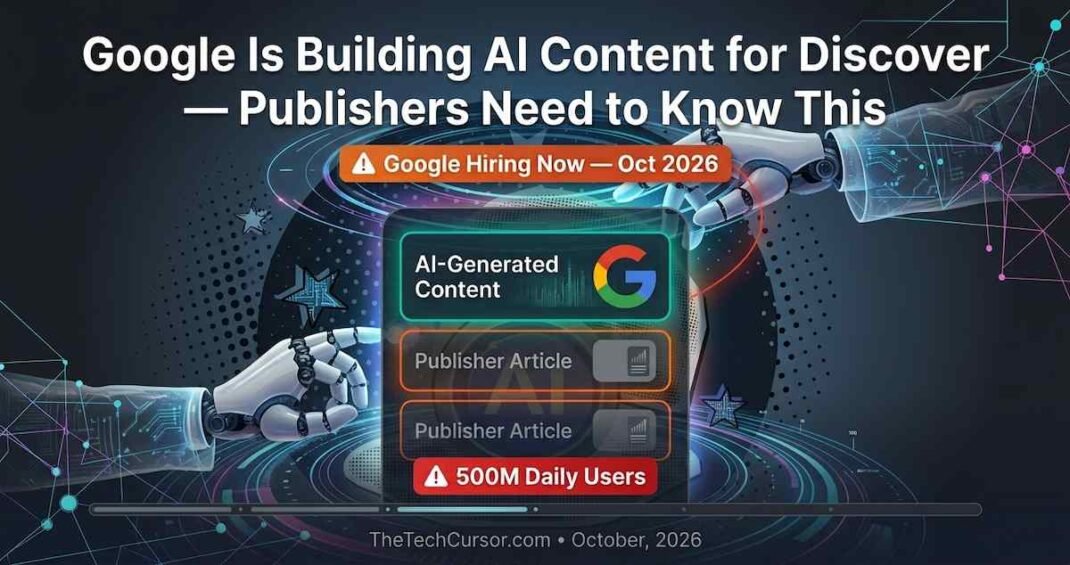
The listings are the clearest signal yet that Discover is moving from a purely algorithmic publisher content feed toward a hybrid model where AI-generated content appears alongside — or instead of — publisher articles.
1. What Google’s Job Listings Reveal
Two engineering listings and one senior design listing describe teams working on AI-generated content for Discover.
A Staff ML Engineer listing for the Discover Feed Recommendation team states that the team “leads by recommending AI-generated content (AIGC) to fulfil user interests.” The role covers quality control, topic discovery, and content understanding for the recommendation system.
A separate Senior Staff ML Software Engineer listing for AI-generated content quality in the Discover feed describes similar work at a more senior level and states that the team uses AI-generated content across major surfaces.
A Principal UX design listing — a director-level role based in Mountain View or New York, with a US base salary of $275,000 to $382,000 plus equity — describes turning Discover into “a proactive, hyper-personalized concierge experience.”
None of the listings includes a timeline for launch. None describes how much of the Discover feed AI content would fill.
2. The Engineering Roles — What They Are Building
The engineering listings describe a system that goes well beyond simple content curation. Several responsibilities are particularly significant for understanding what Google is building.
Agentic flows for proactive surfaces: The Staff ML Engineer role includes building agentic flows that generate content for what the listing calls proactive surfaces — specifically naming Discover and Notifications. This language indicates that the AI content generation is not limited to responding to user queries. It will proactively generate content to push to users before they ask.
Quality controls at scale: Both engineering listings describe quality control mechanisms that check AI-generated content for factuality, freshness, coherence, and tone. Furthermore, feedback loops are designed to identify and surface engaging stories globally. These quality signals mirror the same signals Google uses to evaluate publisher content — suggesting that AI-generated Discover content will be held to comparable standards.
Global content generation: The listings describe generating engaging stories globally — not in English only. Consequently, the AI content build-out for Discover is not limited to English-language markets. It is designed to serve Discover’s international user base across languages.
3. The Design Role — Discover as Concierge
The Principal UX listing is the most strategically revealing of the three roles. Its language describes a fundamentally different vision for what Discover becomes.
The role asks the hire to lead design for a “proactive, hyper-personalized concierge experience” that helps people make progress on their goals. The concierge framing is significant. A concierge does not wait to be asked — it anticipates needs and proactively delivers relevant information.
Applied to Discover, this vision suggests a feed that does not simply surface relevant publisher articles. Instead, it actively synthesizes and delivers personalized information packages — potentially generated by AI — that address users’ stated goals and interests without requiring them to seek out individual publisher sources.
Furthermore, the listing specifically asks the hire to “balance AI capabilities while keeping human voices and sources at the center.” That phrasing acknowledges the tension directly. The design challenge is maintaining publisher and creator relevance in a feed increasingly shaped by AI generation.
The role also lists experience building value exchanges with creators and publishers as a preferred qualification — suggesting that how to compensate or partner with publishers in an AI-generated Discover environment is an active design consideration, not a resolved one.
4. What This Means for Publishers
The implications for publishers are significant — and not entirely negative.
The threat AI-generated content in Discover could reduce the click-through rate for publisher articles in the same way AI Overviews have reduced click-through rates in search results. If Discover surfaces an AI-generated summary of a trending topic, some users who would previously have clicked through to a publisher article may find the summary sufficient.
This concern is consistent with the pattern across Google’s AI features. The Dive Deeper feature in Discover tested earlier this year, and the AI Overviews research both show that AI-generated answers reduce clicks to publisher content.
The opportunity: The listings also describe AI-generated content that links to web content. The Staff ML Engineer listing mentions generating content for proactive surfaces that connects to source material. Furthermore, the Principal UX listing specifically identifies keeping “human voices and sources at the center” as a design principle — and lists experience building value exchanges with publishers as a preferred qualification.
Publishers whose content is high-quality, frequently fresh, and accurately represented by their entities and structured data are better positioned to be cited in or alongside AI-generated Discover content. The signals that make publisher content eligible for AI citation in Search Overviews are likely to be similar signals that influence which publisher content anchors AI-generated Discover features.
5. The Search Console Discover AI Report
Google has already launched a Discover generative AI report in Search Console — which means publisher-level data on AI feature appearances in Discover already exists.
The report counts impressions of links to your site in Discover’s generative AI features, grouped by page, country, and date. The Pages view lists the canonical URLs that supplied the information shown in those features — which may differ from the pages users actually land on after clicking.
Two important limitations apply. Impressions are the only metric the report currently describes — click data is not yet available. Furthermore, the report does not break out individual AI features, and sites with too few impressions may not see data at all.
For publishers monitoring their Discover performance, the Discover generative AI report is the primary data source for understanding current AI feature exposure. The AI visibility dashboard framework should include this report alongside Search Console’s standard AI Performance reports for a complete picture of AI-driven visibility.
6. The Opt-Out Mechanism
Publishers who want to exclude their content from Discover’s generative AI features can do so through the Search generative AI control in Google Search Console.
However, the opt-out covers AI Overviews and AI Mode as well — not just Discover. Excluding a site from the Search generative AI control removes its links and content from all of Google’s generative AI features simultaneously. Content from other sites remains available in those features.
Consequently, a publisher who wants to opt out of Discover AI features must accept that this also removes them from Search AI Overviews and AI Mode. That is a significant trade-off. Furthermore, opting out of AI features means opting out of the AI-driven visibility that is increasingly important as AI search expands.
The opt-out mechanism as currently designed forces a binary choice — all AI features or none — rather than allowing publishers to manage participation at the feature level. Whether that changes as Google’s Discover AI content program develops is unknown.
7. How This Connects to Dive Deeper
The Discover AI content hiring connects directly to features already in public testing. The Dive Deeper button — spotted in testing in September and covered in the Dive Deeper article — opens a short topic overview with links to related stories, starting with videos.
The ML engineering roles describe building AI-generated content for proactive surfaces including Discover. The UX design role describes a concierge experience that helps users go deeper and move from inspiration to action. Both align with what Dive Deeper is testing in practice.
Furthermore, the design listing mentions working with teams at YouTube, Shopping, Chrome, and Android. This cross-product scope suggests Discover’s AI content will not be isolated to the Discover feed itself. The concierge vision extends across Google’s product ecosystem — which has implications for how publishers think about their content’s visibility across Google’s platforms more broadly.
8. Bottom Line
Google’s Discover AI content hiring confirms a direction that has been developing throughout 2026. Discover is moving from a purely algorithmic publisher content feed toward a hybrid model that includes AI-generated content alongside publisher articles.
The timeline is unknown. The share of AI versus publisher content in the feed is undisclosed. However, the investment — three senior technical and design roles, one at director level — signals that this is a priority program, not an experiment.
What Publishers Should Do Now
Monitor the Discover generative AI report in Search Console. This is the primary data source for understanding your current AI feature exposure in Discover. Watch for changes in impression trends as Google’s AI content program develops.
Invest in the signals that support AI citation. Structured data, entity clarity, fresh content, and named author attribution are the signals that make publisher content eligible for AI citation across Google’s features. Building these signals supports Discover AI exposure in addition to Search AI Overviews.
Track Discover traffic separately from Search traffic. In GA4, Discover referrals are distinguishable from Search referrals. Monitoring the trend separately allows early detection of any impact from AI content changes in the Discover feed.
Build direct audience relationships. As AI-generated content takes a growing share of the Discover feed, publisher content that people actively seek out — through newsletters, direct navigation, and community — is protected from the algorithmic displacement that passive Discover browsing creates.