
Read time: 5 min
Table of Contents
- What Google Is Testing
- What Dive Deeper Looks Like
- Why This Is Bad for Publishers
- The Pattern — AI Absorbs Clicks Before Publishers Get Them
- How This Connects to the Discover Traffic Ecosystem
- What Publishers Can Do
- Bottom Line
Google is testing a new feature in Google Discover called “Dive Deeper.” The feature inserts AI-generated topic summaries into the Discover feed. Users can read a synthesized overview of a topic before deciding whether to click through to any publisher’s article.
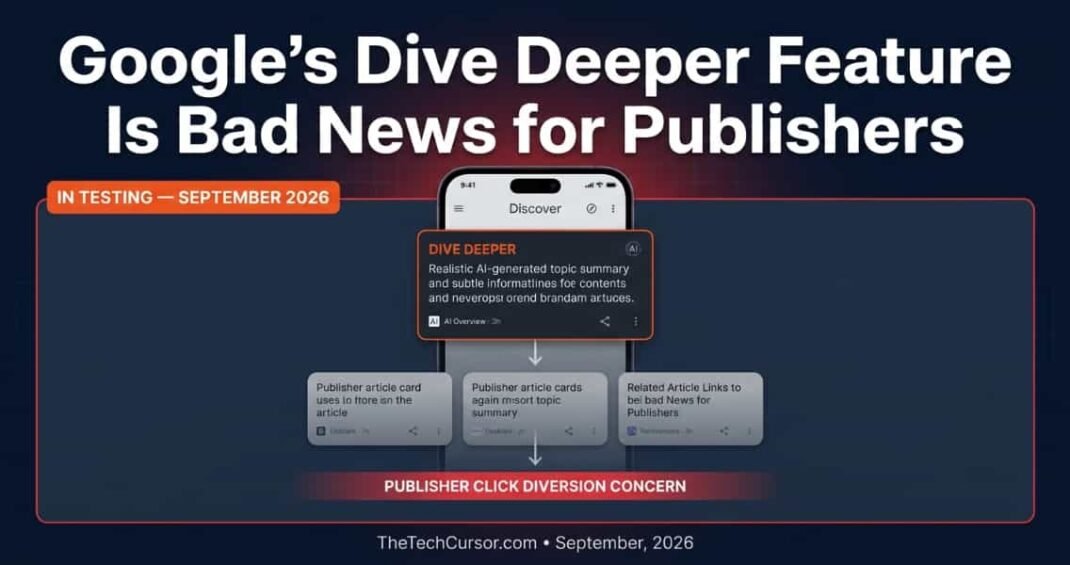
For publishers who depend on Discover traffic, this is concerning news. Dive Deeper follows the same pattern as AI Overviews in search. It gives users enough information to satisfy casual curiosity without requiring a click. Consequently, publishers lose traffic that would otherwise have gone to their content.
1. What Google Is Testing
Dive Deeper is an AI-generated feature that appears within the Google Discover feed. When a topic cluster appears in Discover — a group of articles about the same news story or subject — a Dive Deeper card can appear alongside those articles.
The card presents an AI-synthesized summary of the topic. It pulls from multiple sources. It presents key points in a structured format. Users can read the summary without clicking on any individual article.
The feature is in testing. It is not yet rolling out broadly. However, its appearance in testing signals Google’s direction for Discover — toward AI-mediated content consumption and away from direct publisher click-throughs.
2. What Dive Deeper Looks Like
Based on early screenshots shared by researchers who spotted the feature, Dive Deeper appears as a distinct card within the Discover feed. It sits alongside — or sometimes above — the standard article cards from publishers.
The card includes a topic headline, an AI-generated summary paragraph, and key points extracted from multiple sources. Below the summary, there are links to the individual articles the AI drew from.
The placement matters significantly. When Dive Deeper appears above article cards, it is the first thing users encounter. Users who find the summary sufficient do not need to scroll to the article cards below. Furthermore, users who are moderately curious may read the summary and consider themselves informed — without clicking through to any publisher.
3. Why This Is Bad for Publishers
The concern for publishers is straightforward. Discover has been one of the most valuable traffic sources for content publishers over the past five years. Unlike search, which requires users to actively query something, Discover delivers content proactively to users based on their interests. This passive distribution model has driven significant referral traffic to news sites, blogs, and content publishers.
Dive Deeper threatens that model in a specific way. It does not remove publisher articles from the Discover feed. However, it inserts an AI layer between the user and the publisher’s content. A user who previously would have clicked on an article headline now has the option to read a summary instead.
The impact on click-through rates is predictable. Even a small percentage of users who choose the summary over the article represents a meaningful traffic loss at scale. Discover operates at enormous volume. Small percentage changes in click-through rates translate to large absolute traffic changes for publishers.
Furthermore, the traffic that Dive Deeper is most likely to divert is awareness-stage traffic. Users casually browsing Discover for general topic awareness are exactly the users most likely to find a summary sufficient. Publishers lose the casual reader — while retaining only the highly engaged reader who wants the full article regardless of whether a summary is available.
4. The Pattern — AI Absorbs Clicks Before Publishers Get Them
Dive Deeper in Discover follows the same structural pattern as several other recent Google developments.
AI Overviews in search absorb informational query clicks before they reach publisher articles. Top Stories carousels in AI Overviews add publisher links back — but with lower click rates than traditional organic results. Dive Deeper in Discover inserts an AI summary layer before the article click.
In each case, Google is adding AI-generated content that serves the user’s immediate information need without requiring a publisher click. The pattern is consistent. Moreover, it is accelerating.
This connects directly to the research covered in the Wikipedia AI Overviews traffic impact article. That study found that AI Overviews reduced Wikipedia’s search referrals by approximately 5% in the first year. The mechanism is identical: AI summaries absorb the click that would otherwise have gone to the publisher. Discover’s Dive Deeper feature applies that same mechanism to a different surface.
5. How This Connects to the Discover Traffic Ecosystem
Understanding Dive Deeper requires understanding how Discover traffic works — and why it is structurally different from search traffic.
Search traffic is intent-driven. Users actively look for something. They are more likely to click through because they want a complete answer or a specific resource.
Discover traffic is interest-driven. Users are browsing passively. They respond to content that catches their attention. They are less committed to any individual piece of content before they click.
That lower commitment makes Discover traffic more vulnerable to AI summary interception. A user with passive curiosity about a topic is more likely to find a three-paragraph AI summary sufficient than a user who actively searched for that topic and wants a comprehensive answer.
Furthermore, the Google Search Profiles article shows how Google has been building a Discover audience ecosystem. Search profiles, Preferred Sources, and topic following all create mechanisms for users to see more content from publishers they care about. Dive Deeper sits alongside these positive developments — but cuts against them by reducing the click incentive even for users who follow a publisher’s topics.
6. What Publishers Can Do
The honest answer is that publishers have limited direct control over whether Dive Deeper appears in their topic area or whether their content is included in the AI summaries Google generates.
However, several approaches improve your position within the Discover ecosystem regardless of how Dive Deeper evolves.
Build a loyal Discover audience through Search profiles. Users who actively follow your publication through a Google Search profile see more of your content in Discover. Furthermore, they have a higher baseline engagement with your brand. These users are less likely to find a generic AI summary sufficient compared to casual Discover browsers. Building your Search profile follower base is the most direct investment in audience loyalty that reduces your exposure to summary-driven click loss.
Optimize for content that requires the full article. Certain content types are inherently resistant to AI summary interception. Original reporting with exclusive information cannot be adequately summarized from public sources. Analysis with a distinctive point of view adds value that a neutral summary does not capture. Data-driven content with original statistics creates a reason to visit the source. Consequently, investing in these content types improves your resilience to AI summary features.
Monitor your Discover traffic carefully. Track Discover traffic in Google Search Console and GA4 separately from search traffic. If Dive Deeper begins rolling out more broadly, you will see the impact in your Discover referral data before it shows up in aggregate traffic figures. Early detection allows earlier strategic response.
Diversify your traffic sources. Direct audience relationships — as detailed in the Invisible PR guide — newsletter subscribers, podcast listeners, community members — are immune to AI summary interception. Furthermore, they represent the highest-value audience segment regardless of what happens to referral traffic from Discover.
7. Bottom Line
Google’s Dive Deeper testing signals a continued push toward AI-mediated content consumption in Discover. The feature follows the same structural pattern as AI Overviews in search. It inserts a summary layer that satisfies casual curiosity without requiring a publisher click.
For publishers, the impact is likely to be a reduction in Discover’s casual-reader traffic. Highly engaged readers who want complete, authoritative coverage will still click through. However, the passive browser who represents a significant portion of Discover volume may find AI summaries sufficient.
The strategic response is not to fight the feature. Instead, it is to build the kind of content and audience relationships that make your publication worth clicking through to — even when a summary is available. Original reporting, distinctive analysis, loyal audience development, and traffic diversification are the durable responses to an AI-mediated Discover feed.
Dive Deeper is in testing. Its final form and rollout timeline are unknown. However, the direction it represents is clear. Plan accordingly.
Pingback: Google’s AI Content in Discover: What Publishers Must Know - The Tech Cursor