
Read time: 5 min
Table of Contents
- What Google Just Changed
- Why Gemini Traffic Was Landing in Direct
- What the UTM Parameters Look Like
- What John Mueller Said
- How This Compares to ChatGPT’s UTM Approach
- What This Means for Your GA4 Setup
- The Bigger Picture — AI Attribution Is Improving
- Bottom Line
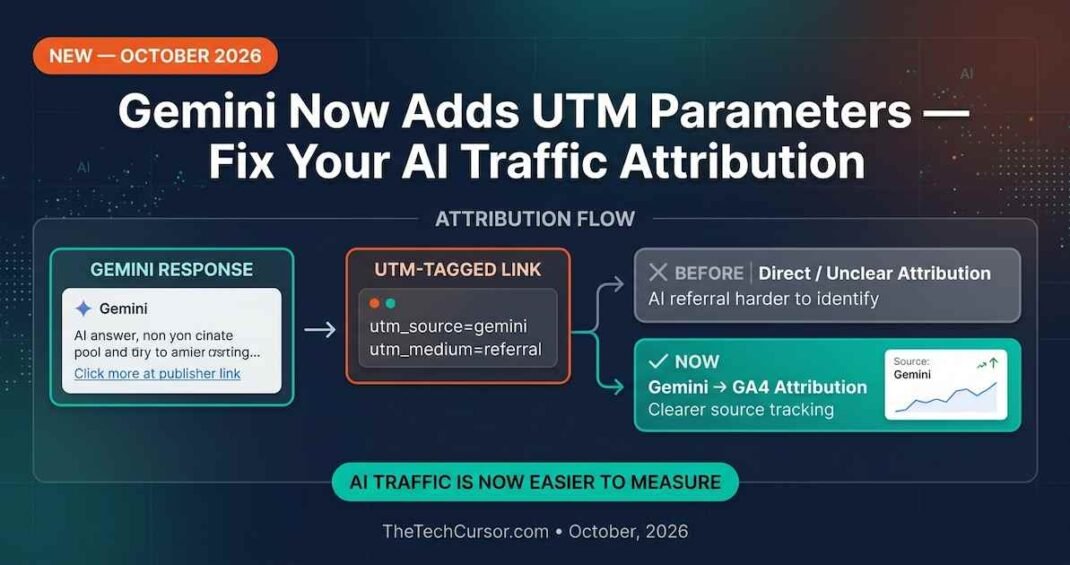
Google Gemini has quietly started adding UTM parameters to outgoing links. The change was spotted by SEOs on Reddit before any official announcement. UTM parameters allow GA4 and other analytics tools to accurately identify Gemini as the source of a visit — rather than misattributing it to direct traffic.
This is a meaningful improvement. Better attribution means better data. Better data means better decisions about where to invest in AI search visibility.
1. What Google Just Changed
Gemini now appends UTM parameters to links it includes in responses. When a user clicks a link in a Gemini response, those parameters travel with the click to the destination website.
The change means site owners can now see Gemini-referred traffic clearly labelled in GA4 — rather than having it disappear into the direct or unattributed bucket.
Furthermore, the parameters survive contexts where the HTTP referrer does not. The referrer header — which browsers send to tell websites where a user came from — is unreliable in many mobile and app contexts. UTM parameters embedded in the URL itself are more durable. They survive in-app webviews and show up in raw server logs as well as analytics dashboards.
2. Why Gemini Traffic Was Landing in Direct
Before UTM parameters, Gemini traffic had a tracking problem. The referrer header existed on desktop web browsers. However, it was unreliable in other contexts.
According to a Reddit discussion that surfaced the change, referrer data from the Gemini mobile app survived only about 9% of the time. Android assistant invocations stripped the referrer entirely. Consequently, a large share of Gemini-referred traffic was landing in GA4’s direct bucket — with no indication it came from Gemini at all.
This created a specific measurement problem. Site owners using GA4 to track AI referral traffic were underreporting Gemini’s contribution. Traffic that appeared as direct was in many cases Gemini-referred. That misattribution made it harder to justify investment in Gemini visibility and harder to compare AI platforms against each other accurately.
UTM parameters solve this problem by moving the attribution data from the unreliable referrer header into the URL itself.
3. What the UTM Parameters Look Like
Google has not yet published official documentation for the Gemini UTM parameters. Consequently, the exact parameter structure is not confirmed from an official source.
However, based on community observations, Gemini links appear to use a standard UTM format that GA4 recognizes automatically. The parameters identify Gemini as the source and the medium as something indicating AI or assistant origin.
The undocumented status matters for one reason. It is not yet clear under what circumstances Gemini adds UTM parameters. ChatGPT, for comparison, adds UTMs only to links grounded in web sources — not to responses generated from training data alone. Gemini’s implementation may follow a similar pattern, but this has not been confirmed.
Until Google publishes documentation, treat Gemini UTM data as directionally useful rather than comprehensively accurate. Some Gemini-originated traffic may still not carry UTMs depending on how the response was generated.
4. What John Mueller Said
John Mueller joined the Reddit thread when it surfaced. His response revealed that Google was aware of the referrer problem — and was open to feedback about fixing it.
Mueller asked whether Gemini had a referrer that was already trackable. A community member explained the problem in detail: referrer data survived on desktop but failed in mobile app contexts and Android assistant invocations. As a result, a large share of traffic was misattributed to direct.
Mueller responded that he was happy to forward information about the referrer problem to the team — specifically if someone could provide a reproducible example of the issue. He treated UTM addition and referrer reliability as complementary improvements rather than alternatives. His comment suggested Google would ideally have both working correctly.
The exchange confirms that the UTM change was not purely proactive. It appears to be at least partly a response to known attribution problems that the SEO community had been raising.
5. How This Compares to ChatGPT’s UTM Approach
ChatGPT has been adding UTM parameters to outbound links for some time. The comparison matters because ChatGPT’s implementation has a specific limitation that Gemini’s may share.
ChatGPT adds UTM parameters only to links that appear in responses grounded in web sources. When ChatGPT retrieves a web page to support its answer and cites that page, the link carries UTM parameters. However, when ChatGPT generates an answer from training data alone — without web retrieval — no UTM is added.
This distinction matters because it means ChatGPT UTM data captures web-grounded citations but misses responses where the AI mentions a brand or site from its training data without fetching a live page.
Gemini’s implementation is not yet documented. It may follow a similar web-grounded-only pattern, or it may add UTMs more broadly. Furthermore, the undocumented status means the behaviour could change as Google refines the implementation.
6. What This Means for Your GA4 Setup
The arrival of Gemini UTM parameters has immediate practical implications for anyone tracking AI search visibility.
Check your existing AI channel grouping. If you have already set up a custom channel group in GA4 for AI traffic — grouping referrals from ChatGPT, Perplexity, Claude, and Gemini — review your rules to ensure Gemini UTM parameters are captured correctly. The specific UTM values Gemini uses may not match the session source values you were previously using to identify Gemini traffic.
Look for changes in your direct traffic trend. If Gemini was previously sending traffic that landed in direct, you may see direct traffic decrease and AI-attributed traffic increase as UTM parameters roll out. This is a reporting improvement — not a traffic change. Furthermore, the shift may make your total attributed traffic numbers look different from previous periods.
Update your AI visibility dashboard. The AI visibility dashboard framework covers how to segment AI referral traffic in GA4. With Gemini UTM parameters now available, the GA4 AI referral segment should be updated to include the Gemini UTM source values alongside existing ChatGPT, Perplexity, and Claude referral sources.
Compare Gemini traffic quality to other AI sources. With accurate attribution, you can now compare Gemini-referred visitors against ChatGPT-referred and Perplexity-referred visitors on engagement metrics and conversion rates. This comparison was not reliably possible when Gemini traffic was landing directly.
7. The Bigger Picture — AI Attribution Is Improving
Gemini’s UTM addition is part of a broader trend toward better AI search attribution. ChatGPT added UTMs. Perplexity has had referrer data for some time. Gemini is now joining the standardized attribution approach.
This matters for the field of AI visibility measurement generally. One of the core challenges in building a business case for GEO investment has been the difficulty of attributing specific traffic and conversions to AI search visibility. When Gemini traffic lands directly, it is invisible to standard reporting. When it carries UTM parameters, it becomes measurable and comparable.
Better measurement drives better investment decisions. The more accurately teams can see how much traffic comes from each AI platform, the more confidently they can allocate resources toward the platforms producing the best results for their specific audience.
Furthermore, the Google Search Console AI reporting limitations remain. GSC impression data does not include clicks from AI features. UTM parameters in GA4 provide a complementary view — direct measurement of sessions that arrived via AI platforms, separate from impressions that may or may not have generated a click.
The two data sources together — GSC for impressions and GA4 for sessions — give a more complete picture of AI search performance than either provides alone.
8. Bottom Line
Google Gemini’s addition of UTM parameters to outbound links is a practical improvement that makes AI traffic attribution more accurate. Gemini-referred visits that previously landed in GA4’s direct bucket can now be properly attributed.
Action Items
Update your GA4 channel groupings to capture Gemini UTM parameters alongside other AI referral sources.
Monitor your direct traffic trend for a decrease that reflects reclassification of previously misattributed Gemini traffic rather than an actual traffic loss.
Update your AI visibility dashboard to include Gemini UTM values in your AI referral segment.
Wait for official documentation before treating Gemini UTM data as comprehensive. The implementation is undocumented, and the conditions under which UTMs are added are not yet confirmed.
The measurement gap between AI search visibility and measurable business impact is narrowing. Gemini UTM parameters are one more step in that direction.