
Keyword Seed Selection for International SEO: Complete Guide
Read time: 8 min
Table of Contents
- Why Seed Keywords Are Different in International SEO
- The Four Sources of International Seed Keywords
- Source 1: Local Competitor Analysis
- Source 2: Market-Specific Search Behaviour Research
- Source 3: Cultural and Linguistic Context
- Source 4: Customer and Sales Team Intelligence
- Common Mistakes in International Seed Selection
- How to Validate Seeds Before Building Full Keyword Sets
- Seed Keywords and AI Search in International Markets
- Building Your International Seed Keyword Framework
- Bottom Line
International SEO begins with keyword research — and keyword research begins with seed keywords. The seeds you choose determine every subsequent step: the topics you cover, the content you produce, the competitors you benchmark against, and the audience you attract.
In domestic SEO, seed selection is relatively straightforward. You start with what you know about your product, your customers, and your category — and build outward from there.
In international SEO, that starting point is unreliable. The words your customers use in one market are often not the words customers use in another — even when the markets share a language. The search behaviours, intent patterns, and category vocabulary that feel obvious in your home market may be entirely different in the markets you are expanding into.
Getting seed keywords wrong in international SEO does not just produce a suboptimal keyword list. It produces a content strategy built on the wrong foundation — one that can take months to identify and longer to correct.
1. Why Seed Keywords Are Different in International SEO
The core challenge in international seed selection is that you are trying to understand search behaviour in a market where you do not yet have first-hand experience.
In your home market, seed keywords emerge naturally from years of customer conversations, sales calls, support tickets, and internal language. You know what your customers call your product category. You know which problems they are trying to solve. You know whether they search for the generic category name or a specific branded term.
In a new international market, none of that accumulated knowledge exists yet. You are starting from scratch — and the instinct to translate your existing seeds directly into the new language is one of the most common and most costly mistakes in international SEO.
Why direct translation fails:
Direct translation produces seeds in the target language — but not necessarily seeds that reflect how that market actually searches. Category vocabulary differs between markets even when the underlying product is identical. Search intent patterns differ. The competitive landscape differs. The dominant brands that shape category vocabulary differ.
A direct translation of your English seeds into German, for example, might produce technically correct German phrases that no German user actually types into a search engine — because German speakers in your category have settled on different terminology, possibly influenced by local market leaders whose brand names have become category synonyms.
Effective international seed selection requires building seeds from the target market outward — not translating from the source market inward.
2. The Four Sources of International Seed Keywords
Building seeds from the target market outward requires drawing on multiple sources simultaneously. Relying on any single source produces an incomplete picture of how the market actually searches.
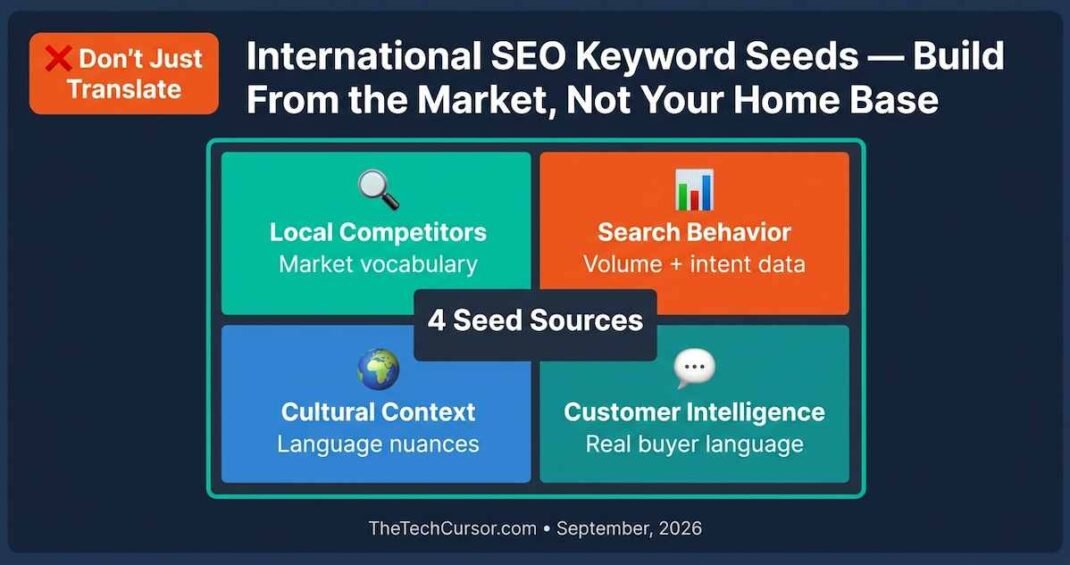
The four most reliable sources for international seed keywords are:
- Local competitor analysis — what vocabulary do established local players use?
- Market-specific search behaviour research — what does data show about how this market searches?
- Cultural and linguistic context — what language nuances shape category vocabulary?
- Customer and sales team intelligence — what words do real buyers in this market use?
Each source captures a different dimension of market search behaviour. Together, they produce a seed set that reflects genuine local search patterns rather than translated assumptions.
3. Source 1: Local Competitor Analysis
Local competitors — brands that have been operating in the target market for years — have already done significant research into how that market searches. Their website copy, navigation structure, page titles, and meta descriptions reflect vocabulary choices informed by real market experience.
How to extract seeds from local competitors:
Start by identifying the market leaders in your category in the target country — not the international players who may be replicating their global strategy, but the locally-established brands whose entire business exists in that market.
Crawl their sites with a tool like Screaming Frog and extract their title tags, heading structures, and navigation labels. These are the vocabulary decisions that experienced local SEOs and marketing teams have made based on genuine market knowledge.
Pay particular attention to:
- How they name the product category itself
- What attributes and benefits they emphasize in their copy
- How they structure their navigation — what topics they separate and what they combine
- What terms appear repeatedly across multiple pages
These patterns reveal the vocabulary the market has already accepted as the standard way to describe your category. Building your seeds from this vocabulary gives you a foundation that reflects genuine market behaviour rather than translation assumptions.
Important caveat: Local competitor vocabulary reflects how the market currently searches — not necessarily how it will search as it evolves or as you introduce new positioning. Use competitor vocabulary as a foundation, not as the ceiling of your keyword ambition.
4. Source 2: Market-Specific Search Behaviour Research
Keyword research tools provide data on actual search volumes and patterns in specific markets. However, using these tools effectively for international seed selection requires a different approach than domestic keyword research.
Start with broad category terms, not specific seeds
In domestic SEO, you often start keyword research with seeds you already know and expand outward. In international SEO, start with the broadest possible category terms and let the tool’s related keyword suggestions reveal the vocabulary the market actually uses.
If you are entering the German market for project management software, do not start with translated versions of your English seeds. Start with the broadest German term for project management — “Projektmanagement” — and examine what the tool surfaces as related terms. The related terms reveal how German searchers actually break down the category.
Use autocomplete as a research tool
Google’s autocomplete function in the target country’s version of Google reflects actual search patterns with no translation bias. Search for your broadest category term in the target language and document what autocomplete suggests. Repeat for multiple starting points. The suggestions are drawn from real search behaviour in that market.
Examine “People Also Search For” in local SERPs
Running searches directly in the target country’s Google — either through a VPN or through Google’s country-specific domains — reveals the “People Also Search For” suggestions that reflect genuinely local search patterns. These are particularly valuable for understanding how the market connects related concepts.
5. Source 3: Cultural and Linguistic Context
Language differences between markets go beyond vocabulary — they extend to formality levels, regional variations, and culturally-specific framings of problems and solutions.
Formality levels affect search vocabulary
Some markets search more formally than others. German searches tend toward more formal, complete phrases. English searches are often more casual and abbreviated. Spanish varies significantly between Latin American markets and Spain. These formality differences affect which seed keywords will match actual search behaviour.
Regional vocabulary differences within languages
Spanish spoken in Mexico, Argentina, Colombia, and Spain uses meaningfully different vocabulary for the same products and categories. Portuguese in Brazil and Portugal differs in both vocabulary and spelling. French in France, Belgium, Canada, and Switzerland has regional variations. Building seeds based on one variant of a language and deploying them across all markets that share that language is a documented failure pattern in international SEO.
Category framing differences
Some categories are framed differently across cultures in ways that affect search vocabulary. A product category that is described primarily by its function in one market may be described by its context of use in another — “work from home tools” versus “remote collaboration software” reflects different framing of essentially the same category.
Understanding these cultural framing differences requires genuine market knowledge — ideally from native speakers with professional experience in the target market, not from translation tools.
6. Source 4: Customer and Sales Team Intelligence
The most underutilized source of international seed keywords is direct intelligence from people who interact with customers in the target market.
If your company has sales representatives, customer support teams, or distribution partners operating in the target market, they have first-hand knowledge of the language real buyers use. The questions buyers ask, the objections they raise, the vocabulary they use to describe their problems — all of this is seed keyword material that no tool can generate.
How to extract seed keywords from sales and support teams:
Ask sales representatives in the target market to document the exact phrases customers use when describing what they are looking for. Not summaries or paraphrases — exact phrases. The specific words customers use in their native language are often the most effective seeds because they reflect genuine demand expressed in natural vocabulary.
Ask customer support teams what questions they receive most frequently — and what language customers use to ask them. Support questions represent genuine problems buyers are trying to solve, expressed in the words they naturally use.
Ask distribution partners and resellers how their customers describe your product category. Resellers who have been operating in the market for years have accumulated significant informal knowledge about local vocabulary and search behaviour.
This intelligence is imprecise compared to keyword tool data — but it captures something tools cannot: the authentic language of real buyers in the target market.
7. Common Mistakes in International Seed Selection
Understanding what to do is more effective when paired with understanding what to avoid. These are the most common seed selection mistakes in international SEO campaigns.
Mistake 1: Direct translation without market validation: Translating your home market seeds without validating that those translated terms reflect actual search behaviour in the target market. Always validate translated seeds against actual search volume data in the target market before building a keyword strategy around them.
Mistake 2: Using global English seeds in non-English markets: Assuming that English search terms will capture international search demand — even in markets with high English proficiency. Most users search in their native language, even when they are comfortable reading English content.
Mistake 3: Ignoring branded terms as category proxies: In some markets, a dominant brand name has become the de facto category term — the way “Googling” became a synonym for web search. Missing these brand-as-category seeds means missing significant search volume that no generic category term will capture.
Mistake 4: Single-source seed development: Building seeds from only one source — typically keyword tool data — and missing the cultural and linguistic nuances that only competitor analysis, native speaker input, and customer intelligence can reveal.
Mistake 5: Treating all markets within a language as identical: Building one seed set for “Spanish” or “Portuguese” markets and deploying it across all countries that share those languages — ignoring the significant vocabulary and intent differences between regional variants.
8. How to Validate Seeds Before Building Full Keyword Sets
Before investing in full keyword expansion from your seeds, validate that the seeds reflect genuine search demand in the target market.
Validation step 1: Search volume confirmation: Check each seed in a keyword research tool filtered to the specific target market. Seeds with zero or negligible search volume in the target market — even if they are logically correct translations — are poor foundations for a keyword strategy.
Validation step 2: SERP analysis: Search each seed in the target market’s Google and examine what appears. The content that ranks for your seeds tells you what Google understands the searcher’s intent to be. If the results are not aligned with what you are trying to rank for, either the seed reflects different intent than you assumed, or the market uses the term differently than you expected.
Validation step 3: Native speaker review: Have a native speaker from the target market — ideally someone with professional experience in your industry — review your validated seed list and flag any terms that sound unnatural, overly formal, or inconsistent with how the market actually speaks about the category. This review catches the cultural and linguistic nuances that data alone cannot identify.
Validation step 4: Small content test: Before committing to a full international content strategy built on your seeds, publish a small set of pages targeting your highest-priority validated seeds and measure their performance against Google’s content quality standards.
9. Seed Keywords and AI Search in International Markets
International seed selection has taken on additional importance as AI search systems expand globally — because the same vocabulary choices that determine traditional search visibility also determine how AI systems understand and represent your brand in international markets.
As covered in the international SEO E-E-A-T article on this site, AI systems face a specific challenge in international markets: they often have less training data about non-English markets, making their understanding of those markets less precise and their entity understanding of brands in those markets less reliable.
Building content around accurate, market-validated seeds helps AI systems understand what your brand is about in each market. International SEO and machine-recognizable E-E-A-T signals matter here — AI systems in non-English markets often have less training data, making accurate local vocabulary even more important for entity understanding. Seeds that reflect genuine local search vocabulary produce content that is more likely to be cited accurately by AI systems operating in that market.
Furthermore, query fan-out in AI search — the process by which AI systems expand a single query into multiple sub-queries — follows the vocabulary patterns of the local market. AI systems in German-language markets fan out queries using German vocabulary and German search patterns. Seeds built from genuine local vocabulary are better aligned with this fan-out process than seeds built from translated assumptions.
10. Building Your International Seed Keyword Framework
Bringing the four sources together into a systematic process produces a seed keyword framework that can be replicated across multiple international markets.
Phase 1: Market reconnaissance (1-2 weeks per market)
- Identify top 5-10 local competitors and extract their vocabulary
- Run broad category searches in local Google and document autocomplete suggestions
- Identify any brand-as-category terms in the market
- Brief local sales/support teams or market partners on seed intelligence collection
Phase 2: Seed candidate development (3-5 days per market)
- Compile all vocabulary from Phase 1 sources into a single candidate list
- Remove duplicates and near-duplicates
- Group candidates by category, intent, and topic cluster — organizing seeds this way makes full keyword expansion more systematic.
- Flag terms that require native speaker review for cultural/linguistic validation
Phase 3: Validation (3-5 days per market)
- Check search volume for all candidates in target market
- Remove zero-volume candidates unless they have strong qualitative support
- Run SERP analysis for priority candidates
- Conduct native speaker review of validated list
- Produce final prioritized seed list organized by topic cluster
Phase 4: Expansion
- Use validated seeds as inputs for full keyword expansion in target market
- Build content briefs around seed clusters — each cluster becomes a topic pillar in the target market’s content strategy.
- Track performance against seeds as baseline metrics — and report results in business terms, not just rankings and traffic.
This framework takes longer than translating existing seeds — but produces a foundation that reflects genuine market behaviour, reduces the risk of building a content strategy on faulty assumptions, and gives you a replicable process that improves with each new market you enter.
11. Bottom Line
International keyword seed selection is one of the highest-leverage decisions in any international SEO campaign — and one of the most commonly done wrong.
The instinct to translate existing seeds is understandable. It is fast, it feels logical, and it produces a starting point immediately. However, it builds an international SEO strategy on assumptions rather than evidence — and those assumptions are often wrong in ways that take months to identify.
The four-source approach — local competitor analysis, market-specific search behaviour research, cultural and linguistic context, and customer intelligence — takes more time upfront. However, it produces seeds that reflect genuine local search behaviour, supports more accurate AI entity understanding in the target market, and gives your international SEO campaign a foundation that is far more likely to produce results worth the investment.
Start with the market. Build the seeds from what the market shows you. Then expand.
Pingback: Why Track AI Prompts in Every Language You Operate In - The Tech Cursor