
Read time: 7 min
Table of Contents
- The English-Only Prompt Tracking Blind Spot
- Why AI Models Respond Differently Across Languages
- The Language Training Data Gap
- What Multilingual Prompt Tracking Reveals
- How to Set Up a Multilingual Prompt Tracking System
- Which AI Platforms to Track in Which Languages
- What to Do With the Gaps You Find
- The Localization Trap — Why Translation Alone Does Not Fix It
- Multilingual Prompt Tracking Cadence
- Bottom Line
Most brands tracking AI prompt visibility are tracking it in English. That is a significant blind spot for any brand operating in multiple markets.
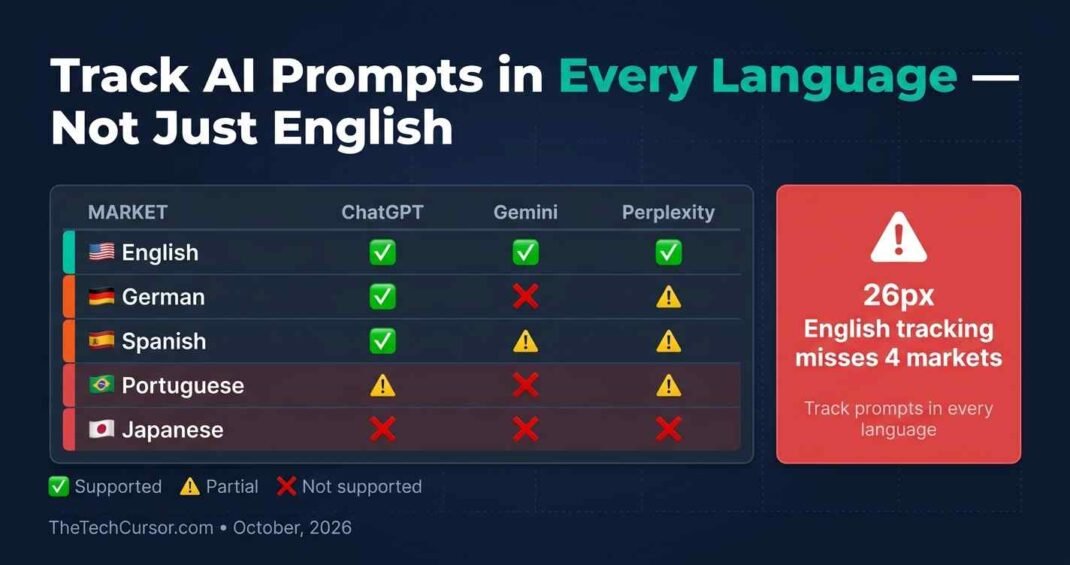
AI systems do not behave the same way across languages. A brand that appears confidently in English-language AI responses may be absent, inaccurate, or poorly represented in German, French, Spanish, Japanese, or any other language in which the brand operates. Furthermore, the English-language tracking results give no indication of this gap — because the systems produce different outputs for different languages.
Multilingual AI prompt tracking is not optional for international brands in 2026. It is the only way to understand what AI search is actually saying about your brand in each of your markets.
1. The English-Only Prompt Tracking Blind Spot
Prompt tracking — submitting test queries to AI systems and recording how your brand appears in responses — is now a standard part of sophisticated GEO programs. The AI visibility dashboard guide covers how to set up prompt tracking systematically.
However, most implementations track prompts only in English. This creates a specific blind spot. The English-language results appear complete and reliable because they are drawn from a rich pool of English-language training data and real-time retrieval. Consequently, they create the impression that AI search visibility is strong across all markets.
The impression is false. English-language prompt results tell you what AI systems say about your brand when English-speaking users ask questions. They tell you nothing about what those systems say when German-speaking, French-speaking, or Japanese-speaking users ask the same questions.
For a brand operating in Germany, France, and Japan, that is three-quarters of its AI search performance that English-only tracking cannot see.
2. Why AI Models Respond Differently Across Languages
The reason AI models respond differently across languages is not simply that they translate queries before answering. They are trained on language-specific data, and they retrieve from language-specific sources.
When a user submits a query in German, a model like ChatGPT or Gemini does not internally translate that query to English, process it, and translate the answer back. Instead, it draws on German-language training data and German-language web retrieval to generate a German-language response. The sources it finds, the entities it recognizes, and the associations it draws are all shaped by the German-language information environment.
That German-language information environment is qualitatively different from the English-language one. Different publications are authoritative. Different brands are prominent. Different terminology is standard. Different regulatory and cultural contexts shape which answers are correct.
Consequently, a brand that has invested heavily in English-language content, English-language PR, and English-language citations has built strong signals specifically in the English-language information environment. Its signals in German, French, or Japanese may be minimal — leading to weak, absent, or inaccurate AI responses in those languages.
3. The Language Training Data Gap
AI language models are trained on significantly more English-language data than data in any other language. English dominates the web, dominates published academic and professional content, and dominates the sources AI companies have been able to license and process.
The practical consequence is that AI models have stronger, more confident entity understanding for brands and topics that are well-documented in English. For the same brands and topics in other languages, the model’s understanding is often thinner, more uncertain, and more vulnerable to conflicting signals.
This training data gap means several things for international brands.
First, a brand that is well-established in English-language AI responses may appear unreliable or absent in other languages — not because the brand is less credible, but because the AI system has less data to draw on.
Second, errors and outdated information are more likely to persist in lower-data languages. An inaccurate description of your brand that has been corrected in English-language sources may still appear in German-language AI responses because the German-language correction has not yet been incorporated into the model’s understanding.
Third, competitors with strong local-language presence may appear more prominently than your brand in local-language AI responses — even if your brand is significantly more prominent globally. Local-language signals carry more weight in local-language AI responses than global English-language authority.
4. What Multilingual Prompt Tracking Reveals
Running the same prompt set across multiple languages reveals four types of information that English-only tracking cannot provide.
Presence gaps: Queries where your brand appears in English-language responses but is absent from responses in another language. These gaps indicate that local-language signals are insufficient for the AI system to confidently associate your brand with the topic.
Accuracy gaps: Queries where your brand appears in both English and local-language responses but the local-language response contains inaccurate or outdated information. This is often the result of the AI drawing on older or lower-quality local-language sources that have not been updated.
Positioning gaps: Queries where your brand appears in responses across languages but occupies different positions. In English, your brand may be the first recommendation. In French, it may appear third or fourth — indicating that local-language competitors have stronger signals for those specific queries in that language.
Terminology gaps: Queries where the terminology used in local-language responses differs from the terminology your brand uses in its local-language content. This signals a disconnect between your brand’s vocabulary and the vocabulary that AI systems associate with your category in that market.
5. How to Set Up a Multilingual Prompt Tracking System
Setting up multilingual prompt tracking requires extending your existing English prompt set into each target language — with important modifications for each market.
Step 1: Translate your core prompt set. Start with your existing English prompt set. Translate each prompt into each target language. However, do not rely solely on direct translation. Have a native speaker review the translated prompts and adjust the terminology to reflect how buyers in that market actually phrase those questions.
Furthermore, add market-specific prompts that have no English equivalent. A German buyer asking about GDPR compliance implications, a French buyer asking about local regulatory requirements, or a Japanese buyer asking about local partnership structures — these are prompts that only make sense in their local-language context.
Step 2: Run prompts in local-language AI interfaces. Do not run translated prompts through English-language AI interfaces. Use the local-language versions of each platform — German ChatGPT, French Gemini, Japanese Perplexity. The local-language interfaces use local-language retrieval and local-language model behaviour that produces meaningfully different results from the English-language interface.
Step 3: Record results with language tagging. In your prompt tracking spreadsheet, add a language column. Record the full response for each prompt in each language. Furthermore, note the specific sources cited — these reveal which local-language sources the AI is drawing on for information about your brand.
Step 4: Compare across languages systematically. For each prompt, compare results across languages. Document the presence gaps, accuracy gaps, positioning gaps, and terminology gaps identified in Section 4. These gaps become your action list for local-language GEO work.
6. Which AI Platforms to Track in Which Languages
Not every AI platform has equal market share in every language. Tracking the wrong platforms wastes tracking effort. Tracking the right ones reveals the most commercially relevant gaps.
German market: ChatGPT and Gemini both have meaningful German-market presence. Perplexity has growing adoption among German research users. Track all three. Furthermore, Bing Copilot has stronger market share in Germany than in most other European markets and is worth including.
French market: ChatGPT and Gemini are the primary platforms. Perplexity has significant French adoption given its research-focused positioning. Track both ChatGPT and Gemini as priority platforms, with Perplexity as secondary.
Japanese market: ChatGPT has strong Japanese market penetration. Gemini is growing. However, Yahoo Japan AI features and Line AI are Japan-specific platforms worth monitoring for brands with significant Japanese market presence.
Spanish market: ChatGPT dominates Spanish-language AI search across both Spain and Latin American markets. However, track Spanish-Spain and Spanish-Latin America separately — the regional vocabulary differences identified in the keyword seed selection guide apply equally to prompt tracking.
7. What to Do With the Gaps You Find
Each type of gap identified through multilingual prompt tracking requires a different response.
Presence gaps → Build local-language signals: If your brand is absent from local-language AI responses for queries where it should appear, the primary need is local-language content and citation. Specifically, publish authoritative local-language content on the relevant topics and build local-language citations from authoritative local sources. The GEO pillars framework — particularly the Reach and Relevance pillars — addresses this directly.
Accuracy gaps → Correct the source material: If AI systems are producing inaccurate information about your brand in a specific language, identify which sources the AI is citing and work to correct the inaccuracy at the source. Furthermore, publish accurate, authoritative local-language content that provides the correct information. AI retrieval systems will gradually incorporate the corrected information as they encounter it in updated sources.
Positioning gaps → Strengthen local-language authority: If your brand appears but ranks lower than competitors in local-language responses, the gap is typically in local-language authority signals. Build more local-language citations, increase local-language expert author attribution, and produce more locally specific content that AI systems can confidently retrieve.
Terminology gaps → Align content vocabulary: If AI systems describe your brand or category using terminology your content does not use, update your local-language content to incorporate the terminology AI systems associate with your category in that market. This alignment improves the probability that AI retrieval systems will correctly match your content to relevant queries.
8. The Localization Trap — Why Translation Alone Does Not Fix It
The most common international GEO mistake is treating translation as equivalent to a local-language content strategy. It is not.
Translated content carries the same information as the source content — but it does not carry local-language signals. A translated English article about your brand’s expertise in financial services tells a German reader what your brand does. However, it does not tell German-language AI systems that your brand is authoritative specifically for German financial services queries — because the German-language signals that establish that authority come from German-language sources and German-language publishing activity, not from translated English content.
Furthermore, translation-first content strategies produce content that AI systems can often identify as translated rather than natively produced. The vocabulary choices, sentence structures, and topic framing of professionally translated content often reflect the source language’s norms rather than the target language’s norms. As a result, the content may score lower on the relevance signals AI retrieval uses to identify market-appropriate sources.
The correct approach — building genuine local-language expertise through locally credentialed authors, market-specific content, and local-language citation — is more expensive and slower than translation. However, it produces the local-language signals that actually move prompt tracking results. The global consistency paradox guide covers the architectural approach to building this in parallel with maintaining global brand consistency.
9. Multilingual Prompt Tracking Cadence
Multilingual prompt tracking requires more operational investment than single-language tracking. Consequently, the cadence should be calibrated to the commercial importance of each market.
Priority markets — monthly tracking: Markets that represent significant current or target revenue should be tracked monthly. Monthly tracking reveals trends quickly enough to identify and respond to emerging gaps before they compound.
Secondary markets — quarterly tracking: Markets that are being developed or that represent smaller current revenue can be tracked quarterly. Quarterly tracking is sufficient to identify significant changes in AI visibility without requiring the full operational investment of monthly multilingual tracking.
New markets — baseline plus 90-day tracking: When entering a new market, establish a baseline prompt tracking snapshot immediately. Then track monthly for the first 90 days to understand how quickly local-language signals build and which interventions produce the fastest results.
All markets — immediate tracking when significant content is published: Whenever significant local-language content is published, a local PR campaign lands, or a major local-language citation is earned, run a targeted prompt check for the relevant queries. AI systems can update relatively quickly when significant new local-language signals appear in sources they retrieve. Tracking immediately after a significant content or PR action reveals whether the action is having the expected effect.
10. Bottom Line
Multilingual prompt tracking is the only way to understand what AI search is actually saying about your brand in each of your markets. English-only tracking creates a false picture of AI visibility that misses the gaps — and the opportunities — that only local-language tracking reveals.
The setup requires investment: translating and localizing your prompt set, running prompts across local-language AI interfaces, recording results with language tagging, and developing the local-language GEO capability to address the gaps that tracking reveals.
The Three Starting Points
First: Take your existing English prompt set and translate the 10 most commercially important prompts into each of your top three non-English markets. Run them through local-language AI interfaces this week. The gaps you find will tell you whether multilingual prompt tracking needs to be a priority.
Second: Add a language column to your existing prompt tracking spreadsheet. Even if you only track English today, building the column now makes expanding to additional languages easier when you are ready.
Third: Connect multilingual prompt tracking results to your local-language content and PR plans. The gaps revealed by tracking should directly inform which local-language content is prioritized and which local-language citation relationships are developed.
AI search is a multilingual channel for multilingual businesses. Tracking it in only one language is like measuring half your search performance and calling it complete.