
Read time: 8 min
Table of Contents
- What the Global Consistency Paradox Is
- Why AI Search Makes This Harder
- The E-E-A-T Signals That Travel vs Those That Do Not
- Building Local Expertise Without Diluting Global Authority
- The Author Entity Problem in International Markets
- Local Citation Signals vs Global Brand Signals
- How to Structure Content for Both Global Consistency and Local E-E-A-T
- Schema Strategy for International E-E-A-T
- Measuring E-E-A-T Performance Across Markets
- Bottom Line
International businesses face a specific tension in E-E-A-T optimization that domestic businesses do not. Building genuine, verifiable expertise signals for a local market requires specificity — local author credentials, market-specific case studies, country-relevant citations. However, that specificity can conflict with the consistent global brand signals that AI systems use to build entity understanding across markets.
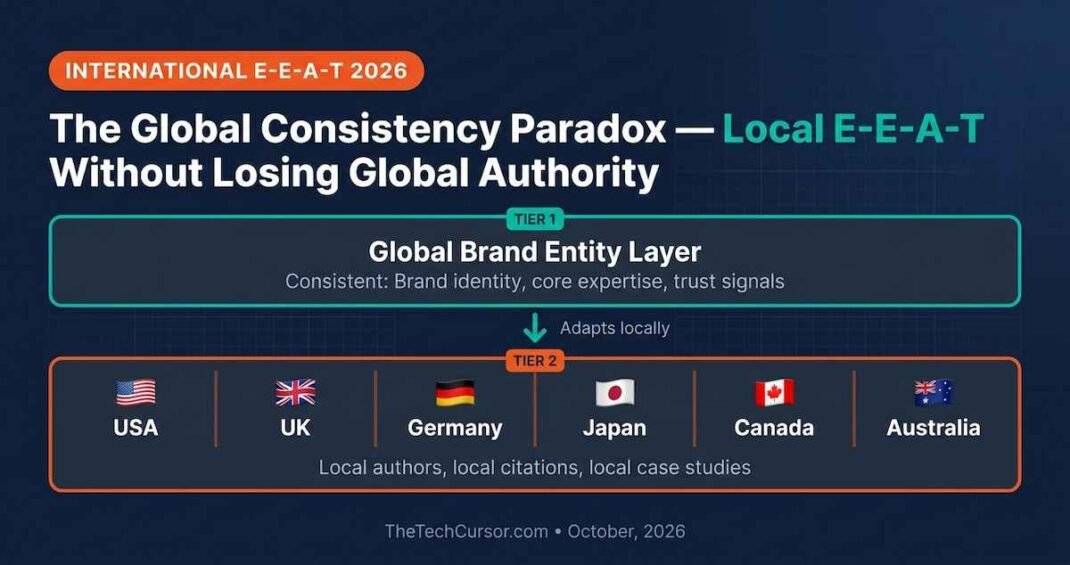
This is the global consistency paradox. The more locally specific your E-E-A-T signals become, the harder it is for AI systems to recognize them as part of the same trusted global entity. The more globally consistent you keep your signals, the weaker your local expertise appears to AI systems evaluating your authority in a specific market.
Resolving this paradox requires understanding which E-E-A-T signals need to be locally specific and which need to be globally consistent — and building your content architecture accordingly.
1. What the Global Consistency Paradox Is
E-E-A-T — Experience, Expertise, Authoritativeness, and Trustworthiness — is Google’s framework for evaluating whether content can be trusted. In domestic SEO, building E-E-A-T is relatively straightforward. You demonstrate expertise in your field, build authority through consistent publishing and third-party recognition, and establish trust through transparent sourcing and verifiable credentials.
In international SEO, that straightforward framework becomes complicated by two competing requirements.
The global requirement: AI systems build brand entity understanding from consistent signals across markets. A brand that describes its expertise differently in different markets, uses different author identities, or maintains inconsistent factual claims creates ambiguous entity signals. AI systems faced with ambiguous signals cite with lower confidence — or avoid citing altogether.
The local requirement: AI systems and Google’s quality evaluators assess expertise and authority in market-specific context. A global brand claiming expertise in German tax law needs to demonstrate that expertise specifically — through German-market credentials, local case studies, German-language citations, and authors with verifiable expertise in German regulations. Generic global credentials do not satisfy local E-E-A-T requirements.
The paradox is that satisfying both requirements simultaneously requires careful architectural decisions about which signals to centralize and which to localize.
2. Why AI Search Makes This Harder
Traditional search evaluated E-E-A-T signals at the page level. A well-optimized local page with strong local signals could rank in a specific market even if the global brand signals were weaker.
AI search evaluates brands holistically across all available information. When an AI system encounters a query about a brand in a specific market, it draws on everything it knows about that brand — including signals from other markets, training data from multiple sources, and real-time retrieval across the brand’s global web presence.
This holistic evaluation means that inconsistencies between markets are more visible to AI systems than they were to traditional ranking algorithms. A brand that claims one set of credentials in the US and a different set in Germany creates a signal conflict that AI systems detect and factor into their confidence when citing the brand.
Furthermore, AI systems have significantly less training data about non-English markets than about English-language markets. Consequently, the entity understanding they build for brands in those markets is often thinner and more vulnerable to conflicting signals. A small inconsistency in a high-data market like the US may be absorbed without much impact. The same inconsistency in a lower-data market like Poland or Thailand can meaningfully damage AI citation confidence.
3. The E-E-A-T Signals That Travel vs Those That Do Not
Resolving the paradox begins with identifying which E-E-A-T signals are inherently global and which must be built locally.
Signals that travel globally: Brand-level trustworthiness signals — company registration, business verification, consistent contact information, transparent ownership — are global. They should be consistent across all markets. An inconsistency in basic brand facts creates trust problems regardless of market.
Core brand expertise positioning — the broad description of what the brand is expert in, at the category level — should be consistent globally. A brand that claims to be an expert in enterprise HR software should make that claim consistently across all markets. The specific evidence supporting that claim can and should be locally specific.
Signals that must be built locally: Author-level expertise is almost always market-specific. A UK-based employment law expert has credentials that are specific to UK employment law. Those credentials do not transfer to German employment law or French employment law. Each market requires authors with locally verifiable credentials.
Case studies and proven results are local. A case study from a US client demonstrates value to US prospects. A German business evaluating the same brand needs German-market case studies — or at minimum, case studies from comparable European contexts.
Third-party validation is local. A citation in Forbes demonstrates authority in English-language media. A citation in Handelsblatt demonstrates authority in German-language business media. Both are valuable, but neither substitutes for the other when AI systems are evaluating market-specific authority.
4. Building Local Expertise Without Diluting Global Authority
The architectural solution to the paradox is a two-tier content and entity structure.
Tier 1: Global brand entity layer: A consistent global layer that establishes the brand’s core identity, expertise category, and trustworthiness signals across all markets. This layer includes the main brand entity page, consistent schema markup, centralized author bios that reflect global credentials, and brand-level third-party mentions across major global media.
This layer should never be localized in ways that create factual inconsistencies. The brand name, founding date, global headquarters, core expertise description, and key leadership should be identical across all market properties.
Tier 2: Local expertise layer: A market-specific layer built on top of the global entity foundation. This layer demonstrates locally verifiable expertise through market-specific authors with local credentials, local case studies, local third-party validation, and content that addresses market-specific regulatory, cultural, or professional requirements.
The critical technical connection between the two tiers is explicit entity linking. Local market pages should carry structured data that explicitly connects them to the global brand entity. Authors on local market pages should carry schema markup that identifies them as employees or contributors to the global brand while also establishing their local credentials.
Furthermore, the GEO pillars framework applies here — specifically the Credibility pillar. Credibility in international markets requires both the global brand trust signals and the locally verifiable expertise signals to be present and explicitly connected.
5. The Author Entity Problem in International Markets
Author entities are the most common failure point in international E-E-A-T strategy. The problem takes several forms.
Using the same global authors for all markets: A US-based author with US credentials writing about German tax regulations has no verifiable local expertise in that market. AI systems evaluating the content may recognize the author’s global credentials but cannot verify their authority specifically for the German-market topic. Consequently, the content carries weaker E-E-A-T signals than equivalent content from a locally credentialed German author.
Creating anonymous local content: Some international businesses solve the local author problem by removing author attribution from localized content entirely. This avoids the expertise mismatch problem but eliminates one of the strongest E-E-A-T signals available — named human authorship with verifiable credentials.
Using translated bylines without local presence: A brand might translate a US author’s name and bio into German and use it on German-market content. This creates a false impression of local presence that AI systems can potentially detect through cross-referencing against local professional directories, LinkedIn, and other entity sources. The credibility risk of this approach outweighs its short-term convenience.
The correct solution is to invest in genuine local author relationships. This means identifying local practitioners with verifiable credentials in each target market, establishing them as contributors with real author profiles that can be cross-referenced against local professional sources, and attributing market-specific content to them.
This is a real investment — finding, vetting, and maintaining relationships with credentialed local authors in multiple markets is operationally demanding. However, the alternative is content with weaker E-E-A-T signals in every market outside the brand’s home territory.
6. Local Citation Signals vs Global Brand Signals
Third-party citation is one of the most powerful E-E-A-T signals available — and one of the most mismanaged in international SEO.
Many international brands build their link and citation strategy primarily in their home market and assume that global authority will transfer to local markets. This assumption is increasingly unreliable in AI search, where local citation patterns are evaluated alongside global ones.
What local citations do that global ones cannot: A citation in a local German business publication sends a specific signal to AI systems: this brand has been evaluated by sources that are authoritative specifically for German-market topics and found worthy of mention. That signal is qualitatively different from a citation in a global publication that covers Germany tangentially.
Local citations also establish local entity associations. When German-language sources consistently mention a brand in the context of specific German-market topics, AI systems build stronger associations between that brand and those topics in the German-language knowledge graph.
Building local citation without losing global consistency: The key principle is that local citations should be additive, not substitutive. They add market-specific authority signals on top of global brand signals — they do not replace them.
Building local citations effectively requires market-specific PR and content relationships — exactly the approach described in the Invisible PR guide. The same principles that apply to building AI visibility for a domestic brand apply to building it in each international market. Expert quotes in local publications, local podcast appearances, and contributions to local industry forums all build the market-specific entity associations that support local E-E-A-T.
7. How to Structure Content for Both Global Consistency and Local E-E-A-T
Content architecture for international E-E-A-T requires making deliberate decisions about what lives at the global level and what lives at the local level.
Global content: brand-level expertise claims: Content that establishes the brand’s core expertise positioning should be developed centrally and adapted for local markets — not recreated from scratch. Global case studies, global research reports, and global thought leadership content establish the brand’s authority foundation. Local markets can reference and link to this content while adding market-specific context.
Local content: market-specific expertise evidence: Content that demonstrates expertise in locally specific topics must be genuinely local. Regulatory guides for local markets, market-specific case studies, local industry analysis, and locally authored expert commentary all need to come from genuine local expertise — not from translated global content with local framing added.
The dangerous middle ground: translated global content: Translated global content with minimal local adaptation is the most common E-E-A-T mistake in international SEO. It appears to satisfy local content requirements while actually contributing weak local E-E-A-T signals. AI systems that recognize translated content as structurally identical to the source material may treat it as thin or low-differentiation despite the language change.
The keyword seed selection for international SEO guide covers how to build content strategies from genuine local search behaviour rather than from translated domestic strategies. That same principle applies to E-E-A-T — build from genuine local expertise, not from translated global positions.
8. Schema Strategy for International E-E-A-T
Structured data is the most reliable mechanism for making E-E-A-T signals machine-readable across international properties — and for explicitly connecting local entity signals to the global brand entity.
Organization schema with explicit market connections: Each local market property should carry Organization schema that explicitly names the parent brand entity. The parentOrganization property creates a machine-readable link between the local market entity and the global brand entity. This helps AI systems recognize local market content as part of the trusted global brand rather than as a standalone unknown entity.
Person schema for local authors: Every local market author should carry Person schema that includes their name, credentials, employing organization, and relevant professional memberships or certifications. The worksFor property should connect the local author to the same Organization entity used in the global brand schema.
Article schema with author and expertise signals: Every market-specific article should carry Article schema that attributes authorship to the locally credentialed author, specifies the article’s topic focus, and connects to the Organization entity.
Review schema for local market validation: Where local market reviews and case studies are available, Review and ItemReview schema make those validation signals machine-readable. This is particularly valuable in markets where AI systems have less training data and therefore rely more heavily on structured data signals to establish entity associations.
9. Measuring E-E-A-T Performance Across Markets
Measuring E-E-A-T performance in international markets requires combining traditional search performance data with AI visibility signals specific to each market.
Traditional signals by market: Track organic rankings, impressions, and clicks separately for each target market using Google Search Console filtered by country. Significant differences in performance across markets with similar content indicate that E-E-A-T signals may be stronger in some markets than others.
AI citation share by market: Run prompt tracking in each target language — not just in English. An AI system responding to a German-language query draws on different signals than the same system responding to an English query about the same topic. Consequently, your brand may have strong AI citation rates in English queries while being largely absent from German-language AI responses.
Third-party mention velocity by market: Track brand mention volume in local-language sources separately from global English-language sources. A brand building local E-E-A-T should show growing mention velocity in local-language publications over time. Flat or declining local mention velocity in a target market signals that local authority building is not producing the expected results.
Author entity strength by market: Check whether your local market authors appear as recognized entities in the target market’s knowledge graph. Searching for author names in local-language Google, checking LinkedIn presence, and verifying professional directory listings all provide indicators of author entity strength in the local market.
10. Bottom Line
The global consistency paradox is real — and it is becoming more consequential as AI search evaluates brands holistically across all available market signals.
The resolution is not to choose between global consistency and local specificity. It is to build a two-tier architecture that maintains consistent global brand entity signals at the foundation while building genuine, locally verifiable E-E-A-T signals in each target market.
The Four Principles for Resolving the Paradox
First: Keep global brand entity signals — brand identity, core expertise positioning, trustworthiness foundations — absolutely consistent across all markets. Inconsistencies in these signals damage global entity confidence.
Second: Build local E-E-A-T through genuine local expertise — locally credentialed authors, market-specific case studies, and local third-party validation. Do not substitute translated global content for genuine local expertise.
Third: Connect local signals to the global entity explicitly through schema markup. The parentOrganization and worksFor properties are your technical tools for making this connection machine-readable.
Fourth: Measure E-E-A-T performance in each market separately — in local languages, through local-language AI citation tracking, and through local-language brand mention monitoring. English-language metrics do not accurately reflect performance in non-English markets.
The global consistency paradox is a challenge that rewards the brands that invest in genuine local expertise rather than those that rely on translated global positioning. In AI search, that distinction will become more consequential over time — not less.