
SEO Content Roadmap for the AI Search Era: A 7-Step Guide
Read time: 9 min
Table of Contents
- Why the Old Roadmap Process No Longer Works
- Step 1: Start From the Business Objective
- Step 2: Build the Keyword Universe and Run a Content Gap Analysis
- Step 3: Read the SERP, Not Just the Keyword
- Step 4: Cluster and Group
- Step 5: Prioritize — Difficulty, Potential, Intent, and AI Overview Reality
- Step 6: Brief and Write for AI Visibility
- Step 7: Measure, Learn, and Iterate
- The Good, Fast, and Cheap Framework for AI Content
- How to Start Without Rebuilding Everything at Once
- Bottom Line
AI tools make it easy to produce more content faster. The “good, fast, cheap” project management triangle suggests you can only have two of the three. In AI-generated content, the same tension applies — and most teams are unconsciously sacrificing “good” to gain speed and cost efficiency.
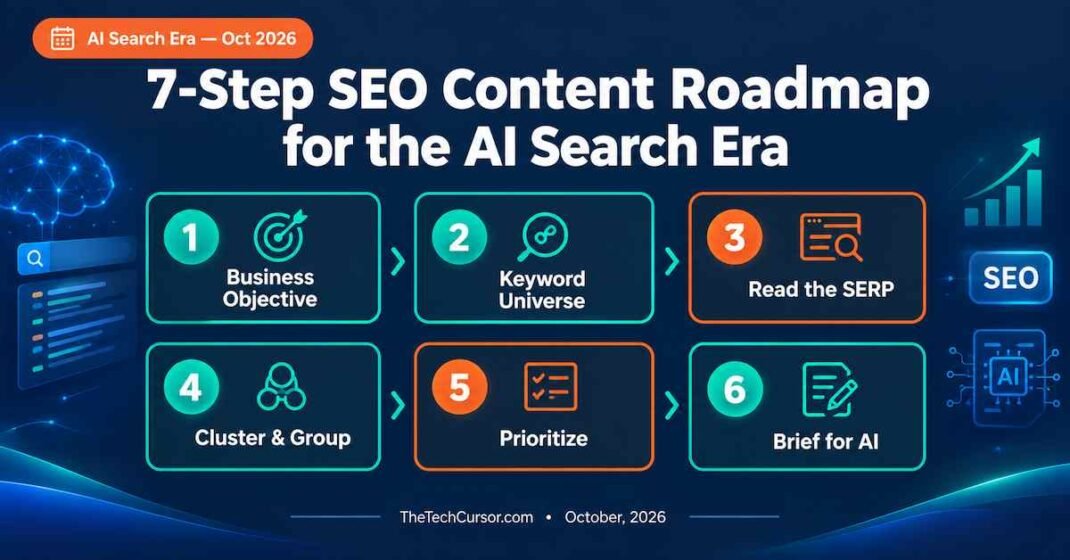
The result is content that gains impressions but loses clicks to AI Overviews, ranks for terms with no conversion value, or earns visibility the business cannot connect to revenue. A disciplined content roadmap prevents this. Here is the six-step process that builds one correctly for the AI search era.
1. Why the Old Roadmap Process No Longer Works
Traditional SEO content roadmaps were built around one question: which keywords can this site rank for? Volume and keyword difficulty were the primary inputs. The output was a list of pages to build, ordered roughly by difficulty and traffic potential.
That approach has two problems in 2026.
First, AI Overviews have fundamentally changed what a ranking is worth. Research found that the top-ranking page loses roughly 58% of its clicks when an AI Overview is present. A keyword that looks attractive on volume and difficulty metrics may deliver a fraction of the traffic it once did — because the AI Overview is absorbing the click before it reaches any organic result.
Second, the old approach did not build from business outcomes. It built from visibility metrics and assumed traffic would translate to revenue. That assumption was always optimistic. In an AI search environment where many clicks are absorbed by AI-generated answers, it has become untenable. Consequently, the roadmap must start from revenue and work backwards to content — not start from rankings and hope they lead to revenue.
2. Step 1: Start From the Business Objective
Before opening any keyword research tool, the roadmap needs a clear definition of what success looks like — expressed in business terms, not SEO metrics.
Every potential keyword, topic, or concept in the roadmap must map to a business outcome. That outcome is typically a conversion to a lead, an e-commerce transaction, or another trackable metric that connects to revenue. Visibility and traffic alone are not sufficient goals for most organizations.
Consider a third-party logistics provider that operates on relationship-based sales. The business needs leads from companies with complex shipping requirements — not transactional customers seeking the lowest cost. For that business, the content roadmap succeeds only when it produces website lead form conversions that the sales team can close. Rankings and impressions that do not generate qualified inquiries are not contributing to the business objective.
If defining the ultimate goal and its measurement is difficult, the content program is at risk of generating activity without return. Stakeholders may see rankings and impressions in reports while the business fails to generate revenue from organic search.
Furthermore, getting this definition right in Step 1 makes every subsequent step more precise. Intent filtering in Step 2, SERP evaluation in Step 3, and prioritization in Step 5 all require knowing what a conversion looks like for this specific business.
3. Step 2: Build the Keyword Universe and Run a Content Gap Analysis
With the business objective defined, the keyword universe becomes the foundation for everything that follows. A content gap analysis reveals which keywords competitors rank for that the target site does not — surfacing the opportunity space before filtering begins.
The content gap analysis process compares the target domain against two to four competitors in a keyword research tool. The output shows keywords where competitors rank in the top positions while the target site does not appear.
Two important judgment calls belong here.
Competitor selection requires deliberate thought. Search competitors — sites that appear in the same SERPs — are often different from business competitors that sales teams discuss internally. The companies that compete directly for keyword visibility may not be direct commercial competitors at all. Both lists are useful, but the content gap analysis requires the search competitor list specifically.
The raw output is not a to-do list. A typical content gap export contains branded terms, irrelevant queries, and off-intent keywords that have no bearing on the business objective from Step 1. Human judgment is required to filter this to terms that actually matter.
In the logistics example, the term “3PL” sits at high difficulty and 29,000 monthly searches. That looks attractive until you examine intent. It is broad, largely informational, and difficult. Meanwhile, “3PL fulfilment” and “3PL companies” are lower difficulty with more defined B2B intent. A well-built keyword universe begins with the terms that balance difficulty, intent, and proximity to the business objective — not simply the highest-volume terms available.
4. Step 3: Read the SERP, Not Just the Keyword
Volume and keyword difficulty tell you whether you can rank. They do not tell you what that ranking is worth. In 2026, the same organic position can deliver dramatically different traffic depending on what AI features appear above it.
This step requires looking at the actual SERP for each priority keyword — not just its metrics. Specifically, it means identifying which terms trigger AI Overviews, whether the target site already appears in AI Overview citations for any terms, and what the full feature set of each SERP looks like.
The presence of an AI Overview is not automatically a reason to skip a term. It is a reason to make a deliberate decision. For informational, top-of-funnel terms where an AI Overview dominates, the strategic question is whether to optimize for citation in the AI Overview rather than for organic click-through. For transactional terms where the AI Overview provides limited direct answers, organic positioning remains highly valuable.
In the logistics example, AI Overviews appeared on nearly every B2B logistics term examined — “3PL companies,” “3PL fulfilment,” “third-party logistics companies.” That reality required a fundamental adjustment to the content plan. Visibility on those terms now means earning citation in the AI Overview. Consequently, content for those terms needs to be written specifically for citation — not for the organic listing format that would have been appropriate a year ago.
This step produces a SERP features column in the working roadmap document. That column carries forward into prioritization in Step 5 and brief writing in Step 6.
5. Step 4: Cluster and Group
A keyword list is not a content plan. Individual keywords only become a plan when they are organized around topics and clusters that match how AI systems evaluate topical authority — and how users actually navigate through a subject.
Clustering organizes keywords by the pages that serve them. Some keywords are best served by a single hub page covering a broad topic. Others require dedicated pages because their intent is sufficiently distinct from related terms.
Keyword tools cluster by ranking overlap — keywords that share the same top-ranking page tend to group together. However, that statistical grouping does not always match business meaning. Human judgment is required to distinguish between a cluster that maps to a real buyer need versus a cluster that is statistically adjacent but not meaningfully related.
The working document structure at this stage has three levels: Cluster, Group, and Keyword. Each cluster maps to a specific destination on the website — a hub page, service page, or article. This mapping ensures that the roadmap produces pages with a clear home on the site and a clear relationship to other pages in the cluster.
In the logistics example, the same seed term generated two distinct clusters with different buyer intent. Core 3PL service terms clustered together around a hub page. Amazon FBA preparation terms formed a separate cluster because the buyer intent was substantially different — more specific, more transactional, closer to a purchase decision. Even though a keyword tool might group these together, they deserve separate pages because they address fundamentally different buyer needs. The topic clusters for SEO and AI search guide covers this distinction in detail.
6. Step 5: Prioritize — Difficulty, Potential, Intent, and AI Overview Reality
With clusters built and SERP data collected, the prioritization step brings four dimensions together into a sequenced roadmap.
Difficulty — can the site realistically compete for this term in a reasonable timeframe?
Potential — given AI Overview presence and typical click-through patterns, what is the realistic traffic potential from ranking well?
Intent — how close does this term sit to the conversion event defined in Step 1?
AI Overview reality — does winning this term mean earning organic clicks, earning citation in an AI Overview, or both?
No tool produces a final score for this combination. The human judgment layer is the most important part of this step. A high-volume, low-difficulty term that triggers an AI Overview and carries informational intent may be less valuable than a lower-volume, moderate-difficulty term that is close to a purchase decision.
The roadmap output from this step is a tiered structure. Foundation terms — winnable, high-intent, and close to the conversion event — go first. Terms requiring more authority to compete, or with more informational intent, follow behind.
Furthermore, terms where the primary value is AI Overview citation rather than organic click-through need to be flagged explicitly. This flag carries into Step 6, because content written for AI Overview citation is structured differently from content written to earn organic clicks.
7. Step 6: Brief and Write for AI Visibility
The roadmap becomes valuable only when it produces content. Step 6 turns each prioritized cluster into a content brief that accounts for both traditional organic ranking and AI Overview citation.
Each brief includes the primary keyword, supporting cluster terms, intent stage, SERP features note from Step 3, target page destination, and the angle or approach the content will take.
Writing for AI citation requires a specific structural approach. Each section should lead with a direct two- to three-sentence answer to the question the section addresses. The supporting detail follows. Headings should mirror how people actually ask questions — not generic topic labels. Answers should be concise enough to be extracted and cited, while supported by specific detail that demonstrates genuine expertise.
Furthermore, the technical layer matters. Schema markup on the target page, internal links from cluster supporting pieces to the hub, and consistent entity signals across all cluster pages all support AI Overview citation probability. The AI visibility dashboard covers how to track whether this work is translating into actual citations.
The elements that genuinely differentiate content in AI search cannot be faked by AI tools operating without human input. Real examples, genuine expertise, concrete data, and specific named entities are the signals AI systems use to distinguish authoritative content from generic content. The brief should specify what first-party knowledge or data needs to be incorporated — and that information should come from real sources before the first draft is written.
7. Step 7: Measure, Learn, and Iterate
A roadmap that produces content without measuring what happens next is half a process. Step 7 closes the loop — connecting the content investment back to the business objective defined in Step 1 and using what the data shows to improve every subsequent roadmap cycle.
Measurement in the AI search era requires tracking two parallel sets of signals. Traditional search performance — rankings, clicks, conversions — tells you how content is performing in the organic channel. AI search performance — citation share, AI referral traffic, brand mentions — tells you how content is performing in the AI discovery channel. Neither set alone is sufficient.
Track AI citations, not just rankings
For each cluster in the roadmap, run the primary keyword and top cluster terms through ChatGPT, Gemini, Claude, and Perplexity monthly. Record whether your content is cited, in what position, and with what accuracy. This prompt tracking reveals which clusters have earned AI search visibility and which have not — independent of organic rankings.
Furthermore, set up GA4 AI referral segments to capture sessions arriving from AI platforms directly. The AI visibility dashboard covers exactly how to build this tracking layer. When Gemini UTM parameters are available, those sessions are now attributable with precision — as covered in the Gemini UTM parameters article.
Measure business outcomes per cluster
Trace leads, conversions, and revenue back to the cluster that generated them — not just the individual page. A cluster that produces 200 organic sessions but 12 qualified leads is performing better than a cluster that produces 2,000 sessions and 4 leads. The business objective from Step 1 is the benchmark. Consequently, reporting should lead with those outcome metrics before presenting traffic and ranking data.
Monthly cluster review
Once per month, review each active cluster against three questions. First, is the content earning citations in AI Overviews and AI platform responses? Second, are those citations translating into AI referral sessions in GA4? Third, are those sessions converting at a rate consistent with the cluster’s intent stage?
Clusters that earn citations but have low conversions may have a landing page or conversion path problem. Clusters with strong organic rankings but no AI citations may have a content structure or entity signal gap. Clusters with neither citations nor rankings need a Step 6 brief revision — or a Step 5 reprioritization if the opportunity has changed.
Quarterly roadmap refresh
Every quarter, return to Step 2 and run a fresh content gap analysis. AI Overview presence changes. New competitors enter SERPs. Buyer vocabulary shifts. A roadmap built on September data may no longer reflect October’s SERP reality by January.
The quarterly refresh does not rebuild the entire roadmap. Instead, it updates the SERP features column for existing clusters, adds new clusters that have emerged from the gap analysis, and removes or deprioritizes clusters where the opportunity has diminished.
Furthermore, the refresh incorporates what the measurement data from the previous quarter revealed. Clusters that outperformed expectations get more resource allocation. Clusters that underperformed despite implementation get a root cause review — was it a brief problem, a technical problem, an entity signal gap, or a prioritization error?
The iteration loop
The most important output of Step 7 is not a report. It is an improvement to the next iteration of Steps 1 through 6. Business objectives become more precisely defined. Competitor selection becomes more accurate. SERP reading becomes more calibrated. Clustering decisions become better informed. Prioritization becomes more reliable. Brief quality improves.
Each roadmap cycle that incorporates what the previous cycle measured produces better outcomes than the one before it. That compounding improvement — rooted in measurement discipline rather than instinct — is what separates a roadmap that works once from a content program that builds durable competitive advantage over time.
8. The Good, Fast, and Cheap Framework for AI Content
The project management triangle says you can only have two of three: good, fast, or cheap. AI content production has made fast and cheap dramatically more accessible. The risk is that good gets sacrificed in the process.
This six-step roadmap is specifically designed to protect the “good” requirement while operating within the fast and cheap constraints that AI tools enable. The research and prioritization work is human-led and judgment-dependent. The production work can incorporate AI tools without sacrificing quality — because the brief already specifies what genuine expertise and specific data need to be present.
The roadmap also provides protection against a specific AI-era failure mode: producing content that earns impressions without earning clicks or conversions. AI Overviews can make a content program look productive in reporting — impressions stay high, rankings look stable — while the actual business value declines because clicks and leads are not materializing.
Furthermore, the roadmap connects visibility to revenue from the start. Every page in the roadmap traces back to the business objective defined in Step 1. Consequently, when reporting time comes, the connection between content investment and business outcome is already built into the plan.
9. How to Start Without Rebuilding Everything at Once
The six-step process applies to a full roadmap rebuild — but it also applies to a single cluster. If rebuilding an entire content program at once is not realistic, the right starting point is to pick one cluster, run it through all six steps, and compare its performance to content built without the process.
That comparison — one cluster built with discipline versus adjacent content built without it — produces the learning needed to justify expanding the approach.
Before starting, capture a baseline. Record current SERP feature presence and click-through rates for the terms you are about to target. AI Overview presence and click patterns will continue to change. Having a pre-roadmap baseline allows progress to be measured against a real starting point rather than against impressions data that may not reflect actual business performance.
The SEO reporting for executives guide covers how to present this kind of baseline and progress data in terms that business stakeholders understand. Furthermore, the State of Search 2027 survey data confirms that teams connecting SEO work to revenue outcomes are the ones maintaining or growing their budgets — even as traffic declines.
10. Bottom Line
An SEO content roadmap for the AI search era starts from business outcomes and works backwards to content. It reads SERPs rather than just keyword metrics. It clusters around buyer intent rather than keyword similarity. It prioritizes based on four dimensions simultaneously. It writes for AI citation alongside organic ranking.
The six steps produce a roadmap that can survive the AI Overview era — not because it avoids AI features, but because it accounts for them at every stage of the research and planning process.
The Seven-Step Summary
Step 1: Define the business objective before opening any keyword tool. Step 2: Build the keyword universe through content gap analysis using real search competitors. Step 3: Read each SERP to understand what a ranking is actually worth given AI Overview presence. Step 4: Cluster by buyer intent and business meaning — not statistical keyword overlap alone. Step 5: Prioritize using four dimensions simultaneously — difficulty, potential, intent, and AI Overview reality. Step 6: Brief and write for AI citation — leading with direct answers, supporting with genuine expertise, and adding the technical layer that makes content citable. Step 7: Measure AI citations and business outcomes monthly, review clusters quarterly, and iterate every subsequent roadmap cycle based on what the data shows.
The roadmap does not eliminate the need for human judgment. It structures the points where human judgment matters most — and supports everything else with research tools and data.