
Category: Link Building | SEO | Digital Marketing
Read time: 10 min
Table of Contents
- The Honest State of Link Building Heading Into 2027
- What Has Changed — SpamBrain 3.0 and Near-Real-Time Enforcement
- The 15 Ways to Win at Link Building in 2027
- Win 1: Original Data and Research
- Win 2: Reactive Digital PR — Newsjacking With Substance
- Win 3: Linkable Assets Built for Specific Audiences
- Win 4: Real Relationship-Based Outreach
- Win 5: Brand Mention Recovery
- Win 6: Competitor Broken Link Replacement
- Win 7: Topically Clustered Internal Linking
- Win 8: Expert Commentary and Quotes
- Win 9: Co-Created Content With Complementary Brands
- Win 10: Community and Forum Participation
- Win 11: Product or Tool Reviews by Real Users
- Win 12: Case Studies With Verifiable Outcomes
- Win 13: Podcast and Video Transcripts as Citable Assets
- Win 14: Strategic Resource Page Placements
- Win 15: Digital PR Through Award Submissions
- The 15 Ways to Fail at Link Building in 2027
- Fail 1: Paid Link Insertions on Irrelevant Sites
- Fail 2: Guest Posting at Scale on Thin Sites
- Fail 3: Private Blog Networks
- Fail 4: Reciprocal Link Schemes
- Fail 5: Exact-Match Anchor Text Manipulation
- Fail 6: Link Buying Disguised as Sponsored Content
- Fail 7: Parasite SEO
- Fail 8: Low-Quality Article Syndication at Scale
- Fail 9: Footer and Sidebar Links
- Fail 10: Link Schemes Disguised as Partnerships
- Fail 11: Expired Domain Schemes
- Fail 12: AI-Generated Content at Scale for Link Bait
- Fail 13: Ignoring Link Decay
- Fail 14: Ignoring Topical Relevance in Anchor Text
- Fail 15: Treating Link Building as Separate From Content Strategy
- Bottom Line
Link building still works heading into 2027. The evidence is clear. A Semrush study found a strong correlation between link quality and AI search visibility. Furthermore, Google’s documentation confirms links remain a primary ranking signal. Independent research consistently finds that pages with stronger link profiles outperform those without. This holds not just in traditional search, but increasingly in AI citation probability as well.
However, the gap between link building done well and link building done poorly has never been larger. Consequently, the consequences of the latter have never arrived faster.
(cite index=”40-1″>SpamBrain 3.0 now evaluates link patterns rather than individual links. Sudden bursts of similar-looking links from mediocre domains, all-exact-match anchor text, and links from sites that also link to spam are flagged. Enforcement is now near-real-time — the August 2025 spam update rollout showed algorithmic devaluation happening within minutes of link pattern detection.</cite>
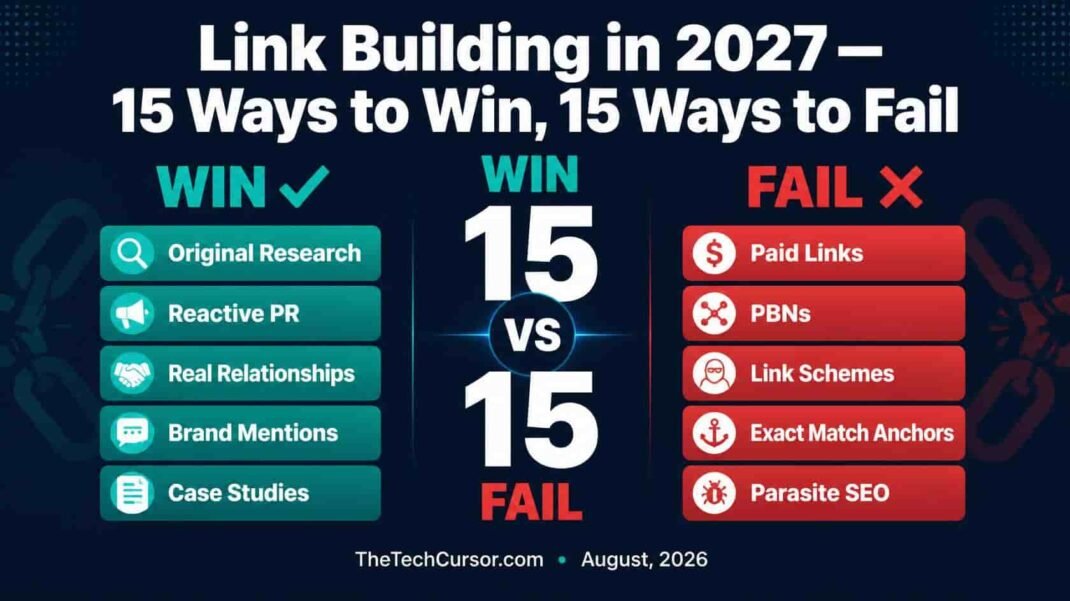
Here is the complete picture: 15 ways that actually work heading into 2027 — and 15 ways that will hurt you.
1. The Honest State of Link Building Heading Into 2027
The framing wars about whether link building is “dead” or “alive” are a distraction from a more useful observation: the returns on legitimate link building have never been higher, and the returns on manipulative link building have never been lower.
(cite index=”43-1″>Backlinks are still an important trust signal, but they work best when they support genuinely useful content — not when they try to compensate for weak pages.</cite>
For AI search specifically, the picture is more nuanced. As covered in TheTechCursor’s article on traditional link building and AI search, AI systems weight the authority and topical relevance of citing sources rather than raw link volume. A strong link profile correlates with AI visibility. Moreover, the same tactics that build a strong link profile for traditional search also tend to build the kind of entity authority that AI systems recognize.
(cite index=”36-1″>LLMs don’t weigh links the same way Google does. Yet a Semrush study found a strong correlation between the quality of a site’s links and its visibility in AI search.</cite>
The most honest framing: quality link building and AI visibility building are not separate disciplines. They are increasingly the same work — because they require the same things: genuine content, credible sources, and authentic third-party validation.
2. What Has Changed — SpamBrain 3.0 and Near-Real-Time Enforcement
Before diving into tactics, three changes in the enforcement environment heading into 2027 are worth understanding explicitly.
(cite index=”40-1″>SpamBrain 3.0 evaluates link patterns, not individual links. Sudden bursts of similar-looking links from mediocre domains get flagged. All-exact-match anchor text gets flagged. Links from sites that also link to spam sites get flagged.</cite>
This pattern-level evaluation changes the risk calculus significantly. Individual links that might have passed inspection previously now create risk when they are part of a pattern that looks like manipulation. A single guest post on a mediocre site may be low-risk. Ten guest posts in the same month on ten similar mediocre sites create a pattern that SpamBrain flags.
(cite index=”40-1″>Enforcement is now near-real-time. Sites that once could get away with manipulation for a quarter before consequences hit now see effects immediately.</cite>
The second change is enforcement speed. The window for executing a link scheme and benefiting from it before consequences arrive has narrowed from months to potentially hours. This eliminates the “quick wins from manipulation before the algorithm catches up” dynamic that some practitioners have relied on.
The third change is the connection between link quality and AI visibility. As covered in TheTechCursor’s series on AI search and entity authority, the same signals that make a link valuable for traditional rankings — topical relevance, source credibility, editorial independence — also contribute to entity understanding in AI systems. The definition of a good link has expanded from “helps rank a page” to “helps establish authority that AI systems recognize.”
3. The 15 Ways to Win at Link Building in 2027
4. Win 1: Original Data and Research
(cite index=”41-1″>A large share of marketers now create content specifically to support editorial link-building efforts.</cite>
Original research is the highest-return link-building investment available because it solves the outreach problem structurally. When your content contains a statistic that journalists, bloggers, and analysts need to support their claims — and that statistic cannot be found anywhere else — the outreach writes itself.
As covered in TheTechCursor’s content repurposing guide and AI citations framework, original data also generates 30-40% higher AI citation rates than generic content. The same asset that earns editorial links also earns AI citations — compounding the return on the research investment.
What works: Proprietary surveys, internal data analysis, benchmark studies, and experimental findings with specific, citable statistics. The more counterintuitive or surprising the finding, the more citable it is.
5. Win 2: Reactive Digital PR — Newsjacking With Substance
When a major story breaks in your industry, journalists need expert commentary — quickly. The organizations that have established themselves as credible, accessible sources of expertise earn mentions in breaking news coverage that organic link-building campaigns cannot replicate.
(cite index=”37-1″>The strongest off-page signals aren’t always followed links. Content, PR coverage, and outreach can reinforce one another.</cite>
Reactive PR requires two things: a monitoring system for industry news (Google Alerts, social media, industry newsletters) and pre-prepared expert perspectives that can be delivered on journalist timelines. As covered in TheTechCursor’s invisible PR guide, named subject matter experts with public profiles are the most effective vehicles for this — a journalist who knows your team’s experts can reach out directly rather than having to discover them.
What works: Rapid-response expert commentary on industry news, prepared perspectives on predictable recurring events (earnings, regulation, algorithm updates), and HARO/media request monitoring.
6. Win 3: Linkable Assets Built for Specific Audiences
The most consistently citable content is content that solves a specific, recurring problem for a specific audience so completely that anyone writing about that problem links to it as the definitive resource.
This requires starting from the audience’s problem rather than from a keyword. As covered in TheTechCursor’s content briefs guide, situation-based content briefs — built around specific triggers, constraints, and fears — produce content that addresses real problems rather than keyword patterns. Content addressing real problems earns editorial links. Content addressing keyword patterns earns content farm links.
What works: Comprehensive guides that answer all the questions a specific audience has about a topic, interactive tools that provide ongoing utility, glossaries and frameworks that become the shared vocabulary of a community.
7. Win 4: Real Relationship-Based Outreach
(cite index=”43-1″>Relationship-based link building still works because trust compounds. When respected writers, operators, or creators know your work, promotion happens more naturally.</cite>
Relationship-based outreach is the inverse of cold email outreach. Instead of starting with a list of target sites and working backwards to find a reason to contact them, you start with genuine professional relationships and look for natural ways those relationships can produce mutual value — including links.
The practical implication: invest in being present in the communities and conversations where your target link sources are active. Comment on their work thoughtfully. Share their content with genuine credit. Build the relationship over time so that when you do reach out about a specific content asset, you are reaching out to someone who already knows you.
(cite index=”41-1″>Roughly one-third of link builders continue outreach for several weeks after publishing a new page.</cite> The most effective outreach programs combine this persistence with genuine relationship development rather than treating every contact as a transaction.
8. Win 5: Brand Mention Recovery
One of the most underused link-building tactics is the systematic identification and recovery of unlinked brand mentions — instances where another site has mentioned your brand, product, or founder without including a link.
These are among the easiest links to earn because the site already has a reason to link to you — they mentioned you. A polite, specific request asking them to add a link to the mention converts at a significantly higher rate than cold outreach about new content.
What works: Google Alerts for brand and product names, Ahrefs or Semrush mention monitoring, and a consistent process for reviewing new mentions and following up on the ones without links. As covered in TheTechCursor’s invisible PR guide, unlinked brand mentions in community platforms also contribute to AI entity signals even without a link — but where a link is appropriate, recovering it compounds the value.
9. Win 6: Competitor Broken Link Replacement
When a competitor’s page that has earned significant inbound links is removed or redirected incorrectly, those links become orphaned — they point to a page that no longer exists. The sites linking to that broken page may be willing to update their link to a working alternative.
What works: Regular monitoring of competitor URL changes using Ahrefs or Semrush, combined with content that genuinely serves as a replacement for the removed page — not just any content from your domain, but content that addresses the same need the original page served.
10. Win 7: Topically Clustered Internal Linking
Internal links do not earn domain authority from external sources — but they distribute the authority earned from external links across your site in ways that directly affect which pages rank and receive AI citations.
As covered in TheTechCursor’s topical maps guide, internal links that connect topically related content — with descriptive, entity-rich anchor text — build the semantic relationship signals that both traditional ranking algorithms and AI systems use to evaluate topical authority.
What works: Regular internal link audits identifying high-authority pages with few outgoing links to related content, systematic internal link building when publishing new content, and anchor text that uses descriptive language rather than generic phrases.
11. Win 8: Expert Commentary and Quotes
Named experts with established professional profiles earn citations differently from brands. When a journalist or researcher quotes an individual expert, that quote typically earns attribution — often with a link to their profile or their organization.
As covered in TheTechCursor’s E-E-A-T 2026 guide, developing named subject matter experts within your organization is both a credibility signal and a link-building mechanism. Each expert placement creates an entity association that benefits both the individual and the organization.
What works: Building individual expert profiles through LinkedIn publishing, industry conference speaking, podcast guesting, and media relationship development. Tools like HARO, Qwoted, and SourceBottle connect journalists with expert sources actively seeking commentary.
12. Win 9: Co-Created Content With Complementary Brands
Co-created content — jointly produced research, guides, or analyses with non-competing brands that share your audience — earns links from two organizations’ networks rather than one. Each brand promotes to their existing audience and link network, compounding the reach of a single content investment.
What works: Joint research studies, co-authored guides, comparative analyses that benefit from each partner’s perspective, and webinars or events that produce citable written outputs. The partnership needs to be genuine — content that reads like a marketing collaboration without authentic complementarity is less citable and less promotable.
13. Win 10: Community and Forum Participation
As covered in TheTechCursor’s article on why traditional link building no longer works for AI search, community presence is AI search infrastructure. Reddit accounts for over 67% of uncited URLs ChatGPT retrieves when generating responses — making authentic community participation one of the highest-leverage link-building-adjacent investments available.
Direct links from Reddit are nofollow — they do not pass link equity in the traditional sense. However, the AI visibility value of authentic community presence, combined with the referral traffic from engaged communities and the secondary links that community visibility earns from publishers who discover your content there, makes it a net positive.
What works: Genuine expertise contributions to relevant subreddits, Slack and Discord communities, Quora, and niche forums. The emphasis on “genuine” is not optional — community members recognize promotional content immediately, and expelled or downvoted content harms rather than helps.
14. Win 11: Product or Tool Reviews by Real Users
For product companies, earning genuine reviews from real users on credible review platforms generates links, social proof, and AI entity signals simultaneously. Platforms like G2, Capterra, Trustpilot, and TripAdvisor are among the most cited sources in AI responses for product and service evaluation queries.
As covered in TheTechCursor’s article on local business Gemini citations, review platform presence is among the five factors that most influence whether local businesses appear in AI-generated recommendations. The same principle applies to SaaS and product brands evaluated in B2B contexts.
What works: Systematic review collection programs that encourage authentic user feedback, responses to all reviews (positive and negative), and ensuring your category and product attributes are accurately represented on each platform.
15. Win 12: Case Studies With Verifiable Outcomes
(cite index=”39-1″>Link volume tells only part of the story. See what separates earned authority from spam, recycled ideas, and pitches destined for the trash.</cite>
Case studies with specific, verifiable outcomes — real clients, real numbers, real before-and-after evidence — are among the most citable content types available. As covered in TheTechCursor’s analysis of the Fractl survey, case studies are the top credibility signal for marketing services buyers at 34%.
They are also highly citable in AI search. When AI systems generate responses comparing approaches, recommending methodologies, or evaluating service providers, case studies with clear outcomes are the content type most likely to be cited as evidence.
What works: Client permission to use specific numbers, structured case study format (challenge, approach, result), and distribution that puts the case study in front of journalists, analysts, and publishers covering your industry.
16. Win 13: Podcast and Video Transcripts as Citable Assets
Podcast appearances and video content generate their own distribution and audience — but the link-building value is locked in audio or video format that AI crawlers cannot index. Transcripts unlock that value.
A podcast episode where your founder discusses an important industry topic generates a link-building asset when transcribed and published as a blog post or article. The transcript becomes indexable, citable, and distributable in a format that earns links from the written web.
As covered in TheTechCursor’s invisible PR guide, podcast content is indexed through show notes and transcripts on podcast platforms and the host’s website — creating multiple citation surfaces from a single content appearance.
What works: Publishing full or edited transcripts of podcast and video appearances on your own site, providing the host with a well-formatted transcript for their show notes, and syndicating key insights as standalone articles that reference and link to the original content.
17. Win 14: Strategic Resource Page Placements
Resource pages — curated lists of the best tools, guides, and references in a specific category — are among the most editorially clean link sources available. They exist specifically to point readers to valuable external resources. When your content genuinely belongs on a resource page, a well-crafted outreach email has a high conversion rate precisely because the editorial logic for linking is already built into the page’s purpose.
The key distinction from generic link outreach is specificity. Resource page outreach that says “I thought you might want to add our guide” is easy to ignore. Outreach that says “Your resource page on [specific topic] links to [existing resource] — we published a more comprehensive version with original data that your readers would find more useful” gives the editor a specific, evaluable reason to update their page.
What works: Identifying resource pages in your category using Google search operators (intitle:"resources" + "your topic" or inurl:resources + "your topic"), auditing the quality and recency of what is already listed, and reaching out only when your content genuinely improves on what is already there. As covered in TheTechCursor’s search operators AI search guide, these operator combinations can be combined with after: date filters to find recently updated resource pages most likely to be actively maintained.
18. Win 15: Digital PR Through Award Submissions
Industry award programs generate a specific type of link that is both editorially clean and AI-visibility-positive: third-party recognition from an established industry organization. When your brand wins or is named a finalist for a credible industry award, the awarding organization publishes the announcement — typically with a link — and industry publications cover the results.
Furthermore, award coverage tends to appear on authoritative, topically relevant domains — the same domains that AI systems already trust for your category. A placement in an industry award announcement on a respected trade publication creates exactly the kind of topically relevant, editorially independent citation that both traditional rankings and AI citation systems weight most heavily.
As covered in TheTechCursor’s invisible PR guide, award recognition is one of the six highest-value invisible PR tactics for AI visibility. The link value and the AI entity signal compound from the same activity — making award submissions one of the highest-ROI link building investments available relative to time spent.
What works: Building a systematic award submission calendar — identifying the 5 to 10 most credible awards in your specific industry category, setting reminders for submission deadlines, preparing submission materials in advance, and amplifying any recognition across your owned channels to create additional indexed references to the award mention.
19. The 15 Ways to Fail at Link Building in 2027
The failure modes are faster and more consequential heading into 2027 than they have ever been. Here is the complete list of what SpamBrain is pattern-matching against — and what Google’s manual reviewers are actively looking for.
Fail 1: Paid link insertions on irrelevant sites: Paying for links on pages with no topical connection to your content is the most common and most detected link scheme. SpamBrain identifies topical irrelevance as one of the clearest indicators of spam patterns.
Fail 2: Guest posting at scale on thin sites: A limited number of high-quality guest posts on genuine publications with real editorial standards is legitimate. However, producing 20+ guest posts per month on sites that exist primarily to sell guest post placements creates the pattern SpamBrain flags.
Fail 3: Private Blog Networks (PBNs). PBNs are among the most clearly detectable link-manipulation tactics. The footprint of shared hosting, similar site structures, overlapping link targets, and thin content is increasingly visible to SpamBrain’s pattern matching. Furthermore, as covered in TheTechCursor’s article on GEO vendor scams, PBN brand mentions are being sold as “GEO optimization” — the rebranding does not reduce the risk.
Fail 4: Reciprocal link schemes: “I’ll link to you if you link to me” arrangements between sites that have no natural reason to exchange links create a detectable pattern. This is especially true when they occur at scale or across topically unrelated domains.
Fail 5: Exact-match anchor text manipulation: Heavy use of exact-match anchors — particularly across multiple sites — is a SpamBrain flag. Exact-match anchor text offers no clear ranking advantage compared to more natural phrasing.
Fail 6: Link buying disguised as “sponsored content” Commercial link arrangements that are not properly disclosed as sponsored are both a Google policy violation and an FTC compliance issue. The disclosure must be prominent enough for both users and Google to recognize — as covered in TheTechCursor’s review snippet guidelines article.
Fail 7: Parasite SEO — publishing on high-authority domains for link equity: As covered in TheTechCursor’s article on Google’s Site Reputation Abuse policy, this tactic is under active enforcement — including the EU’s DMA intervention. Moreover, the August 2026 spam update showed harder-than-normal enforcement on exactly these patterns.
Fail 8: Low-quality article syndication at scale: Publishing the same article across dozens of low-quality sites for backlinks creates thin content and duplicate content simultaneously. Consequently, SpamBrain now detects these two signals more reliably than ever.
Fail 9: Footer and sidebar links Sitewide links from footers and sidebars — “powered by,” agency attribution links, and partner badges — are heavily discounted. They can also create negative signals when they appear across a large number of unrelated domains.
Fail 10: Link schemes disguised as “partnerships” Commercial arrangements that require a link as part of a business relationship — “we’ll feature you in our directory if you link to us” — are link buying with a different label. Nevertheless, Google’s guidelines are explicit that these arrangements violate its spam policies.
Fail 11: Expired domain schemes: Purchasing expired domains with existing link profiles and redirecting them to target pages is among the tactics SpamBrain 3.0 specifically targets. The pattern of sudden link profile changes combined with domain history analysis makes these schemes detectable. Building thin sites on expired domains carries the same risk.
Fail 12: AI-generated content at scale for link bait: Using AI to produce large volumes of thin, templated content purely to create pages that attract links creates exactly the spam pattern that both the June and August 2026 spam updates targeted. The content needs to be genuinely useful — AI generation does not change that requirement.
Fail 13: Ignoring link decay: Links are not permanent assets. Sites go offline, pages get restructured, and links get removed. A link-building program without a link decay monitoring and recovery process is constantly running to stand still rather than making net progress. The inevitability of link decay is one of the underacknowledged costs of link-building strategies that focus on volume rather than relationship.
Fail 14: Ignoring topical relevance in anchor text: A backlink from a cooking website using the anchor text “best SEO agency” sends a confused signal — the topical context does not match the anchor. SpamBrain 3.0 evaluates not just whether a link exists but whether the surrounding content, page topic, and anchor text are coherent. Topically incoherent links are increasingly treated as noise at best and spam signals at worst. Every link acquisition effort should ask: does the context of this link make natural sense for this anchor?
Fail 15: Treating link building as separate from content strategy: The most expensive link building mistake is not a specific tactic — it is a structural one. Teams that separate link building from content production consistently produce content that is difficult to earn links for, and pursue links for content that was never designed to earn them. The result is wasted outreach effort, low conversion rates, and link profiles built on low-quality placements because nothing better was available to promote. As covered in TheTechCursor’s link intent guide, content and link building need to be part of the same process from the beginning — not separate workflows that occasionally interact.
20. Bottom Line
(cite index=”42-1″>Link building in 2027 requires thinking like a publisher, creator, or brand rather than an SEO manipulator. You are not trying to trick Google — you are trying to create content and relationships so valuable that links happen naturally and enthusiastically.</cite>
The 15 winning strategies share a common thread: they produce links as a byproduct of genuinely useful content, genuine relationships, and genuine expertise. The 15 failure modes share a different common thread. Specifically, they attempt to acquire links independently of the genuine value that links are supposed to signal.
As SpamBrain 3.0 makes manipulation detectable in near real-time, the gap between these two approaches will only widen. Furthermore, as AI search makes entity authority — not just link volume — the measure of credibility, the advantage of legitimate link building compounds further.
Build links the way you would want to earn them. That framing has never been more strategically correct than it is heading into 2027.
Pingback: Why Traditional Link Building No Longer Works for AI Search — And What to Do Instead - The Tech Cursor