
Read time: 7 min
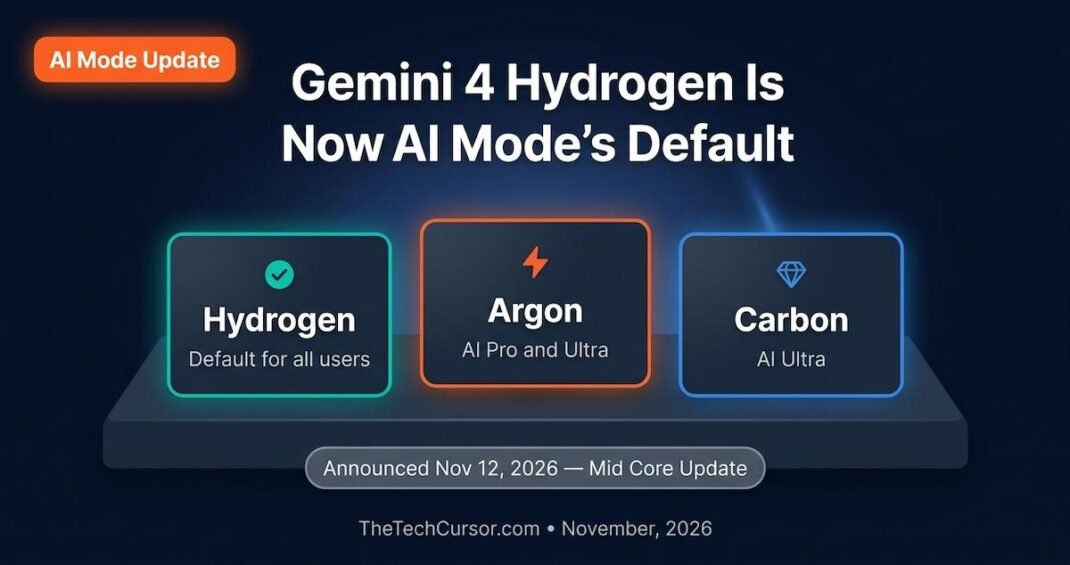
On November 12, 2026, Google made Gemini 4 Hydrogen the default model in AI Mode for all users worldwide. It also uses the model for the hardest questions in AI Overviews. Google calls it the biggest model upgrade to Search yet.
The change arrived two days into the November core update. Therefore, it complicates how site owners read their data. Here is what is confirmed, what is not, and what to do.
1. What Google Announced
Nick Fox, a Google executive, said Search is getting a massive upgrade and that it is available now for all users, globally. Robby Stein, Google’s VP of Product for Search, added that Hydrogen is the new default in AI Mode. He said it is also used for the hardest questions in AI Overviews.
Google’s own announcement says Hydrogen is available globally in Search for all users. It promises more helpful, visual, and intuitive responses.
No subscription is needed for Hydrogen. Only the larger Carbon model in AI Mode requires a paid plan.
2. The Gemini 4 Model Tiers
Google now offers several Gemini 4 models in Search. The table summarizes who gets what, based on reports.
| Model | Role in AI Mode | Who gets it |
|---|---|---|
| Hydrogen | Default model | All users |
| Argon | Optional choice | AI Pro and Ultra subscribers, since October 13 |
| Carbon | Flagship option | AI Ultra subscribers, since November 10 |
One report describes Hydrogen as a faster, cheaper model than the larger Gemini 4 systems. It also says Hydrogen is rolling out in the Gemini app and for developers. Treat those extra details as secondary reporting.
3. What Google Says Changes
Google lists several improvements. These are the company’s claims, not independent test results.
- Faster responses across AI Mode.
- Better understanding of intent, including long questions, multi-part requests, and typos.
- Improved query fan-out and linking. AI Mode splits a question into sub-searches and shows more useful links.
- More visual answers, such as images, tables, maps, and interactive tools.
- Richer language understanding across the languages AI Mode already supports.
Google has not announced new language support as part of this update. Also, none of these claims has been tested independently yet.
4. What About AI Overviews
The details on AI Overviews are less clear. Google’s Search post does not mention them. The information comes from Stein’s thread.
Hydrogen handles the hardest AI Overview questions. However, that does not mean every AI Overview uses it. Google has not defined which questions count as the hardest, and it has not said which model answers the rest.
Google made Gemini 3 the default for AI Overviews globally in January. The announcement does not name which model Hydrogen replaces in Search.
5. Does It Affect Core Rankings?
Google has not said that Hydrogen changes core rankings. One industry observer believes it affects AI Overviews and AI Mode only, not the ranking of regular results.
Still, the line is blurry. Google has said it folds core ranking signals into its AI experiences. Consequently, the model may influence which pages those experiences surface.
The timing adds confusion. The November core update began on November 10, and Hydrogen arrived on November 12. Therefore, you cannot easily separate the effects of the two.
6. What Google Has Not Said
Several gaps matter for site owners.
Google has not published figures on how many more sites Hydrogen links to. It has not said whether click-through from AI Mode has changed. It has also not defined the hardest questions in AI Overviews.
Without that data, claims about traffic gains or losses are speculation. The AI Mode clicks research previously showed AI Mode reducing clicks. Whether Hydrogen changes that is unknown.
7. How to Keep Your Measurement Clean
Two overlapping changes make this a messy period. Plan your tracking accordingly.
- Log the dates. Record November 10 (Carbon for Ultra and the core update start) and November 12 (Hydrogen default).
- Track citations weekly. Note which AI Mode answers cite you, and compare week to week.
- Wait before concluding. Give it a couple of weeks. The core update may run until about November 24.
- Separate the signals. Compare AI citation changes with traditional ranking changes in Search Console.
The AI visibility dashboard guide explains how to set up this tracking.
8. What to Do With Your Content
The claims point to some practical steps. These are analysis, not Google guidance.
Answer sub-questions clearly. Better fan-out means AI Mode asks more specific sub-queries. Pages that state specific facts clearly are easier to cite. The R4T-Diffusion article explains how fan-out works.
Prepare for visual answers. Use clean tables, original images with accurate alt text, and structured data that matches visible content.
Keep entity information consistent. The GEO pillars framework explains how credibility and structure support citations.
Watch shopping. AI Mode shopping answers already lean toward Google’s own surfaces, as the AI Mode product links study described.
9. Bottom Line
Gemini 4 Hydrogen became AI Mode’s default for everyone on November 12 and now handles the hardest AI Overview questions. Google says it brings faster, more visual, better-linked answers. It has not published data on links or clicks, and its effect on core rankings is unconfirmed.
The Takeaway
Treat this as a measurement event. Therefore, log the dates, track your citations weekly, and wait before drawing conclusions. Meanwhile, keep your pages clear, specific, and well structured.
10. Sources Reviewed
- Google Search gets major upgrade with Gemini 4 Hydrogen (link provided; not opened)
- Search Engine Roundtable — Google Search Gets Massive Upgrade With Gemini 4 Hydrogen
- Circulate Digital — Gemini 4 Hydrogen in Google Search: what it means for your AI visibility
- Business Upturn — Google rolls out Gemini 4 Hydrogen in Search worldwide
- Magica — Google makes Gemini 4 Hydrogen the worldwide default in AI Mode
- Pasquale Pillitteri — Gemini 4 Hydrogen arrives in Google Search
- ASO World — Gemini 4 Hydrogen: Google’s New Default Search Model