
Published: June 18, 2026
Read time: 6 min
If your business has published a “best [category] software” listicle that conveniently ranks your own product first, new research suggests it might be doing the opposite of what you intended. A detailed analysis by SEO researcher Lily Ray found that Google AI Overviews frequently cite these self-promotional listicles as a source — while recommending a competitor instead, in 69% of cases.
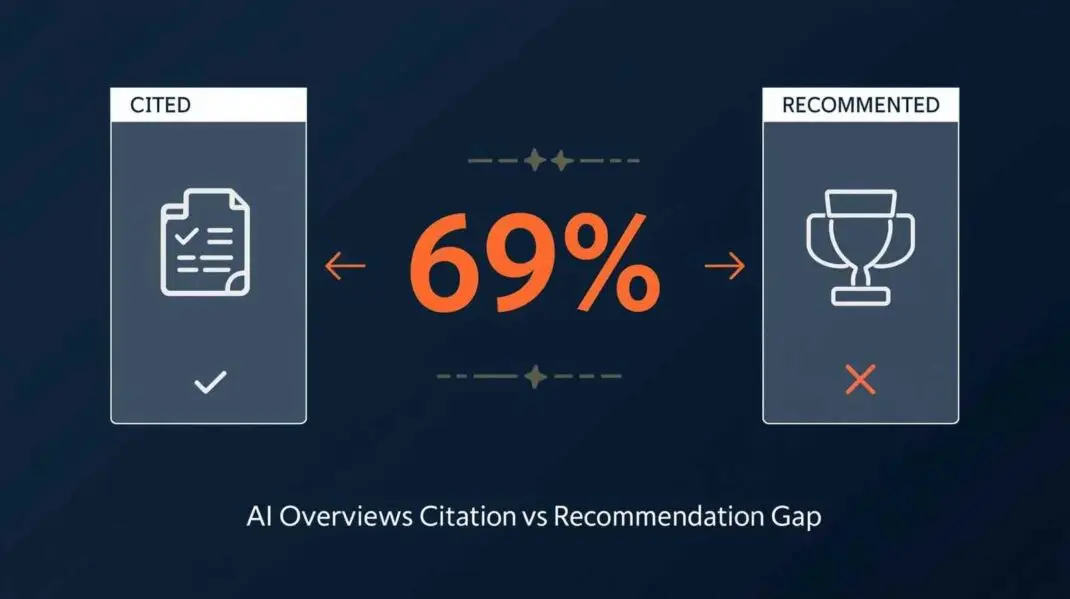
In other words, you are doing the work of building the comparison page. Google is using your page as a reference. And then it is sending the customer to someone else.
Here is what the data actually shows and what it means for your content strategy.
The Study: What Ray Actually Measured
Ray analyzed 100 B2B “best [category] software” queries across Google AI Overviews at three separate checkpoints — April 15, May 15, and June 8, 2026. Using Ahrefs Brand Radar, she collected the full AI Overview answer text and every cited source for each query, then measured two distinct outcomes for each result: whether a self-promotional listicle was cited as a source, and whether the brand behind that listicle was actually recommended in the response.
Out of 80 prompts that triggered an AI Overview response, self-promotional listicles were cited 323 times in total. However, in 224 of those cases, Google cited the brand’s own page as a source — and then did not recommend that brand at all.
A Concrete Example: Oasis LMS
One case from the study illustrates the pattern clearly. For the query “best LMS for selling courses,” Google’s AI Overview cited Oasis LMS as a source. However, it did not recommend Oasis LMS as an answer to the query.
Instead, the AI Overview recommended Kajabi, Thinkific, LearnWorlds, and Teachable — all of which happened to be named within the Oasis LMS article itself. Oasis LMS had effectively built a comparison page that helped Google identify and recommend its competitors, while Oasis LMS’s own brand was left out of the actual recommendation.
Ray documented similar patterns across multiple categories, including help desk software, task management tools, survey platforms, CRM systems, and SEO software.
Why This Happens: Citation Is Not the Same as Recommendation
The core insight from this research is that being cited as a source and being recommended as an answer are two completely separate outcomes — and brands need to stop conflating them.
When a brand publishes a “best X software” listicle that names several competitors alongside itself, that page becomes useful to Google’s AI Overview system as a reference document. It contains a structured list of relevant products in the category, which is exactly the kind of content AI systems pull from when assembling an answer.
However, citing a page as a useful reference does not obligate the AI system to recommend the brand that published it. If a competitor has stronger third-party signals — more mentions elsewhere, a better link profile, or broader brand recognition — the AI system can use your listicle’s structure while recommending someone else entirely.
Stronger Brands Still Win — Even When Cited Less
Ray’s analysis found a consistent pattern: brands that already led their category, were widely mentioned across third-party sources, and had stronger overall link profiles were significantly more likely to appear in the actual AI Overview recommendations — regardless of whether they had published a self-promotional listicle.
This reinforces a theme that has appeared across recent AI search research: third-party authority and external validation carry substantially more weight than self-published content when it comes to actually being recommended, rather than merely cited.
Organic Visibility Is Also Declining for These Sites
The damage from this tactic is not limited to AI Overview recommendations. Ray also reported organic search visibility declines for many of the sites in her analysis that relied heavily on self-promotional listicles.
These declines reportedly began around January 20, 2026, across dozens of analyzed sites. Many of the affected sites had also scaled other SEO and AI-search-focused content formats heavily — including AI-generated articles, extensive comparison pages, and large volumes of “best” pages consistently ranking their own brand first.
Critically, Ray found that these organic visibility declines continued and accelerated during Google’s May 2026 core update — the same update covered in our earlier breakdown of that rollout’s impact on AI-generated and self-promotional content.
Where AI Overviews Actually Pull Their Recommendations From
If self-promotional listicles are not driving recommendations effectively, where is Google’s AI actually getting its trusted information? Ray’s research found that Google relies heavily on third-party and user-generated content sources for “best” queries.
Reddit citations specifically have increased sharply in recent months. Alongside Reddit, Forbes and YouTube were among the most frequently cited domains across AI Overview responses containing the word “best.”
This finding connects directly to the broader pattern around topic-specific authority — AI search systems consistently favour independent, third-party validation over brand-controlled content when assembling recommendations, particularly for comparison and “best of” style queries.
There Is a Legal Risk Here Too
Beyond the SEO and visibility concerns, this tactic carries a regulatory dimension that brands should not ignore. Self-promotional “best of” content that presents company-controlled material as if it were independent, objective review content may create legal exposure under the FTC’s Consumer Review Rule — particularly in cases where reviews are not based on genuine product use, or where material relationships between the listicle and the ranked brands are not clearly disclosed.
This adds a compliance dimension on top of the SEO and AI visibility concerns already documented in Ray’s research.
What This Means for Your Content Strategy
If your brand currently relies on self-promotional “best” listicles as part of your SEO or content strategy, this research suggests several concrete adjustments worth considering.
Stop expecting self-published comparison content to drive AI recommendations. Being cited as a source is not the same outcome as being recommended. If your goal is to appear as the actual answer in AI Overviews, self-promotional listicles are not the lever that achieves that.
Invest in genuine third-party coverage instead. Since stronger, more widely mentioned brands consistently win the actual recommendation slot, redirecting effort toward earning mentions on independent publications, review sites, and community platforms like Reddit will likely move AI visibility more effectively than another internally ranked listicle.
Be honest about disclosure if you keep publishing comparison content. If your brand continues producing “best of” style content that includes your own product, clearly disclosing the commercial relationship reduces legal exposure under FTC guidance — and arguably builds more genuine trust with readers and AI systems alike.
Watch your organic visibility trends closely if you have scaled this content type. Given the documented declines accelerating through the May 2026 core update, sites with large volumes of self-ranked “best” content should audit this content category specifically rather than assuming the broader update impact was unrelated.
Redirect resources toward third-party-citable assets. Original research, data studies, and expert-authored content that other sites want to reference and link to naturally tend to perform better in this environment than internally-controlled comparison pages.
Bottom Line
A citation in an AI Overview feels like a win — your brand’s content appears in the answer. However, Lily Ray’s research makes clear that this feeling is often misleading. In the majority of cases studied, brands that published self-promotional listicles saw their own pages cited as sources, while competitors received the actual recommendation that drives clicks and conversions.
The lesson is direct: stop optimizing for citation as a proxy for success. Optimize for the third-party authority and independent validation that actually earns the recommendation. Otherwise, you may simply be building better comparison pages for Google’s AI to use while sending customers to someone else.
Pingback: What Makes a Good Listicle? New Research on 3,000 Pages Reveals the Signals That Actually Matter - The Tech Cursor