
Published: June 22, 2026
Read time: 8 min
Most content gets created once, published once, and then slowly forgotten. Traffic peaks in the first few weeks, then decays. By month three, the piece is barely visible in search results — and completely invisible in AI-generated answers.
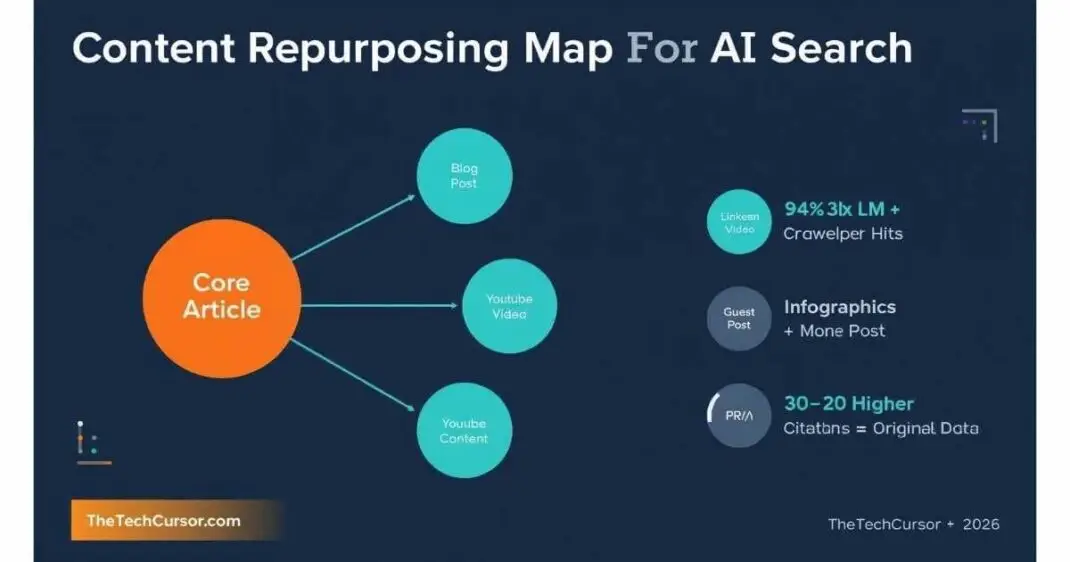
Content repurposing solves this problem. However, in 2026’s AI search environment, repurposing is not just about recycling content into social posts. It is about strategically distributing content across formats and platforms in ways that specifically increase your chances of being cited by AI systems like ChatGPT, Google AI Overviews, and Perplexity.
Here is a complete content repurposing map — what AI systems actually prefer, which formats work best, and a step-by-step process to build your own repurposing strategy.
What AI Systems Actually Prefer — The Data
Before building a repurposing map, it helps to understand what large language models prioritize when deciding what to cite. The research on this is more detailed than most marketers realize.
Content freshness matters enormously. Content published in the last five years receives 94% of LLM crawler hits, according to research by Seer Interactive. Furthermore, the majority of those hits target content from the past year specifically. This means keeping content updated — and staggering new and repurposed content over time — is not just good SEO practice. It is a direct AI visibility signal.
Original data and statistics dramatically increase citation rates. Content that includes statistics and qualitative data results in 30 to 40% higher citation rates, according to research compiled by Onely. AI systems are trained on data that predates current trends — so when a user asks something that requires up-to-date information, AI tools actively look for trustworthy sources with recent, specific data to cite.
Structured content gets cited three times more accurately. Well-structured content — with clear headings, bullet points, tables, definitions, and step-by-step formats — is three times more likely to receive accurate citations than unstructured prose, according to research by Snezzi. AI systems do not store or retrieve entire pages. Instead, they split content into smaller overlapping segments and retrieve only the most relevant chunks for a given query. Content that is already organized into self-contained, clearly labelled sections is inherently easier for AI to extract and cite accurately.
Platform distribution affects citation likelihood. Reddit, LinkedIn, and Wikipedia are among the most-cited domains across major LLM platforms. However, ChatGPT significantly reduced citations to Wikipedia and Reddit in late 2025 — signalling that distribution across a diverse range of high-authority platforms, rather than relying on any single channel, is the more sustainable strategy.
The Best Content Formats for AI and SEO Visibility
Not all content formats contribute equally to AI visibility. Here is a practical breakdown of which formats matter most — and why:
| Format | SEO Value | AI Citation Value | Best Platforms |
|---|---|---|---|
| Long-form blog articles | Very High | Very High | Your website |
| Guest posts | High | High | External publications |
| Videos (with transcripts) | Very High | High | YouTube, website |
| PR and media coverage | High | Very High | News sites, industry publications |
| Webinars (transcribed) | High | High | Website, YouTube, LinkedIn |
| Infographics and data charts | Medium | Medium | Website, social, email |
| Forum posts and threads | Medium | Medium | Reddit, niche forums |
| Social media posts | Medium | Medium | LinkedIn, X, Instagram |
| Case studies | Medium | Medium | Website, sales materials |
| Email newsletters | Low | Low | Email only |
The key insight from this table: long-form content on your own website, combined with PR and media coverage on external high-authority sites, delivers the strongest combined SEO and AI citation value. Furthermore, any video content with embedded transcripts significantly increases AI readability compared to video alone.
The 6-Step Content Repurposing Map
Here is a practical, step-by-step process for building a content repurposing map that works for both traditional SEO and AI search visibility.
Step 1: Choose a Core Topic With Real Depth
Every repurposing map begins with one central idea that can anchor content across multiple formats and channels. However, not every topic supports this — some ideas are too narrow to expand meaningfully.
Choose a topic that:
- Aligns directly with your product, service, or core expertise
- Has a clear search demand or reflects genuine audience questions
- Can expand into multiple angles — how-tos, comparisons, FAQs, data studies
- Has enough relevance to support ongoing updates over time
- Offers opportunities to include original data, expert commentary, or first-hand experience
Topics with these qualities give you raw material that can genuinely be repurposed — not just reformatted.
Step 2: Create One Comprehensive Primary Asset
Once you have defined the topic, build a single in-depth piece of content that explores it fully. This primary asset becomes the foundation from which everything else is built.
For most content teams, this is a long-form blog article, a detailed webinar, or a comprehensive video. The format matters less than the depth — the primary asset needs enough substance to support multiple derivative formats.
Tips for the primary asset:
- Cover the topic comprehensively, including key questions, subtopics, and use cases
- Include original data, internal research, or expert quotes with full attribution — name, title, credentials
- Structure content clearly with a table of contents, headings, clearly defined sections, and actionable takeaways
- Highlight key statistics visually, so AI systems can extract and cite them easily
Step 3: Break the Primary Asset Into Repurposable Components
Before distributing, identify the individual components within your primary asset that can stand alone as separate content pieces:
- Key statistics → Infographic, social post, data chart
- Expert quotes → LinkedIn post, pull quote graphic, PR pitch
- Step-by-step sections → Short video, carousel post, FAQ page
- Comparison tables → Standalone comparison page, social thread
- Case study elements → Case study page, sales material, email
- FAQs → Forum post, dedicated FAQ page, voice search optimization
Each component maps to a format and a platform. Planning this mapping before creating any derivative content saves significant production time and ensures nothing is created without a clear distribution purpose.
Step 4: Stagger Your Publishing Cadence
Publishing everything at once eliminates the freshness advantage that staggered distribution provides. Instead, release content across a planned timeline:
- Week 1: Publish the primary long-form article on your website
- Week 2: Publish a LinkedIn article or guest post based on the key insights
- Week 3: Release a short-form video or webinar clip on YouTube
- Week 4: Distribute an infographic or data chart on social media and embed it in the original article
- Month 2: Submit a PR pitch or contributed article to an industry publication
- Ongoing: Participate in relevant Reddit or forum discussions linking back to the primary asset
This staggered approach maintains consistent freshness signals across the topic over time — which directly increases AI crawler engagement with your content.
Step 5: Define Your Update Cycle
Different content types decay at different rates. Establishing a clear update schedule prevents your best content from becoming outdated and losing both SEO rankings and AI citation eligibility.
- Fast-changing content (industry statistics, trend pieces, tool comparisons): Update quarterly
- Stable evergreen content (how-to guides, foundational explainers): Review annually
- Data-driven content (research reports, benchmark studies): Update whenever new data becomes available
When you update content, republish or redistribute it across channels to send freshness signals — embedding updated statistics in the original article, resharing on social, or sending to your email list. Each redistribution creates a new freshness touchpoint for AI crawlers.
Step 6: Track Performance and Refine
A content repurposing map without measurement is incomplete. Track which formats, platforms, and topics drive the most value — then adjust the map based on what the data shows.
Key metrics to monitor:
- AI citation frequency — which repurposed formats are being cited in AI-generated answers?
- Organic traffic by format — which formats drive the most sustained traffic over time?
- Engagement by platform — where are audiences most actively engaging with repurposed content?
- Citation share — for topics where you are being cited, how much of the citation space do you own?
Double down on high-performing formats and channels. Cut formats that consistently underperform despite adequate distribution. Refine the map each quarter based on what the data actually shows rather than assumptions about what should work.
Connecting Repurposing to Your Broader AI Visibility Strategy
Content repurposing does not exist in isolation. It connects directly to several other elements of AI search visibility covered in TheTechCursor’s content strategy series:
Query fan-out (covered in Article 30) means that comprehensive primary assets — which address multiple related questions within a single piece — are evaluated against many simultaneous sub-queries. Repurposing that distributes those answers across multiple formats increases the probability of being cited for each sub-query variation.
Topic-specific authority (covered in Article 24) requires concentrated signals from high-authority sources in your niche. Guest posts and PR placements as part of your repurposing strategy directly build this authority.
Content pruning (covered in Article 27) and repurposing work together — pruning removes thin, weak pages while repurposing consolidates and strengthens the content that deserves to remain.
Bottom Line
A structured content repurposing map turns a single well-researched piece of content into a multi-platform asset that generates visibility across traditional search, AI citations, social, email, and earned media simultaneously.
The brands and publishers that build this systematic approach — rather than treating each content piece as a one-and-done activity — will consistently outperform those who create and forget. In an AI search environment where freshness, structured data, and cross-platform presence all directly influence citation likelihood, repurposing is no longer optional. It is the difference between content that compounds in value over time and content that decays into invisibility.