
Category: Link Building | AI Search | SEO Strategy | Off-Page SEO
Published: June 24, 2026
Read time: 8 min
Site: TheTechCursor
Most link building in 2026 still follows the same playbook it did a decade ago: find high-authority sites, earn backlinks, watch rankings improve. That playbook still works for traditional SEO — but it increasingly misses the most important visibility channel: AI search.
AI systems do not rank your content by counting backlinks. They evaluate whether your content is the right evidence for the right decision-maker at the right moment. If it is not, you will not be cited — regardless of how many links you have.
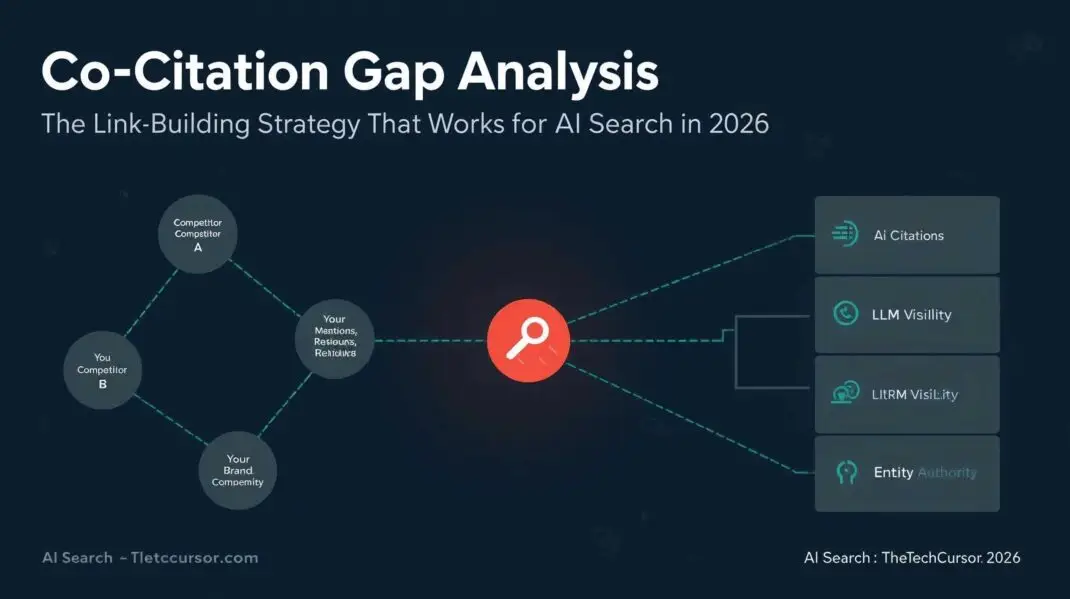
Co-citation gap analysis is the advanced link-building methodology built specifically for this reality. It maps which sources AI systems trust for each type of buyer or decision-maker, identifies where your content is missing from those citation sets, and tells you exactly where to build content and earn placements to close those gaps.
Here is how it works — and how to apply it.
Why Traditional Link Building Falls Short for AI Search
For fifteen years, link building focused on anchor text — the specific words used when linking to a page. Anchor text told search engines what a page was about.
In AI search, the unit that matters is anchor context — not just what a page says, but why that evidence is relevant to a specific decision-maker at a specific moment in their decision process.
AI systems do not retrieve pages based on keyword matching alone. They evaluate whether a page provides the right evidence for the question being asked — and whether that evidence comes from a source the AI already trusts for that specific type of question.
This means two brands can have similar backlink profiles and similar content quality — yet one appears consistently in AI-generated answers while the other does not. The difference is usually in the co-citation context: one brand’s content has been placed in the right sources, for the right audiences, addressing the right decision points.
What Is a Co-Citation Gap?
A co-citation gap is the absence of your content from the citation set that AI systems use when answering questions for a specific audience or decision-maker.
Here is a simple way to think about it:
When someone asks an AI assistant “what is the best [type of software] for [specific use case]?”, the AI retrieves evidence from sources it already trusts for that topic and audience. It then synthesizes those sources into an answer.
If your brand’s content is not in the sources the AI retrieves — for that specific question, for that specific audience — you will not be recommended. Not because your content is poor quality, but because it was never positioned as evidence for that particular decision.
A co-citation gap analysis identifies exactly which decisions your content is missing from — and which sources you need to appear in to close those gaps.
The Core Concept: Buyer Roles and Decision Points
The most important insight behind co-citation gap analysis is that different people involved in the same decision ask fundamentally different questions — and AI systems retrieve different sources for each of them.
Consider a company choosing a marketing analytics platform. Several people are involved in that decision:
- The Marketing Director asks: “Which platform gives the clearest ROI visibility?”
- The IT Manager asks: “How does this integrate with our existing stack, and what are the security implications?”
- The CFO asks: “What is the total cost of ownership and how does it compare to alternatives?”
- The End User asks: “Is this platform actually easy to use day-to-day?”
Same product. Same purchase decision. Four completely different questions — and AI systems retrieve largely different sources for each.
If your content only addresses the Marketing Director’s concerns, you may be cited when the Marketing Director researches — but invisible when the IT Manager, CFO, or End User asks their questions. And if any of those people have veto power over the decision, your absence from their citation set is a real commercial problem.
How to Run a Co-Citation Gap Analysis
Here is a practical, simplified version of the methodology:
Step 1: Map the Decision-Makers and Their Core Concerns
Start with one purchasing decision your brand is involved in. List every person who needs to say yes before that decision is made. For each person, write down their primary concern or fear — in their own voice, as a question they would actually ask.
For example, for a cybersecurity software purchase:
| Role | Core Question |
|---|---|
| CISO | “Will this actually reduce our breach risk — and can I prove it to the board?” |
| IT Manager | “How complex is the implementation, and what ongoing maintenance does it require?” |
| CFO | “Is the cost justified, and what happens to pricing at renewal?” |
| Legal/Compliance | “Does this meet our regulatory requirements and audit trail needs?” |
The compliance or legal role is frequently the most underserved in content strategies — and often has the most veto power. This is where co-citation gaps are most commonly found.
Step 2: Run Role-Specific Prompts in AI Search Tools
For each role, create a specific prompt that captures their perspective and concerns — in first person, in their voice, with no brand names mentioned.
Run each prompt through AI search tools that show their sources — Perplexity, Google AI Mode, or ChatGPT with web search enabled. For each prompt, capture:
- Which sub-queries did the AI generate?
- Which pages did it read?
- Which pages did it actually cite in the answer?
The difference between pages read and pages cited is critical. A page that is read but not cited has a content problem — the AI consulted it but found it insufficient as evidence. A page that is never read has a discoverability problem.
Step 3: Build Your Citation Matrix
Create a simple spreadsheet with:
- One row per unique cited URL
- One column per buyer role
- A count column showing how many roles cited each source
Sort by the count column. This reveals three important patterns:
Shared core sources — cited by multiple roles. These are the high-authority, high-trust sources for this topic overall. Appearing in these sources benefits visibility across all decision-makers simultaneously.
Role-exclusive sources — cited by only one role. These represent specialized trust networks for each decision-maker. If your content needs to reach the IT Manager, you need to appear in the sources IT Managers trust — which may be entirely different from sources Marketing Directors trust.
The isolated veto holder — the role whose cited sources share almost nothing with anyone else’s. This is your co-citation gap priority. This decision-maker can block the purchase, has the least content serving their specific concerns, and is the most underserved by existing content in your category.
Step 4: Identify Your Gaps and Build Targeted Content
With the matrix complete, you can see exactly where your brand is absent from the citation set — and for which decision-makers.
Prioritize content creation and outreach in this order:
1. The veto holder with isolated sources. Build content specifically for their concerns and earn placements in the sources they trust. This is the highest-leverage gap because closing it removes a blocker that your competitors are also likely missing.
2. Empty edges between must-agree roles. Where two decision-makers both need to say yes but share no common cited sources, a bridge asset — content that addresses both roles’ concerns in one resource — can fill that gap.
3. Phase gaps. Run your analysis again for different stages of the decision journey: initial research, shortlisting, final evaluation, implementation, and renewal. Most brands focus entirely on the initial research phase and are absent from later stages where purchase decisions are actually made.
Step 5: Earn Placements in the Right Sources
The sub-queries the AI generates during your analysis are a map of the domains it already trusts for this topic and audience. These are your outreach targets — not the highest-authority sites in general, but the highest-authority sites for this specific decision context.
Guest posts, original research cited by these publications, expert quotes in their articles, and earned coverage are all legitimate ways to earn placement in these trusted sources. The goal is to become part of the citation set that AI systems retrieve when a specific decision-maker asks their specific question.
Why This Approach Works for AI Search
Co-citation gap analysis works for AI search for the same reason topic-specific authority building works — because AI systems build topic-specific, audience-specific trust networks, not a single universal ranking.
As covered in TheTechCursor’s article on topic-specific off-page SEO authority, AI search engines trust different sources for different topics and different audiences. Generic high-authority links spread across unrelated contexts do not concentrate authority where it matters for specific decision-making contexts.
Co-citation gap analysis takes this one step further: it maps not just which topics you need authority in, but which specific decision-makers you need to be trusted by — and which sources those decision-makers already rely on.
Furthermore, this connects directly to the entity understanding framework covered in TheTechCursor’s breakdown of Google’s entity SEO patent. Building the right evidence in the right places for the right decision-makers is, at its core, how you teach Google’s AI systems that your entity is the right answer for a specific type of buyer with a specific type of need.
Measuring Whether It Is Working
The measurement loop is straightforward: lock your prompt set, run it as a baseline, build your content and earn your placements, then re-run the same prompts three to four weeks later.
Look for three changes:
- Your brand appears in citations where it previously did not
- Sources you earned placement in are now being retrieved by the AI for the relevant decision-maker prompts
- Previously empty edges between roles begin showing shared citation sources
The cited set is the scoreboard. It tells you directly whether your content is now part of the evidence AI systems are using — not just whether it ranks for keywords.
Bottom Line
Co-citation gap analysis reframes link building for the AI search era. Instead of asking “how do I get more links?” it asks “which decision-makers am I missing from, and which sources do I need to appear in to reach them?”
The brands that answer this question systematically — mapping their citation gaps by buyer role, building targeted content, and earning placements in role-specific trusted sources — will build AI search visibility that compounds over time. Those who continue optimizing only for keyword rankings will find themselves increasingly invisible at the moments that actually drive purchasing decisions.
Start with the decision-maker who can say no and who no one else is writing for. That is where the gap is. That is where the opportunity is.