
Category: SEO Strategy | AI Search | Digital Marketing
Published: July 8, 2026
Read time: 7 min
Site: TheTechCursor
SEO and AI search optimization (AEO/GEO) share a lot of common ground — but they are not the same thing. Sticking with your tried-and-true SEO approach will not get you as far in AI search visibility. Some priorities that drove results in traditional search matter more now. Others that consumed significant effort are delivering diminishing returns.
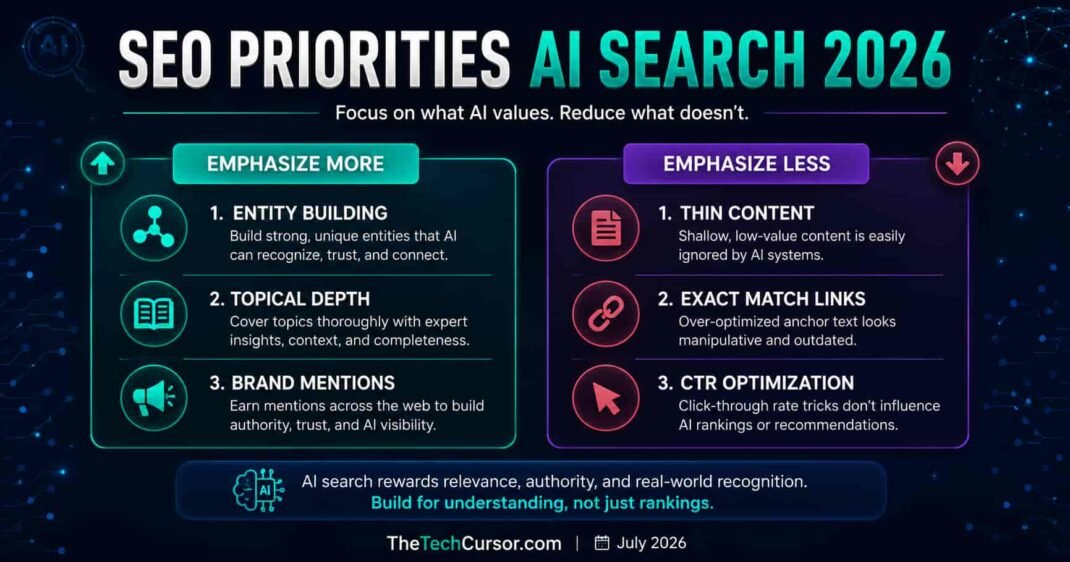
Here is a clear, practical breakdown: three SEO priorities to emphasize more in 2026, and three to emphasize less.
Table of Contents
- Why Your SEO Priorities Need to Shift
- MORE: Build Brand Authority and Strong Entity Signals
- MORE: Build Topical Depth With Content Clusters
- MORE: Earn Unlinked Brand Mentions and Community Presence
- LESS: Chasing High-Volume Keywords With Thin Content
- LESS: Pursuing Exact-Match and Manipulative Link Building
- LESS: Optimizing for CTR on Standard Blue Links
- The Payoff Is Not Always More Traffic
- Bottom Line
1. Why Your SEO Priorities Need to Shift
AI search systems — Google AI Overviews, AI Mode, ChatGPT, Perplexity — evaluate content differently from traditional search algorithms. They do not just rank pages. They assess entities, synthesize understanding across multiple sources, and generate answers that cite the sources they consider most authoritative.
This changes which SEO efforts have the biggest downstream impact. Some work that drove traditional rankings contributes significantly to AI visibility. Other work that consumed large amounts of time — chasing keyword volume, building link quantity — has much less effect on whether AI systems recommend your brand.
Understanding which priorities to shift is not about abandoning SEO fundamentals. It is about allocating effort where it generates the most return in an environment where AI-generated answers resolve a growing share of queries before any blue link is clicked.
2. MORE: Build Brand Authority and Strong Entity Signals
Why it matters more now: AI systems need to “know” your brand exists and what it stands for before they will cite you. Entity recognition is foundational to AI visibility in a way it never was for traditional search. LLM training data rewards brands with a consistent, cross-platform presence — not just websites that rank for target keywords.
What this looks like in practice:
Ensure brand information is consistent across Wikipedia, LinkedIn, Crunchbase, industry directories, and anywhere else an LLM might pull entity data. Inconsistency across sources creates uncertainty in AI systems about what your brand actually represents — which suppresses citation probability.
PR and SEO teams need to work more closely together, because earned media mentions are now entity-building signals — not just reputation management. A mention in a respected industry publication contributes to how AI systems understand and represent your brand.
Named authorship matters significantly more now. Bylined experts with their own credible web presence add authority to the content they produce — as covered in TheTechCursor’s E-E-A-T 2026 article. Building author entities with visible credentials, professional profiles, and consistent publishing records is an increasingly important part of content strategy.
The payoff: When entity infrastructure is in place, new content earns AI citations faster because the AI already has a clear picture of who the brand is and why it is credible.
3. MORE: Build Topical Depth With Content Clusters
Why it matters more now: AI systems favor sources that demonstrate comprehensive authority on a topic — not just individual pages that rank for individual keywords. A thin content footprint is far more exposed in AI search than it was in traditional search. A single well-ranking page is not enough; AI systems want evidence of sustained expertise across a topic area.
What this looks like in practice:
Stop asking “what do we rank for?” and start asking “what topics do we want AI systems to associate us with?” These are different questions — and they produce different content strategies.
Internal linking becomes more important because it signals topical relationships between pieces for LLM processing. As covered in TheTechCursor’s topical maps guide, a well-structured content cluster with clear semantic connections gives AI systems the evidence they need to classify your brand as authoritative in a specific area.
Content audits should focus on topic coverage gaps — not just underperforming pages. Missing subtopics within your core expertise area are often the reason AI citations remain inconsistent.
The payoff: One strong content cluster can generate broad AI visibility across multiple related queries. Brands that own a topic cluster around the problem their product solves get cited by AI systems before the sales conversation even begins.
4. MORE: Earn Unlinked Brand Mentions and Community Presence
Why it matters more now: LLMs are trained on the broader web — far beyond pages with backlinks. A mention of your brand on Reddit, Quora, a niche forum, or an industry community carries weight even without a link attached. AI systems pattern-match what the web says about your brand across many sources, not only what ranks in Google.
Trusted third-party communities like Reddit carry particular weight because LLMs have been heavily trained on them and often treat their content as authentic user sentiment.
What this looks like in practice:
Monitoring unlinked brand mentions is becoming as important as tracking backlinks. Where is your brand being discussed? Are those conversations positive, accurate, and relevant to how you want to be perceived? These questions matter for AI visibility in ways that traditional SEO never required.
Community participation and digital PR are now SEO-adjacent priorities. Getting your brand mentioned in the right places matters whether a hyperlink is attached or not. As covered in TheTechCursor’s link intent article, the most valuable off-site signals are earned through genuine contribution — not purchased placements.
The payoff: Brands with an active presence in relevant communities surface more naturally in AI answers to conversational, recommendation-style queries — particularly the “what does Reddit think about X?” and “best Y according to users?” queries that AI systems handle frequently. For challenger brands, earned community mentions can build AI-visible authority faster than traditional link building.
5. LESS: Chasing High-Volume Keywords With Thin Content
Why it matters less now: AI Overviews absorb the click for generic informational queries. Ranking number one for a broad head term increasingly means significant effort invested in attracting traffic that never arrives. A query with 50,000 monthly searches that triggers an AI Overview may deliver less traffic than a query with 2,000 searches that does not.
Volume alone is no longer a proxy for opportunity. The first question to ask about any keyword is not “how much traffic could this drive?” but “will someone still need to click through after AI answers this query?” If the answer is no, the opportunity is not what it appears to be in the keyword tool.
The shift: Focus on queries where the searcher needs to take action, make a comparison, or access something only your site provides. Those are harder for AI to fully resolve — which means clicks still happen.
6. LESS: Pursuing Exact-Match and Manipulative Link Building
Why it matters less now: Low-quality link volume does nothing for AI citation likelihood. LLMs weight the authority and relevance of citing sources — not raw link counts. The publications that matter for AI citation are those with genuine editorial standards, which cannot be gamed the way link networks can.
As covered in TheTechCursor’s recent article on GEO vendor scams, paid brand mention schemes and PBN placements are already being recognized as manipulation — and AI platforms are developing the same pattern-recognition capabilities that Google applied to link spam after the Penguin update.
The shift: Five links from publications your target audience actually reads may matter more for AI citation than a hundred links from low-authority sources. The metric that matters is source authority and topical relevance — not link volume.
7. LESS: Optimizing for CTR on Standard Blue Links
Why it matters less now: A growing share of informational queries are resolved without any click. Optimizing title tags and meta descriptions for CTR on queries dominated by AI Overviews offers diminishing returns — the click-through choice is made before the blue links appear for many queries.
Time and resources spent micro-optimizing CTR for zero-click queries could be better spent earning the citation within the AI answer itself. The game has moved up the page.
The shift: Aim to become the cited source within the AI answer rather than the blue link below it. For queries where clicks still happen — transactional and navigational intent — CTR optimization remains valuable. Those query types are more resistant to AI resolution and still drive click-through behavior.
Furthermore, CTR optimization still matters for your overall impression on users who do see your listing. However, it should not be the primary investment for queries where AI is likely to intercept the click.
8. The Payoff Is Not Always More Traffic
Here is an honest acknowledgement: making these priority shifts may result in losing some volume in traditional SEO metrics — impressions and clicks to your site may decline as AI Overviews resolve more queries.
However, that traffic was often low-intent anyway. The metrics that matter most — conversions, pipeline, revenue — are increasingly driven by AI-referred traffic, which, as covered in TheTechCursor’s Adobe AI traffic data analysis, converts 54% better than non-AI traffic in retail and significantly better across other verticals as well.
Trading broad impressions volume for higher-intent AI citations is the trade-off AI search increasingly rewards. The brands that understand this earliest will have a meaningful advantage as the share of AI-influenced discovery continues to grow.
9. Bottom Line
AI search has not made SEO irrelevant — but it has reshuffled which SEO efforts generate the most return. The fundamentals still matter: crawlability, indexability, E-E-A-T, content quality. What has changed is the weighting.
Emphasize more:
- Entity building and cross-platform brand consistency
- Topical depth through content clusters
- Unlinked brand mentions and community presence
Emphasize less:
- High-volume keywords with thin, generic content
- Link volume over link quality
- CTR optimization for queries AI is resolving without clicks
The SEO teams that adapt these priorities now will build AI search visibility that compounds over time — while teams still optimizing for a version of search that is rapidly changing will find diminishing returns on significant effort.