
Published: July 13, 2026
Read time: 7 min
When Google AI Overviews answer a query without generating a click, most analytics dashboards show nothing. No session, no conversion, no revenue attributed. The standard interpretation: that impression was worthless.
That interpretation is wrong. Acting on it leads to strategic decisions that underinvest in some of the most valuable visibility your brand can have in 2026.
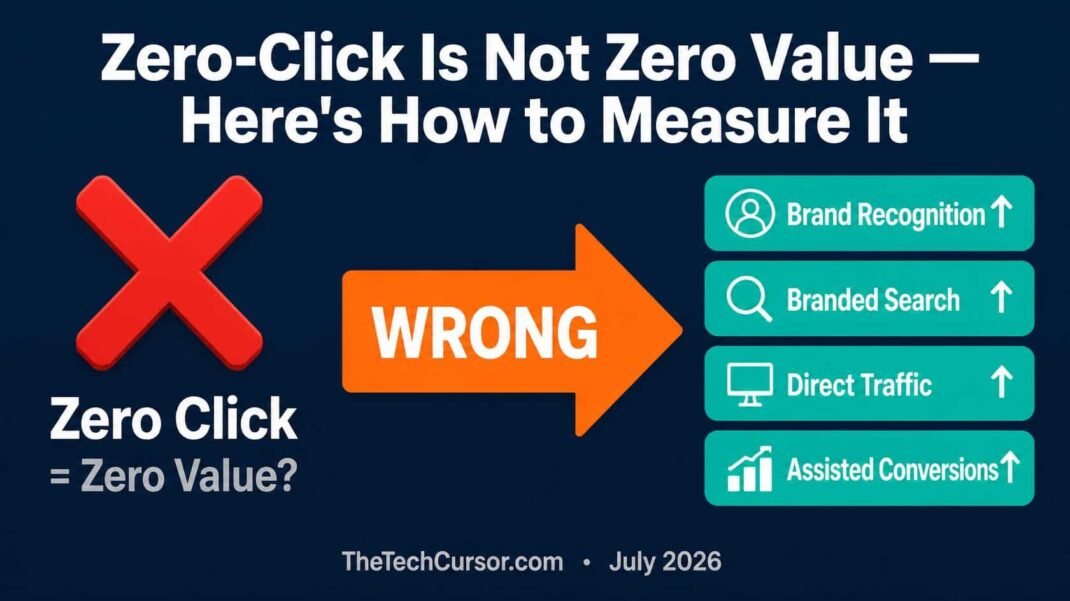
Zero-click is not zero value. Instead, it is zero measurement — which is a fundamentally different problem. Here is what AI impressions actually do and how to measure their real business impact.
Table of Contents
- The Zero-Click Panic — Why It Is Partly Misdirected
- What AI Impressions Actually Do
- The New Conversion Funnel: Impression → Recall → Search → Convert
- How to Measure Zero-Click AI Value — 5 Methods
- Method 1: Branded Search Lift
- Method 2: Assisted Conversion Tracking in GA4
- Method 3: Direct Traffic Trends
- Method 4: Share of Voice in AI Responses
- Method 5: Customer Survey Attribution
- What This Means for Your AI Search Strategy
- Bottom Line
1. The Zero-Click Panic — Why It Is Partly Misdirected
The concern about zero-click search is legitimate. As covered in TheTechCursor’s analysis of SEO priorities to rethink, click-through rates drop significantly when AI Overviews resolve queries on the search results page. Pew Research data shows users click blue links just 8% of the time when an AI summary is present, versus 15% when it is not.
For purely informational queries — definitions, simple facts, basic how-to answers — that traffic loss is real and unlikely to recover. Investing significant resources in ranking for queries that AI will permanently resolve without a click is a poor allocation.
However, the conclusion many teams draw — that AI visibility without clicks is worthless — misses something fundamental about how brand awareness works.
Consider a user who sees your brand cited in an AI Overview for a relevant query. They have received something valuable: a credible, Google-endorsed signal that your brand is an authority in that space. They may not click today. They may not convert immediately. Nevertheless, they are more likely to recognize your brand the next time they encounter it, more likely to search for you directly, and more likely to choose you when they are ready to buy.
This is how brand advertising has always worked — and AI Overviews function like high-quality, targeted brand impressions delivered at the exact moment of topic relevance.
2. What AI Impressions Actually Do
Research from multiple marketing science studies consistently shows that brand impressions — even without a direct click or conversion — generate measurable downstream effects:
Brand recognition lift: Repeated exposure in relevant contexts increases recognition and recall. For example, a user who sees your brand cited in AI Overviews three times across different queries will recognize your brand with higher probability when they encounter it again — whether in an ad, a social post, or a direct search.
Search intent activation: Brand impressions can also activate latent purchase intent. A user researching mattress types who sees a specific brand consistently cited in AI answers is more likely to search for that brand when they are ready to buy — converting a passive impression into an active branded search.
Trust transfer: Being cited by Google’s AI system functions as a credibility endorsement. Google’s brand authority transfers partially to the brands it cites consistently. This is not visible in click data — but it influences conversion rates when those users do eventually interact with your brand.
Consideration set inclusion: For high-consideration purchases — software, services, B2B products, significant consumer purchases — users build a consideration set before actively evaluating options. AI citations at the awareness stage can place your brand in that consideration set before any direct search or site visit occurs.
3. The New Conversion Funnel: Impression → Recall → Search → Convert
Traditional digital marketing assumed a relatively linear funnel: ad impression → click → landing page → conversion. Attribution was relatively straightforward because each step left a digital trace.
AI search creates a new funnel shape where a critical step — the brand impression in an AI Overview — leaves no trace in standard analytics:
Step 1: AI Overview impression. User searches for a relevant topic. Your brand is cited in the AI-generated answer. The user does not click. No session recorded.
Step 2: Recall activation (days or weeks later). The user encounters a trigger — a social post, a colleague’s recommendation, an ad — that activates memory of the brand they saw cited. This connection is invisible to analytics.
Step 3: Branded search. The user searches directly for your brand. This generates a session — but it is attributed to “organic branded search,” with no connection to the AI Overview impression that influenced it.
Step 4: Conversion. The user converts. Attribution goes to the last click — organic, branded search, direct, or another tracked touchpoint. The AI Overview that helped build the recognition and trust is invisible throughout.
This is not a new problem — TV advertising, word of mouth, and PR have always faced similar attribution challenges. However, the specific invisibility of AI Overview impressions in standard analytics is leading teams to systematically undervalue a significant brand-building channel.
4. How to Measure Zero-Click AI Value — 5 Methods
None of these methods provides perfect attribution. Together, they build a directional picture of the downstream value that AI Overview impressions are generating for your brand.
5. Method 1: Branded Search Lift
What it measures: Whether increased AI Overview impressions correlate with increased branded search volume over time.
How to implement:
Track your AI Overview impression data from Google Search Console’s AI Performance Reports — now rolling out globally as covered in TheTechCursor’s recent update. Separately, track weekly branded search volume for your brand name and branded term variations in Search Console.
Look for correlations over 60- 90-day windows. Branded search lift from AI impressions typically takes weeks to materialize, not days. If your AI Overview impressions increase substantially and branded search volume rises 4-8 weeks later, that correlation is worth noting — though it is directional rather than definitively causal.
Furthermore, if you have access to Google Trends data for your brand, this can serve as an additional corroboration signal for branded search trends without requiring Search Console access for branded keyword specifics.
6. Method 2: Assisted Conversion Tracking in GA4
What it measures: Whether AI-referred sessions that do not convert directly are appearing in the assisted conversions of users who later convert through other channels.
How to implement:
In GA4, navigate to Advertising > Attribution > Conversion paths. Filter for conversion paths that include an AI referral source — ChatGPT, Perplexity, Google AI Mode referrals — in any position except last click.
This approach will not capture AI Overview impressions that generated no click at all. However, it does reveal the assisted value of AI-referred sessions where the user clicked through once and then returned via a different channel to convert. The picture is partial — but it provides directional evidence.
As covered in TheTechCursor’s LLM prompt tracking guide, creating a dedicated channel grouping for AI referral sources in GA4 is essential for this analysis. Without that grouping, AI referral sessions are often misclassified as direct or referral traffic with no AI attribution.
7. Method 3: Direct Traffic Trends
What it measures: Whether increases in AI Overview visibility correlate with increases in direct traffic over time.
Why it works: Users who recall a brand from an AI impression frequently type the brand name directly into a browser rather than searching for it — particularly on mobile. This generates direct traffic that carries no source attribution but can be correlated directionally with AI visibility changes.
How to implement:
Track direct traffic trends in GA4 alongside your AI Overview impression data from Search Console. Look for correlations in monthly trends over a 3-6 month window. Direct traffic is notoriously noisy — many factors influence it — so this method works best as corroboration alongside other signals rather than as a standalone attribution method.
8. Method 4: Share of Voice in AI Responses
What it measures: Your brand’s presence and citation frequency in AI responses for your most important topic queries, relative to competitors.
Why it matters: Share of voice in AI responses is a leading indicator of future branded search and direct traffic lift. Brands that consistently appear in AI responses for relevant queries build recognition faster and more efficiently than those that appear inconsistently.
How to implement:
Using an AI visibility platform — or manual prompt testing across ChatGPT, Perplexity, and Google AI Mode — track citation frequency for your brand versus two or three key competitors across your core topic queries. Track this monthly. A growing share of voice in AI responses should precede — by 4-8 weeks — a corresponding lift in branded search and direct traffic.
As covered in TheTechCursor’s AI visibility measurement framework, combining prompt tracking with GA4 and Search Console data gives you the most complete picture of how AI visibility is translating into business outcomes.
9. Method 5: Customer Survey Attribution
What it measures: Self-reported awareness sources from customers at the point of conversion.
Why it matters: This is the most direct method for capturing AI impression influence — but also the least scalable and most subject to recall bias.
How to implement:
Add a single question to your post-purchase or post-signup survey: “How did you first become aware of [brand name]?” Include “I saw it mentioned in an AI search result (Google AI, ChatGPT, etc.)” as an explicit option alongside the standard channels.
Even with low survey completion rates, the responses provide directional evidence of AI impression attribution that no analytics tool can capture. If even 5-10% of converters report first awareness from an AI search result, that is significant — and likely understated given recall bias and survey completion gaps.
Furthermore, consider adding this attribution question to sales call qualification for B2B businesses — where the sales team can probe more deeply into how the prospect first heard of the brand and what that touchpoint actually was.
10. What This Means for Your AI Search Strategy
The measurement challenge around zero-click AI value has a direct strategic implication: teams that can only justify investment in measurable, last-click attribution will systematically underinvest in AI search visibility.
This creates a strategic opportunity. The brands willing to invest in AI Overview visibility — even when that investment does not show up cleanly in last-click attribution — will build brand recognition and consideration set inclusion advantages that compound over time.
The brands that dismiss AI Overview visibility because “there are no clicks” will eventually face a competitor recognition gap that is expensive to close.
Practical guidance:
Treat AI Overview visibility the way you would treat high-quality display advertising or earned media — as brand investment with delayed, distributed attribution. Build a quarterly brand health scorecard that combines the five methods above, tracking AI visibility alongside branded search trends and direct traffic patterns.
Present this framework to leadership early. The conversation about zero-click value is easier before traffic losses arrive than after. Moreover, teams that build the measurement infrastructure now will be best positioned to demonstrate AI visibility ROI as the channel continues to scale.
11. Bottom Line
Zero-click AI impressions are not zero value. They are zero measurements — and solving that measurement problem is one of the most important analytics challenges in digital marketing right now.
The five methods covered here — branded search lift, assisted conversion tracking, direct traffic trends, AI share of voice, and customer survey attribution — do not provide perfect attribution. Together, they build a directional picture that makes the business case for AI visibility investment far more defensible than “we cannot measure it, so we will not invest.”
Start building this measurement framework now. The brands that understand what AI impressions are worth — and can demonstrate it — will make better investment decisions and build durable advantages as AI search continues to grow.
Zero-click is not zero value. Measure it accordingly.
Pingback: Google Is Now Automatically Expanding AI Overviews for Some Queries — What This Means for Clicks - The Tech Cursor
Pingback: WeatherNext 3: Google Search Is Becoming a Task Engine - The Tech Cursor