
Published: July 14, 2026
Read time: 7 min
Somewhere between the launch of ChatGPT and the current moment, “AI content detection” became a legitimate industry. Dozens of tools now promise to tell you whether a piece of content was written by a human or generated by an AI. Publishers use them to screen submissions. Employers use them to evaluate job applications. Teachers use them to flag student work. Marketing teams use them to audit vendor deliverables.
There is one significant problem: the tools are less accurate than most people using them realize — and what they actually measure is not quite what most people think.
Here is an honest breakdown of how AI content detectors work, what the research says about their accuracy, and whether your team should be using one at all.
Table of Contents
- Why AI Content Detection Has Become a Problem
- How AI Content Detectors Actually Work
- The Accuracy Problem — What the Research Shows
- The False Positive Problem
- The Leading Tools Compared
- What AI Detectors Cannot Tell You
- Google’s Position — Does AI Content Get Penalized?
- Should You Use an AI Content Detector?
- What Actually Matters — Quality Over Origin
- Bottom Line
1. Why AI Content Detection Has Become a Problem
The demand for AI content detection tools emerged from a straightforward anxiety: if AI can generate content that looks human-written, how do you know what you are reading was actually written by a person?
For some use cases, that question matters a great deal. Academic institutions need to evaluate whether students produced their own work. Publishers need to assess whether submitted pieces reflect genuine human expertise. Businesses need to know whether contracted content writers are delivering original work or running prompts through ChatGPT and billing for it.
However, as AI writing tools have become more sophisticated — and as more human writers have integrated AI assistance into their workflows — the line between “AI content” and “human content” has become genuinely blurry. Furthermore, the detection tools have not kept pace with the writing tools in terms of reliability.
2. How AI Content Detectors Actually Work
Understanding what these tools measure helps explain their limitations.
Most AI content detectors are built on one or both of two underlying techniques:
Perplexity measurement: Perplexity measures how predictable or surprising a piece of text is. AI language models generate text by predicting the most probable next word given the context. As a result, AI-generated text tends to be less “surprising” — lower perplexity — than human writing, which introduces more variation, unexpected word choices, and structural unpredictability.
Detectors that measure perplexity flag text with consistently low perplexity as likely AI-generated.
Burstiness measurement: Burstiness refers to variation in sentence length and complexity. Human writers naturally vary their sentence structure — short, punchy sentences followed by longer, more complex ones. AI models tend toward more uniform sentence patterns — more consistent length, less dramatic variation in complexity.
Detectors that measure burstiness flag text with low variation as likely AI-generated.
The fundamental limitation: Both of these are statistical proxies, not direct evidence. A clear, precise, well-organized human writer may produce text with low perplexity and low burstiness — and get flagged as AI-generated. An AI prompt engineered for variety may produce high-perplexity, high-burstiness text — and pass as human-written.
3. The Accuracy Problem — What the Research Shows
The research on AI content detector accuracy is not encouraging. Studies consistently find meaningful error rates — particularly for false positives, where human-written content is incorrectly flagged as AI-generated.
Key findings from recent research:
- A Stanford study found that AI detectors disproportionately flag non-native English speakers as AI writers — because non-native writing patterns can mimic some statistical characteristics of AI output
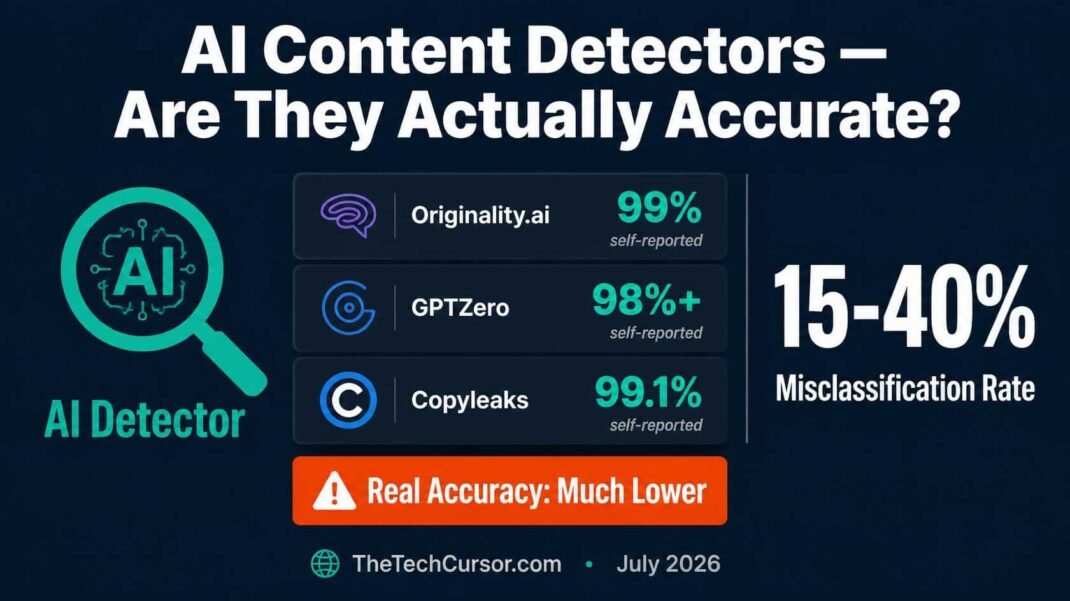
- Multiple studies found accuracy rates ranging from 60% to 85% across leading tools — meaning 15% to 40% of content is misclassified
- When writers are explicitly instructed to humanize AI content — adding personal anecdotes, restructuring sentences, introducing deliberate variation — detection accuracy drops significantly
- GPT-4 and Claude 3.5+ era models produce text that current detection tools struggle with more than earlier AI outputs
The accuracy problem is getting worse, not better, as AI writing models improve faster than detection methods.
4. The False Positive Problem
False positives — human content incorrectly flagged as AI — are the most damaging accuracy failure mode for most practical use cases.
Consider the implications:
- A student submits genuine original work and receives an academic penalty based on a tool’s incorrect classification
- A freelance writer delivers authentic human-written content and loses a client relationship based on a false positive
- A marketing team rejects a qualified job candidate’s writing sample because a detector flagged it
These are real harms that are difficult or impossible to appeal, because the tools do not explain their reasoning — they return a score, not evidence.
Furthermore, certain types of legitimate human writing are systematically more likely to receive false positives:
- Technical writing — precise, consistent language with low stylistic variation
- Non-native English — patterns that differ from native speaker “burstiness” norms
- Highly edited writing — professional editing often removes the idiosyncrasies that make text feel “human” to a detector
- Writing in formal registers — legal, academic, and scientific writing tends toward the consistency patterns detectors flag as AI
The tools were largely calibrated on specific types of writing samples. Content that differs from those samples — in style, register, or linguistic background — faces higher false positive rates.
5. The Leading Tools Compared
| Tool | Primary Method | Claimed Accuracy | Known Limitations |
|---|---|---|---|
| Originality.ai | Perplexity + ML classifier | 99% (self-reported) | Higher false positive rate on technical content; version-specific |
| Copyleaks | Proprietary ML model | 99.1% (self-reported) | Struggles with heavily edited AI content |
| GPTZero | Perplexity + burstiness | 98%+ (self-reported) | Non-native English false positives documented |
| Winston AI | ML classifier | 99.6% (self-reported) | Limited testing on Claude-generated content |
| Turnitin AI | Proprietary (academic) | 98% (self-reported) | Calibrated for academic writing; poor on other formats |
Important caveat: Claimed accuracy figures are almost universally self-reported by the tool vendors — often tested on datasets they controlled. Independent third-party accuracy testing consistently finds lower numbers. Furthermore, accuracy degrades as AI writing models improve — a tool’s 2024 accuracy figures may not reflect its 2026 performance against current AI output.
6. What AI Detectors Cannot Tell You
Even when an AI detector is correct that the content involved AI generation, it cannot tell you:
How much AI was involved? A piece where a human wrote the outline, key arguments, and conclusion — then used AI to smooth transitions and expand a paragraph — looks the same to a detector as a piece entirely generated by AI from a single prompt.
Whether the AI assistance was appropriate. Using AI to check grammar and suggest phrasing is categorically different from having AI write the entire piece. A detector cannot distinguish between these use cases.
Whether the content is accurate, useful, or original in its ideas. A detector that flags content as AI-generated tells you nothing about whether the content is actually good. Conversely, content that passes as human-written tells you nothing about its quality.
Whether the content violates any policy. The content policy question — should this content have been produced this way for this purpose? — is a judgment call that depends on context, not a statistical score.
7. Google’s Position — Does AI Content Get Penalized?
This is the most practically important question for Marketers and SEO professionals — and Google’s answer is clear.
Google does not penalize content based on whether it was AI-generated. Google’s spam policies target low-quality content produced at scale to manipulate search rankings — regardless of whether that content was produced by a human or an AI. The mechanism of production is not the issue. The quality and purpose are.
As covered in TheTechCursor’s article on Google’s official AI search guidance, Google has explicitly stated that AI-assisted content is acceptable provided it meets the same quality standards as human-written content — genuine helpfulness,
E-E-A-T signals, and content that serves readers rather than manipulating algorithms.
The June 2026 Spam Update targeted AI-generated spam — low-quality, mass-produced content created purely for ranking manipulation. It did not target AI-assisted content produced with genuine editorial oversight and reader value in mind.
Running your content through an AI detector before publishing to “check if Google will penalize it” is therefore solving the wrong problem. Google does not use AI detectors to evaluate your content. It evaluates quality, usefulness, and relevance — regardless of how the content was produced.
8. Should You Use an AI Content Detector?
The honest answer depends entirely on what you are trying to achieve.
Legitimate use cases:
- Academic institutions evaluating whether submitted work reflects the student’s own thinking — with the significant caveat that results must be treated as one input to a broader evaluation, not as definitive evidence
- Publishers or brands screening vendor content for cases of complete AI generation with no human contribution — again, as a starting signal for investigation, not a verdict
- Internal quality audits to identify whether contracted writers are consistently delivering genuine human work versus AI output with minimal editing
Use cases where detectors add little value:
- Pre-publish screening for Google penalties — Google does not work this way
- Evaluating content quality — a detector score tells you nothing about whether content is accurate, useful, or original in its thinking
- Definitively proving or disproving AI use — the accuracy limitations make this unreliable as a standalone verdict
If you do use a detector, treat the output as a data point, not a verdict. Investigate further before taking action. Do not penalise writers, vendors, or students based on a detection score alone — particularly given the documented false positive rates.
9. What Actually Matters — Quality Over Origin
The more useful frame for content teams in 2026 is not “was this written by AI?” but “does this content deliver genuine value to readers?”
As covered in TheTechCursor’s guide to training Claude for brand voice, the most effective use of AI in content production is as a capable collaborator — handling structure, research synthesis, and drafting — while human expertise provides the original thinking, judgment, specific experience, and editorial standards that make content genuinely worth reading.
Content produced this way may score as “AI-generated” on a detector — because AI was involved in its production. However, it also delivers genuine reader value, reflects authentic expertise, and satisfies Google’s quality standards. The detection score is irrelevant to any of these outcomes.
The teams that will produce the best content in 2026 are not those obsessing over detector scores. They are the ones building clear editorial standards for how AI tools are used — what AI handles, what humans must contribute, and what quality bar every piece must meet regardless of how it was produced.
10. Bottom Line
AI content detectors are real tools with legitimate use cases — and significant limitations that most people using them do not fully understand.
They measure statistical proxies for AI generation, not direct evidence. Their accuracy is lower than vendor claims suggest, particularly against current AI models. Their false positive rates create real risks for human writers, students, and contractors whose work gets incorrectly flagged.
For marketers and SEO professionals specifically: Google does not use AI detectors, and running your content through one before publishing does not reduce your SEO risk. What reduces your SEO risk is producing content that is genuinely helpful, well-sourced, and editorially sound — regardless of what tools were involved in its production.
If you are going to use an AI detector, use it as one signal among many — not as a verdict. And be honest about what it can and cannot tell you.