
Published: July 17, 2026
Read time: 7 min
Perplexity just launched Deep Research — and it is making a credible case to be the most capable autonomous research tool available to marketers and knowledge workers in 2026.
The pitch is straightforward: instead of asking Perplexity a question and getting an answer, you assign Perplexity a research task, and it works through it autonomously — searching, reading, synthesizing, and iterating across dozens of sources over several minutes before delivering a structured, cited report.
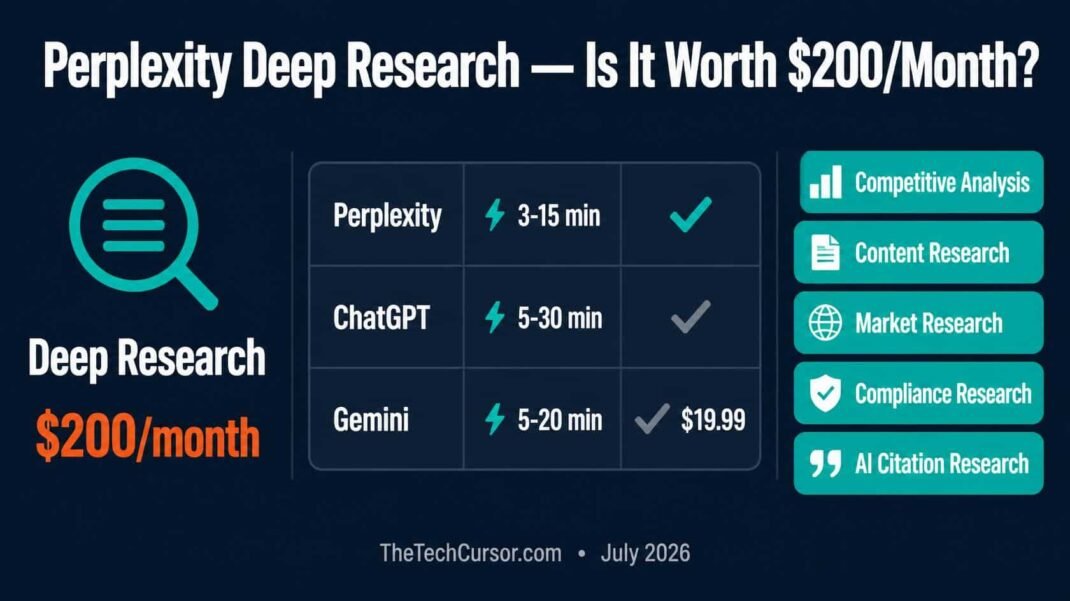
At $200 per month for the Max plan, it is not cheap. However, for teams that do significant research work, it may be one of the more defensible AI tool investments available right now. Here is what it actually does, how it compares to alternatives, and whether the price tag is justified.
Table of Contents
- What Is Perplexity Deep Research?
- How It Works — The Autonomous Research Loop
- What Makes It Different From Standard Perplexity
- Deep Research vs ChatGPT Deep Research vs Gemini Deep Research
- The Best Use Cases for Marketers and SEO Professionals
- The Limitations You Need to Know
- The $200/Month Question — Is It Worth It?
- How to Get the Most Out of Deep Research
- Bottom Line
1. What Is Perplexity Deep Research?
Deep Research is Perplexity’s autonomous research agent — a feature that takes a complex research question and works through it systematically, without requiring constant human guidance.
Standard Perplexity answers questions with cited sources. Deep Research conducts research — reading multiple sources, identifying gaps, pursuing follow-up questions, and synthesizing findings into a coherent report with full source attribution.
The distinction matters. Answering a question requires retrieving and summarizing relevant information. Conducting research requires evaluating sources, identifying contradictions, pursuing threads that lead to better understanding, and organizing findings into a structure that serves the research goal.
Deep Research is designed for the second category of tasks.
2. How It Works — The Autonomous Research Loop
When you submit a Deep Research task, Perplexity does not immediately return an answer. Instead, it begins an iterative research process that typically takes 3 to 15 minutes, depending on complexity.
The process works in roughly five stages:
Stage 1: Query decomposition. Perplexity breaks your research question into component sub-questions that collectively address the full scope of your request. This is similar to the query fan-out process covered in TheTechCursor’s AI search series — except here it is happening explicitly for a research task rather than implicitly for a search query.
Stage 2: Parallel source retrieval. Perplexity searches across the web simultaneously for sources relevant to each sub-question. It prioritizes recent, authoritative sources and — for Max plan users — can access academic databases and paywalled content beyond the standard web index.
Stage 3: Source evaluation and reading. Unlike standard search, Deep Research actually reads the sources it retrieves — extracting relevant information, evaluating credibility, and identifying where sources agree, disagree, or provide complementary perspectives.
Stage 4: Gap identification and iteration. If the initial sources do not fully address the research question, Deep Research identifies what is missing and runs additional searches to fill those gaps. This iterative loop is what distinguishes it from a single-pass search summary.
Stage 5: Synthesis and report generation. Finally, Deep Research synthesizes its findings into a structured report — with section headers, key findings, and inline citations for every factual claim. The output is not a chat response. It reads more like a research brief.
3. What Makes It Different From Standard Perplexity
Standard Perplexity is excellent for quick, well-sourced answers to specific questions. Deep Research is designed for different situations entirely.
| Standard Perplexity | Deep Research | |
|---|---|---|
| Best for | Quick factual queries | Complex multi-part research |
| Time to answer | Seconds | 3-15 minutes |
| Source depth | Retrieves and summarizes | Reads and evaluates |
| Iteration | Single pass | Multiple iterative passes |
| Output format | Chat response with citations | Structured report with citations |
| Academic access | Limited | Expanded (Max plan) |
The practical implication: use standard Perplexity for quick lookups and fact-checks. Use Deep Research for tasks that would otherwise require 30 minutes to several hours of manual research — competitive analysis, market landscape briefs, literature reviews, regulatory research.
4. Deep Research vs ChatGPT Deep Research vs Gemini Deep Research
Perplexity is not alone in this category. Both OpenAI and Google have launched their own deep research capabilities. Here is how they compare:
| Perplexity Deep Research | ChatGPT Deep Research | Gemini Deep Research | |
|---|---|---|---|
| Price | $200/month (Max) | $200/month (Pro) | $19.99/month (Advanced) |
| Research time | 3-15 minutes | 5-30 minutes | 5-20 minutes |
| Source access | Web + academic databases | Web + uploaded files | Web + Google ecosystem |
| Output format | Structured report | Structured report | Structured report |
| Citation quality | Strong — inline citations | Strong — inline citations | Good — section citations |
| Real-time web | Yes | Yes | Yes |
| Strengths | Speed, source breadth, citation density | File analysis, coding integration | Google data integration, Workspace |
The honest comparison: All three are genuinely capable. The best choice depends on your existing tool stack and specific use cases.
For teams already on Google Workspace, Gemini Deep Research’s integration advantage is significant — and the lower price makes it far more accessible. For teams that need maximum research depth with strong citation quality at speed, Perplexity Deep Research performs consistently well. For teams doing complex file analysis alongside research, ChatGPT Deep Research has an edge through its file handling capabilities.
5. The Best Use Cases for Marketers and SEO Professionals
Deep Research tools are not useful for every marketing task. However, for specific workflows, they can replace hours of manual research with a structured brief delivered in minutes.
Competitive landscape analysis: Assign Deep Research to map out a competitive category — who the major players are, what their positioning is, where the gaps exist, and what recent moves each competitor has made. A task that typically requires 2-4 hours of manual research and synthesis can return a solid first draft in 15 minutes.
Content research and source identification For long-form content requiring substantial research — industry reports, comprehensive guides, data-driven articles — Deep Research can identify relevant sources, extract key statistics, and organize findings by theme. This does not replace editorial judgment, but it dramatically accelerates the research phase.
Market and audience research: Understanding a new market, audience segment, or product category benefits from the iterative research approach. Deep Research can synthesize trade publications, analyst reports, consumer discussions, and news coverage into a coherent landscape brief.
Regulatory and compliance research For brands operating in regulated industries — finance, healthcare, legal, food and beverage — staying current on regulatory changes and compliance requirements is time-intensive. Deep Research can monitor and synthesize updates across multiple regulatory sources into digestible briefs.
AI citation landscape research. For SEO professionals specifically, Deep Research can help map which sources are being cited for specific topics in AI search responses — identifying the publications and platforms your content strategy should target. This use case connects directly to the topic-specific authority building covered in TheTechCursor’s off-page SEO series.
6. The Limitations You Need to Know
Deep Research is genuinely capable — and genuinely limited in ways that matter for professional use.
Hallucination risk remains. Deep Research reads more sources and cites them more carefully than standard AI responses. Nevertheless, it can still produce incorrect synthesis — particularly when sources conflict, when information is ambiguous, or when the research question touches on very recent events that are not yet well-documented online.
Always verify key claims against the cited sources before using Deep Research output in client-facing or decision-critical work.
Report quality varies with prompt quality. Like all AI tools, Deep Research performs better with specific, well-structured research questions than with vague or overly broad requests. “Research AI search optimization” will produce a less useful output than “Provide a comparative analysis of how Google AI Overviews, ChatGPT, and Perplexity select sources for inclusion, with specific focus on what content attributes influence citation probability.”
Investing time in prompt quality pays dividends in output quality.
Not a replacement for primary research, Deep Research synthesizes existing published information. It cannot conduct interviews, run surveys, analyze proprietary data, or generate genuinely new insights that do not already exist in some form online. For research questions that require primary data, it is a useful background tool — not a replacement for the actual research.
Paywalled content access is imperfect. Max plan access to academic and paywalled content is better than standard web-only access. However, it is not comprehensive. Significant paywalled content remains inaccessible, and the depth of academic database coverage varies by discipline.
7. The $200/Month Question — Is It Worth It?
Perplexity Max at $200/month is a premium commitment. Whether it justifies the price depends entirely on how much research work your team actually does.
The math for individual professionals: If Deep Research saves you 2 hours of manual research per week — a conservative estimate for regular users — that is approximately 8 hours per month. At $25/hour of saved time, the tool breaks even. At $50/hour or above, the ROI is clear.
The math for teams: A single Perplexity Max account can serve multiple team members if research tasks are coordinated rather than running simultaneously. For small teams, the cost per user drops significantly with shared access.
The comparison to alternatives: At $200/month, Perplexity Max is priced identically to ChatGPT Pro. Gemini Advanced at $19.99/month is dramatically cheaper — though with trade-offs in research depth and citation quality. If budget is a constraint, Gemini Advanced is worth serious evaluation before committing to the $200 tier.
Who should consider Perplexity Max:
- Content strategists and writers who regularly produce research-heavy content
- SEO professionals doing competitive and landscape analysis
- Consultants and agency professionals who bill for research-intensive work
- Marketers in regulated industries require ongoing compliance research
Who probably does not need it:
- Teams whose research needs are primarily quick, factual lookups
- Marketers with light research requirements who can use standard Perplexity or free-tier alternatives
- Teams already invested in Gemini Advanced, who find its research output sufficient
8. How to Get the Most Out of Deep Research
If you decide to adopt Deep Research — from Perplexity, ChatGPT, or Gemini — these practices will significantly improve the quality of output:
Be specific about scope and depth. Specify the scope of your research request explicitly. “Analyze the top 5 competitors in the B2B HR software market, focusing on their positioning, pricing model, and recent product announcements from the last 6 months” produces more useful output than “research HR software competitors.”
Specify your output format. Tell Deep Research how you want the output structured. “Provide a brief executive summary followed by detailed sections for each competitor, with a comparison table at the end” gives the tool clear formatting guidance.
Request source diversity explicitly. If you want coverage across different source types — industry publications, academic research, news coverage, community discussions — specify that in the prompt. Otherwise, Deep Research may weight toward the most authoritative sources in a narrow range.
Treat output as a first draft. Deep Research output is a starting point, not a finished deliverable. Plan for a review pass — checking key claims against cited sources, adding context from your own knowledge, and editing for your specific audience and format requirements.
Build a prompt library. If you run similar research tasks regularly, develop standardized prompt templates that consistently produce useful outputs. A well-crafted prompt template for competitive analysis, saved and reused across engagements, compounds in value over time.
9. Bottom Line
Perplexity Deep Research is one of the most capable autonomous research tools available to marketers and knowledge workers in 2026. Its iterative research loop, strong citation quality, and structured output format make it genuinely useful for complex research tasks that would otherwise require significant manual effort.
At $200/month, it is a tool for teams that do meaningful research work — not a casual addition to a tools stack. For those teams, the time savings are real, and the ROI is defensible.
Furthermore, the category is evolving rapidly. ChatGPT, Gemini, and emerging competitors are all investing in deep research capabilities. Teams that build effective workflows around these tools now will have both a productivity advantage and a head start in adapting as the tools continue to improve.
If research is a significant part of your team’s work, Deep Research tools deserve serious evaluation. Start with the free or lower-cost tiers of each platform before committing to the premium pricing — and build your assessment around the specific research tasks your team does most often.