
Category: Google Search | AI Overviews | SEO News
Read time: 5 min
Site: TheTechCursor
Table of Contents
- What Happened
- What Was Launched — Then Paused
- Why the Pause Matters for Publishers and Brands
- The Brand Control Problem
- The Zero-Click Escalation
- What Comes Next
- Bottom Line
Google launched AI-generated images inside AI Overviews on July 14, 2026 — and then paused the feature.
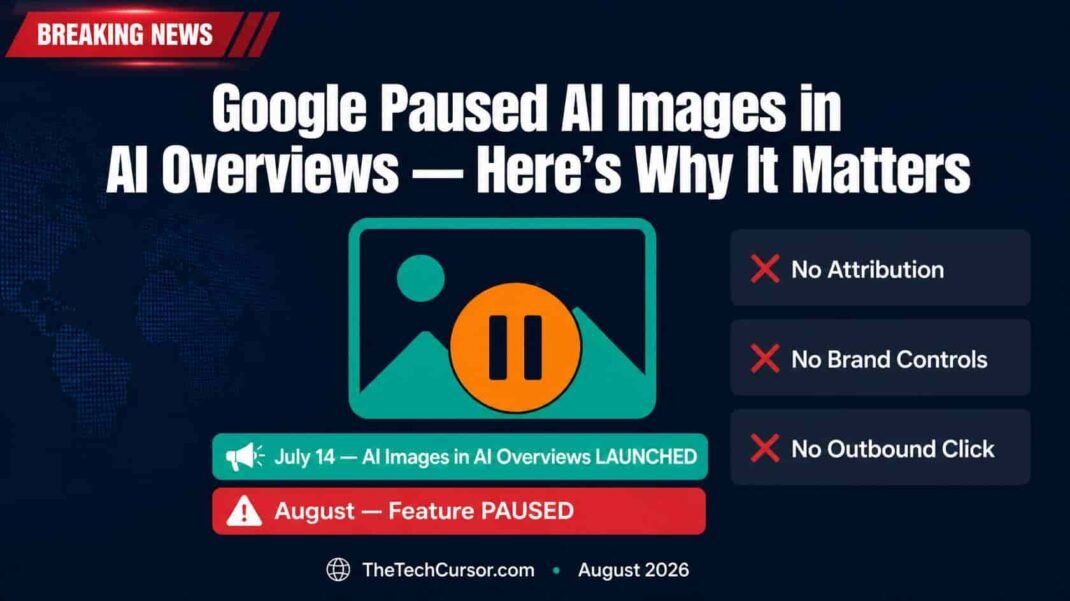
The announcement arrived as a milestone: Google Images’ 25th anniversary. <cite index=”62-1″>On July 14, Google announced that image generation was coming directly into AI Overviews, powered by what it calls its “latest Nano Banana model.” Search stops linking to a publisher’s photograph and starts drawing its own picture, with no attribution, no outbound click, and no stated brand controls.</cite>
The feature was live briefly — and then Google quietly pulled it back. Here is what the launch revealed, why the pause happened, and what it signals about where AI Overviews are heading.
1. What Happened
Google launched AI image generation directly inside AI Overviews as part of its Google Images 25th anniversary celebration. The feature allowed AI Overviews to generate original images in response to search queries — rather than surfacing existing photographs from the web.
Shortly after launch, Google paused the feature. The exact reason has not been formally stated by Google, but the pattern is familiar: the 2024 pause of Gemini’s people image generation for accuracy issues related to race representation followed a similar arc — launch, backlash, pause, refinement, relaunch.
2. What Was Launched — Then Paused
The AI image generation feature inside AI Overviews used Google’s Nano Banana model family. <cite index=”62-1″>Nano Banana Pro launched November 20, 2025, built on Gemini 3 Pro. Nano Banana Pro and Nano Banana 2 both reached general availability on May 28, 2026, and Nano Banana Lite followed on June 30, 2026.</cite>
The capability itself was not entirely new — image generation had already been available in AI Mode. <cite index=”62-1″>What changed on July 14 is the surface.</cite> Moving image generation from AI Mode — a dedicated conversational search tab — into AI Overviews placed it on the main search results page for a vastly larger share of queries and users.
That surface change transformed the scale and visibility of the feature — and likely amplified both the positive reception from users and the concerns from publishers and brands that triggered the pause.
3. Why the Pause Matters for Publishers and Brands
The AI image generation feature in AI Overviews was not paused because of a minor edge case. It was paused because it revealed a structural tension that Google has not yet resolved.
When AI Overviews generate original images in response to search queries, several things happen simultaneously:
No outbound click is generated. A user who previously might have clicked through to a photography site, a stock image platform, or a brand’s own visual content receives an AI-generated image instead — with no click to any external source.
No attribution is provided. The generated image does not credit any source, artist, or brand. It is presented as Google’s output — not as content discovered from the web.
No brand controls exist. <cite index=”62-1″>For the first time, the default search surface doesn’t just summarize the web’s words. It draws its own pictures.</cite> Brands have no mechanism to prevent AI Overviews from generating images that represent their products, services, or visual identity — accurately or inaccurately.
4. The Brand Control Problem
The brand control gap is the most commercially significant concern for marketers.
When AI Overviews generate images in response to product queries, those images may not accurately represent the brand’s actual products, colour schemes, or visual identity. A user searching for a specific product and receiving an AI-generated image of a similar — but incorrect — product could make purchasing decisions based on inaccurate visual information.
Furthermore, there is no opt-out mechanism specifically for AI image generation. The Search Console opt-out setting — <cite index=”65-1″>which lets sites pull content out of AI Overviews, AI Mode, and Discover’s AI features</cite> — applies to text content and citations. It does not address AI-generated images that Google creates independently without sourcing from any specific publisher page.
This means the pause in AI image generation is not just a temporary quality issue. It is a signal that Google needs to develop a new layer of brand controls before the feature can safely relaunch at scale.
5. The Zero-Click Escalation
AI-generated images in AI Overviews represent a significant escalation in the zero-click trend that has been reshaping search traffic patterns throughout 2026.
Text-based AI Overviews reduce clicks by resolving informational queries without requiring a visit to a publisher’s page. AI-generated images go further — they reduce clicks on visual queries that previously drove significant traffic to photography sites, image libraries, e-commerce product pages, and branded media.
<cite index=”64-1″>The announcement sent some corners of the SEO world into panic. The reality is more nuanced.</cite> Not every query that triggers AI image generation would have generated a meaningful click to an external source anyway. However, for product-related and brand-adjacent visual queries — where a click to the brand’s own imagery was a legitimate commercial outcome — AI-generated images represent a genuine traffic displacement.
As covered in TheTechCursor’s earlier analysis of zero-click AI value, the appropriate response is not panic but measurement. Understanding which visual queries drive AI image generation rather than image clicks is the first step toward an informed strategic response.
6. What Comes Next
Based on Google’s historical pattern with paused features, the AI image generation capability in AI Overviews is unlikely to be permanently discontinued. The 2024 pause of Gemini’s people image generation lasted several months before a refined version relaunched.
Several developments are likely before relaunch:
Accuracy improvements. The pause likely includes refinement of the Nano Banana model’s output quality for search-specific image generation — improving accuracy, realism, and relevance to specific queries.
Brand controls development. Google will need to develop mechanisms that give brands some input into how AI-generated images represent their products and visual identity — whether through structured data signals, brand verification, or opt-out mechanisms specifically for image generation.
Publisher and advertiser consultation. The structural concerns around attribution and click displacement are significant enough that Google is likely to consult with major publishers and advertisers before relaunching — similar to the consultation process that preceded major AI Overviews policy changes in 2025.
For marketers, the pause is an opportunity to prepare. Ensure your product structured data is complete and accurate — this is likely to influence how AI systems understand and represent your products visually. Review your brand guidelines documentation and ensure it is accessible in ways that Google’s systems can potentially reference.
7. Bottom Line
Google’s pause of AI-generated images in AI Overviews is a significant development — not because the feature failed, but because its brief existence revealed unresolved structural questions about attribution, brand controls, and click displacement that Google needs to address before a stable relaunch.
For SEO professionals and brand marketers, the pause is a window to prepare. Audit your product structured data. Ensure your brand’s visual identity is accurately represented in your existing web content. Monitor the Search Console opt-out settings as they evolve. And watch for Google’s next announcement on this feature — which, based on historical patterns, is likely to include new brand control mechanisms that did not exist in the July 14 launch.
AI-generated images in search are coming. The pause just means they are coming more carefully.