
Category: AI Search | Content Strategy | SEO | GEO
Read time: 7 min
Site: TheTechCursor
Table of Contents
- The Measurement Gap That Is Costing Brands Citations
- Why Trending Topics Create Citation Opportunities
- The Opportunity Void Concept
- Step 1: Build a Daily Trend Monitoring Routine
- Step 2: Identify Opportunity Voids Before Competitors
- Step 3: Publish Fast — But With Information Gain
- Step 4: Structure Content for AI Extraction
- Step 5: Monitor Your Citation Performance
- The Tools That Make This Workflow Possible
- Bottom Line
Only 14% of marketers currently track AI citation visibility — despite 43% naming AI search optimization as a core 2026 strategy.
<cite index=”63-1″>That gap — between the brands treating AI search as a priority and the brands actually measuring their presence in AI-generated answers — represents the largest measurement gap in the current SEO landscape.</cite>
Trending topics are one of the clearest opportunities to close that gap. When a topic is emerging — gaining search volume before most publishers have covered it comprehensively — AI systems face a scarcity of quality sources to cite. Brands that publish authoritative, structured content at that moment are significantly more likely to be cited than those who arrive weeks later into a crowded content landscape.
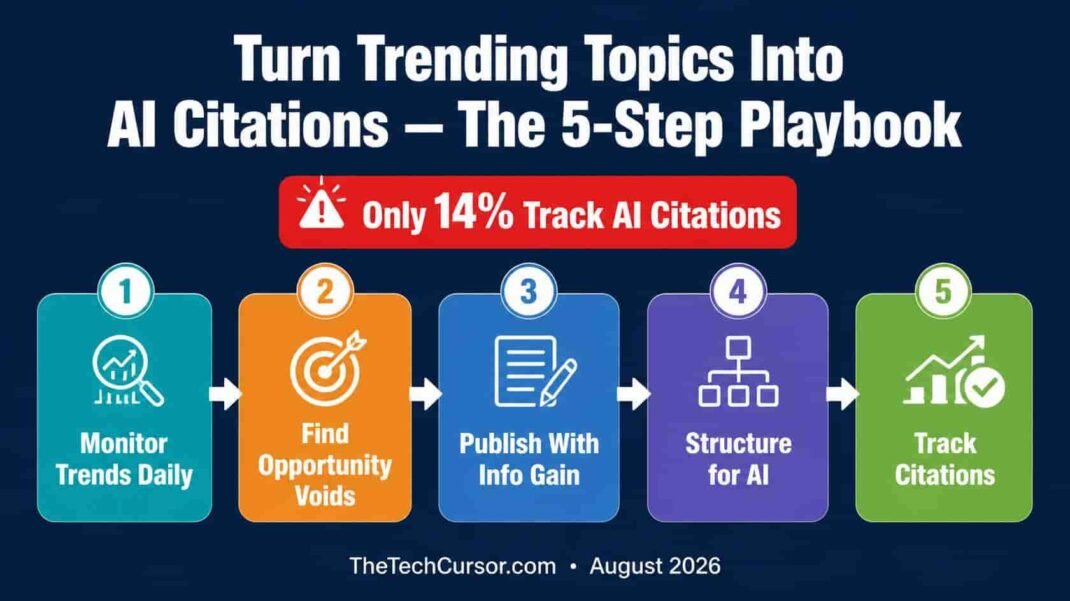
Here is the complete workflow for monitoring trending topics and converting them into AI citations.
1. The Measurement Gap That Is Costing Brands Citations
<cite index=”63-1″>Only 14% track AI/LLM citation visibility, despite 43% naming AI optimization a core 2026 strategy.</cite> This disconnect between strategic intent and measurement reality has a concrete cost: brands are investing in AI-optimized content without knowing whether those investments are producing citations — and therefore without the data to improve.
Furthermore, <cite index=”60-1″>traditional tools aggregate clickstream data over 30 to 90 days. By the time a breakout term appears in those databases, the trend curve may have already flattened.</cite>
This timing problem is particularly acute for AI citations. AI systems cite sources they encounter during retrieval — meaning the content that earns citations for a trending topic is content that existed when the topic was actively being searched, not content published after the trend peaked.
The brands that win AI citations for emerging topics are the ones with a real-time trend monitoring workflow — not the ones waiting for monthly keyword reports.
2. Why Trending Topics Create Citation Opportunities
When a topic begins to trend, AI search systems encounter an information gap. Users are asking questions that the AI’s training data does not fully address — because the topic is too new, too specific, or too rapidly evolving for the existing corpus to satisfy.
<cite index=”60-1″>A robust GEO strategy involves identifying “Opportunity Voids” — topics where the AI cannot yet provide a comprehensive answer due to a lack of consensus data.</cite>
In these voids, AI systems are actively searching for any credible, well-structured source that addresses the topic. The citation competition is lowest exactly when the search demand is rising most rapidly — creating a narrow window where publishing first with high-quality content produces citation rates that would be unachievable weeks later when dozens of competitors have covered the same topic.
<cite index=”60-1″>These Breakout topics represent high-intent demand with often lower competition levels than established keywords.</cite> For brands that can identify them early and publish quickly with genuine expertise, they represent the most efficient citation acquisition available.
3. The Opportunity Void Concept
An Opportunity Void is a topic where:
- Search volume is rising rapidly
- Existing content coverage is thin, low-quality, or highly fragmented
- AI systems are encountering the topic but cannot yet generate a confident, well-sourced response
- No clear authoritative source has established dominance
Opportunity Voids are temporary by definition. Within days to weeks of a topic emerging, publishers begin covering it comprehensively — and the citation landscape becomes competitive. The window for early entry closes quickly.
<cite index=”60-1″>For a beauty brand, this means complementing your “best moisturizer” (evergreen) strategy with content addressing a Breakout ingredient the week it begins to gain traction.</cite>
The same logic applies across every industry. A B2B software company monitoring for emerging regulatory changes, new technology frameworks, or shifting industry terminology can publish authoritative explanations during the void — before the space fills with generic competitor content.
4. Step 1: Build a Daily Trend Monitoring Routine
<cite index=”60-1″>For high-velocity topics, a daily routine helps maintain visibility. Check the “Trending Now” dashboard daily. Filtering by specific country ensures local relevance.</cite>
The core monitoring stack:
Google Trends — Trending Now dashboard: This is the primary signal source for emerging topics. The “Trending Now” tab shows what is gaining search volume right now — not what was popular last month. Filter by country and category to surface trends relevant to your industry.
Google Trends — Breakout terms in your topic area: Search for your core topic areas and filter results to show “Breakout” terms — queries growing over 5,000% in the time period. These are the Opportunity Voids before they become saturated.
Google Search Console — Emerging query clusters: New queries appearing in your Search Console data with growing impressions but low clicks often signal topics adjacent to your existing authority where you are being surfaced but not yet satisfying searchers effectively. These are gaps to close.
Industry news feeds and social listening: Reddit, LinkedIn, industry Slack communities, and Twitter/X often surface emerging topics 24-48 hours before they appear in Google Trends data. Monitoring these surfaces gives additional lead time.
The daily routine:
- 15 minutes each morning reviewing Trending Now in your category
- Weekly review of Breakout terms in your core topic areas
- Monthly audit of emerging query clusters in Search Console
This does not require sophisticated tooling to start. Google Trends is free and sufficient for the core monitoring workflow.
5. Step 2: Identify Opportunity Voids Before Competitors
Not every trending topic is an Opportunity Void worth pursuing. Evaluate each emerging topic against three criteria:
Relevance to your brand’s entity: Does this topic connect naturally to what your brand is already known for? AI systems cite sources that have established topical authority in adjacent areas — not random publishers who happened to cover a topic once. A trending topic that sits within your existing entity space is significantly more likely to produce a lasting citation than one that is tangentially related.
Content gap assessment: Search the trending topic directly in Google, ChatGPT, and Perplexity. What does the existing coverage look like? If AI systems are generating confident, well-sourced answers with multiple credible citations — the void is already filled. If responses are thin, heavily hedged, or drawing from low-quality sources — an Opportunity Void exists.
Your genuine expertise: Can your brand produce content on this topic that adds genuine information gain — original data, first-hand expertise, or a perspective that is not already available? Publishing fast with generic content does not earn citations. Publishing fast with genuine expertise does.
6. Step 3: Publish Fast — But With Information Gain
Speed matters for trending topics. However, speed without quality is worse than no content at all — it produces pages that AI systems encounter and dismiss, which can actually create a negative association between your brand and that topic.
<cite index=”59-1″>The goal in 2026 is to serve as the citation that powers the answer.</cite> That requires content that contains something AI systems cannot generate from their training data alone.
Information gain checklist for trending topic content:
- Does the piece include original data, a proprietary perspective, or a first-hand account?
- Does it directly address the specific questions emerging from the trend — not just the surface topic?
- Does it take a clear, defensible position rather than hedging with generic “on one hand, on the other hand” framing?
- Is it structured so that specific claims are extractable — stated clearly enough to be quoted or cited individually?
Furthermore, <cite index=”60-1″>user behaviour has evolved from keyword-heavy searches to natural language prompts. Content structure should adapt.</cite> An article that is simply a list of facts may be less effective than one that frames those facts within a clear narrative or framework that directly addresses the question users are asking.
7. Step 4: Structure Content for AI Extraction
Even well-researched content fails to earn AI citations if it is not structured in ways that AI systems can parse and extract efficiently.
<cite index=”64-1″>What matters is providing structured, concise information that Google can extract — lists, tables, FAQs, or definitional passages. Schema.org markup and clean entity linking increase the likelihood of being cited as a source in AI Mode.</cite>
Structural elements that maximize citation probability:
Direct question-answer pairs: Lead each section with the specific question it answers — stated explicitly in the heading. AI systems retrieving content for a specific query match against headings before body text.
Definition blocks: When covering an emerging topic or term, include a clear, concise definition as the first substantive paragraph. This is the single most citable format for definitional queries.
Structured data lists: Use bulleted or numbered lists for key points, steps, or options. AI systems extract list items more reliably than equivalent information embedded in prose.
Tables for comparisons: Any comparison between options, approaches, or versions should be in a table format — not described in paragraphs. Tables are among the most consistently cited formats across AI systems.
FAQ sections: Add a brief FAQ at the end of trending topic content addressing the most common follow-up questions. These directly match AI systems’ query fan-out patterns — as covered in TheTechCursor’s query fan-out guide.
8. Step 5: Monitor Your Citation Performance
Publishing without monitoring is half a strategy. Citation monitoring closes the loop — revealing which content is actually being cited, for which queries, and across which AI platforms.
<cite index=”61-1″>Monitor AI Citations: Tools like Otterly.ai, Goodie AI, and Semrush’s AI Visibility Overview now track where and how often your brand appears in AI-generated responses.</cite>
What to track for each trending topic piece:
- Is the piece being cited in Google AI Overviews for the target query?
- Is it appearing in ChatGPT or Perplexity responses for related queries?
- Are branded searches for your company increasing in Search Console following publication?
- Is direct traffic showing a lift in the 2-4 weeks after publication?
Furthermore, track the citation decay curve. <cite index=”59-1″>The brands that focus on extractable, authoritative content will gain exposure</cite> — but trending topic content has a shorter citation window than evergreen content. Monitoring citation performance helps you identify when to update, refresh, or redirect a trending topic piece to maintain its relevance as the topic matures.
9. The Tools That Make This Workflow Possible
For trend monitoring:
- Google Trends (free) — Trending Now + Breakout terms
- Google Search Console (free) — emerging query clusters
- Semrush Topic Research — content gap and trend identification
- SparkToro — audience and interest monitoring
For AI citation monitoring:
- <cite index=”62-1″>Otterly.ai, Goodie AI, and Semrush’s AI Visibility Overview — multi-engine visibility tracking including ChatGPT, Perplexity, Google AI Overviews, and Google AI Mode with daily monitoring and citation intelligence</cite>
- Peec AI — enterprise citation tracking with sentiment analysis
- Promptmonitor — branded mention tracking across AI platforms
For content structure validation:
- Google’s Rich Results Test — schema markup validation
- Screaming Frog — heading structure and content architecture audit
- Manual prompt testing — run target queries in ChatGPT, Perplexity, and Google AI Mode before and after publication
10. Bottom Line
Trending topics create the most accessible AI citation opportunities available — because the combination of rising demand and thin content coverage creates voids that AI systems actively need to fill.
The brands capturing those opportunities are running daily trend monitoring routines, evaluating Opportunity Voids against genuine expertise, publishing with information gain rather than generic coverage, structuring content for AI extraction, and closing the loop with citation performance monitoring.
<cite index=”63-1″>Only 14% of marketers currently use AI citation tracking tools.</cite> That means 86% of the brands treating AI search as a strategic priority are doing so without knowing whether their investments are working. Building the monitoring workflow is not just a competitive advantage — it is the minimum viable measurement for a channel that is growing faster than any other in digital marketing.
Start with Google Trends. Add one citation monitoring tool. Build the daily routine. The Opportunity Voids are there — and they close faster than most brands realize.
Pingback: How Knix Beats H&M and Victoria's Secret in AI Search — The Vertical Authority Playbook for DTC Brands - The Tech Cursor