
Category: Google | SEO Policy | EU DMA | Digital Marketing
Read time: 6 min
Table of Contents
- What Google Just Announced
- The Complete Timeline — From EU Investigation to Policy Reversal
- What Site Reputation Abuse Policy Actually Is
- Why the EU Disagreed With Google
- What Changes on August 30 in the EEA
- What Stays the Same — Outside the EEA
- The Parasite SEO Implication — A Window Just Opened in the EU
- What Publishers Should Know
- What This Means Globally — The Regulatory Trend
- Bottom Line
Google just blinked.
Facing a potential fine of up to 10% of its global annual turnover under the EU’s Digital Markets Act, Google has announced it will suspend enforcement of its Site Reputation Abuse manual actions for users in the European Economic Area — effective August 30, 2026.
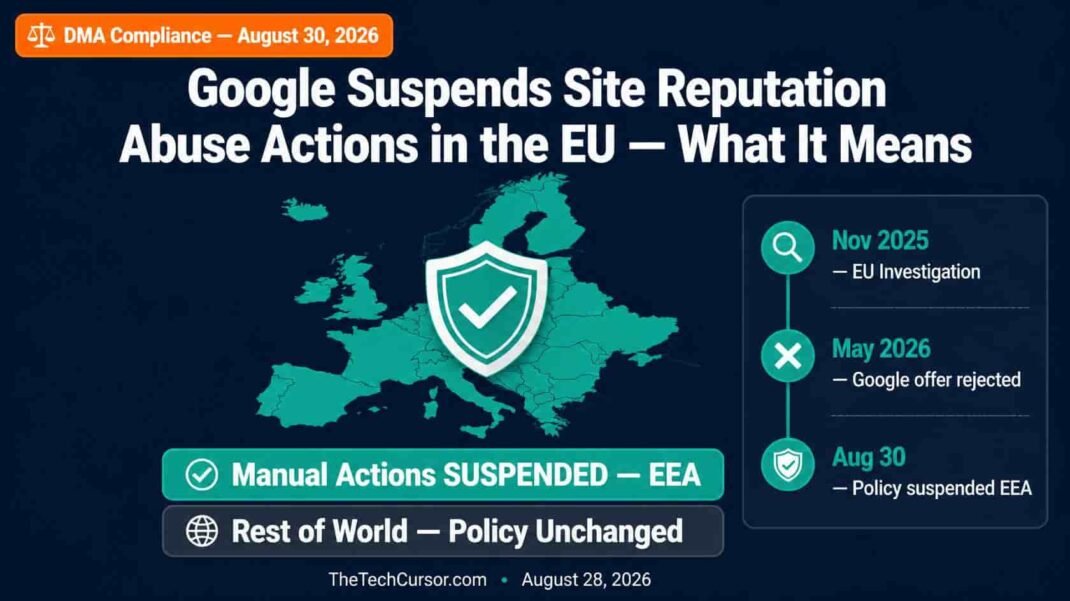
<cite index=”36-1″>Google said that from August 30, any manual actions taken to demote sites would not apply to users in the 27 EU nations, Iceland, Norway and Liechtenstein. The policy would not change outside the European Economic Area.</cite>
This is a significant capitulation — and a significant development for publishers, SEOs, and anyone watching the global regulatory battle over how Google applies its spam policies.
1. What Google Just Announced
Google has modified how its Site Reputation Abuse (SRA) spam policy is deployed across the European Economic Area (EEA) — specifically to avoid non-compliance fines under the Digital Markets Act (DMA).
The change is operational, not rhetorical. Starting August 30, manual actions applied under the Site Reputation Abuse policy will not affect search results for users in the 27 EU member states plus Iceland, Norway, and Liechtenstein. The algorithmic component of the policy — Google’s automated systems that detect and demote site reputation abuse — is not confirmed to be suspended, though the manual action component is explicitly withdrawn.
Outside the EEA, the policy continues unchanged.
2. The Complete Timeline — From EU Investigation to Policy Reversal
| Date | Event |
|---|---|
| November 13, 2025 | European Commission opens formal DMA investigation into Google’s Site Reputation Abuse policy |
| May 6, 2026 | Google submits remedies offer to EU Commission |
| May 8, 2026 | EU Commission rejects Google’s offer — “simply not strong enough” |
| August 2026 | Google announces EEA-specific policy suspension effective August 30 |
| August 30, 2026 | Manual actions under Site Reputation Abuse policy no longer apply to EEA users |
The speed of this resolution — from investigation to policy change in nine months — reflects the DMA’s significant enforcement leverage. <cite index=”41-1″>Google faces fines of up to 10% of the company’s total worldwide turnover, or 20% in case of repeated infringement.</cite> At Google’s revenue scale, 10% of global turnover represents a fine in the tens of billions of dollars — a consequence significant enough to motivate rapid compliance.
3. What Site Reputation Abuse Policy Actually Is
Google’s Site Reputation Abuse policy — introduced in 2024 — targets what is commonly called parasite SEO: the practice of publishing third-party content on a high-authority domain to exploit that domain’s ranking signals for queries unrelated to the host site’s core topic.
Common examples include:
- News publishers hosting sponsored content sections from advertisers that rank independently using the publisher’s domain authority
- Coupon or deals sections on major publications that rank for commercial queries entirely separate from the publication’s editorial content
- Third-party “best of” or review pages hosted on high-authority domains as commercial partnerships
Google’s stated rationale was that these arrangements were manipulative — using a trusted domain’s authority to rank content that would not otherwise earn those rankings on its own merit.
4. Why the EU Disagreed With Google
<cite index=”34-1″>The European Commission will specifically focus on Google’s “site reputation abuse policy,” which appears to deprive a common and legitimate way for publishers to monetize their websites and content.</cite>
The EU’s objection is not that spam policies are illegitimate — it is that Google’s specific application of this policy disproportionately harmed publishers’ ability to monetize their content through commercial partnerships, which the EU considers a legitimate revenue stream.
<cite index=”39-1″>Early monitoring suggests some publishers are being demoted in Google Search when they include content from commercial partners, even when that content is a key, legitimate income stream such as sponsored articles or branded hubs. Regulators say that if a spam policy undercuts a “common and legitimate way” for publishers to monetise their sites, it may breach DMA rules on fair treatment.</cite>
The DMA requires Google to apply “fair, reasonable, and non-discriminatory general conditions of access for business users” to its search ranking. The EU concluded that demoting publishers for hosting legitimate commercial content partnerships violated this requirement — treating publishers unfairly relative to other content sources.
<cite index=”41-1″>Google defended the policy in a blog post, arguing that the DMA “is already making Search less helpful for European businesses and users. This surprising new investigation risks rewarding bad actors and degrading the quality of search results.”</cite>
Google’s position was that its spam policy was necessary for search quality — and that suspending it in the EEA would reward genuine abuse. The EU disagreed sufficiently to maintain its non-compliance proceedings, ultimately forcing Google’s hand.
5. What Changes on August 30 in the EEA
For sites in the EEA that have received manual actions under the Site Reputation Abuse policy, the practical implications are direct:
Manual action penalties are suspended for EEA users. If your site received a manual action under the Site Reputation Abuse policy, that action will no longer affect search results for users in the EEA as of August 30.
Previously demoted content may recover rankings in EEA results. Sites that lost rankings in EU markets due to Site Reputation Abuse manual actions may see partial recovery in those specific markets.
Commercial content partnerships may face reduced demotion risk in the EEA. Publishers hosting sponsored content sections, branded hubs, or other commercial partnerships may face less manual action risk for EEA traffic specifically.
The algorithmic component may still apply. Google has explicitly confirmed the manual action suspension — but has not confirmed whether the algorithmic detection and demotion of site reputation abuse has also been suspended in the EEA. The distinction matters: manual actions are applied by Google reviewers, while algorithmic demotions are applied automatically. Both exist within the Site Reputation Abuse policy.
6. What Stays the Same — Outside the EEA
The EEA suspension does not affect Google’s enforcement outside the EU. For publishers, SEOs, and site owners targeting audiences in the United States, United Kingdom, Asia-Pacific, and other non-EEA markets:
- Site Reputation Abuse manual actions remain fully active
- The policy continues to target parasite SEO arrangements
- Commercial content partnerships that violate the policy guidelines remain subject to demotion
The August 30 change is geographically limited and does not signal any softening of Google’s Site Reputation Abuse enforcement outside the regulatory scope of the DMA.
7. The Parasite SEO Implication — A Window Just Opened in the EU
The practical implication that the SEO community will notice most rapidly: the EEA is now a different regulatory environment for site reputation abuse than the rest of the world.
Sites that host third-party content on high-authority domains — whether for commercial partnerships or other arrangements — face reduced manual action risk for EU traffic from August 30. This differential enforcement creates a geographic disparity in how the same content practices are treated in search results.
<cite index=”39-1″>Relying on parasite SEO to prop up your organic channel looks increasingly fragile for 2026 planning. Investing in your own domain’s authority, content depth and brand recognition becomes less optional and more like basic hygiene.</cite>
However, the EEA suspension complicates that advice — at least temporarily. What is explicitly discouraged by Google policy in non-EEA markets is now less rigorously enforced in EEA markets, at least for manual actions.
This creates a genuine strategic question for publishers and site owners with significant EU traffic: how to approach commercial content partnerships in a market where the enforcement environment has just changed significantly.
8. What Publishers Should Know
If you operate primarily in EU markets: The Site Reputation Abuse manual action suspension is directly relevant. If you have avoided commercial content partnerships due to manual action risk, that risk has decreased for EEA-targeted traffic from August 30. However, the algorithmic component of the policy is not confirmed suspended — proceed with caution and monitor search performance closely.
If you operate globally: Your non-EEA traffic remains subject to full Site Reputation Abuse enforcement. The EEA suspension does not change your risk profile for US, UK, or other non-EEA audiences.
If you received a manual action under Site Reputation Abuse: Check whether the manual action was applied globally or regionally. From August 30, the manual action penalty for EEA users will be suspended — though you should verify this through Search Console data after the change takes effect.
For publishers fighting the policy globally: The EU’s success in forcing this concession is the most significant publisher-vs-Google regulatory victory related to search quality policies in recent years. It demonstrates that the DMA’s enforcement leverage is sufficient to change Google’s behaviour — and creates a precedent that other regulators may seek to leverage.
9. What This Means Globally — The Regulatory Trend
The Site Reputation Abuse EEA suspension sits within a broader pattern of regulators successfully pressuring Google to modify its behaviour in ways that have global implications.
The Penske vs Google hearing covered in TheTechCursor’s recent article saw a US judge express strong skepticism about Google’s AI Overviews practices. The EU DMA has now forced a concrete policy concession on site reputation abuse. The UK’s Competition and Markets Authority has ongoing investigations into Google’s practices. Global antitrust action against Google is simultaneously more active than it has ever been — and increasingly effective.
The common thread across these cases is that Google’s dominant position in search is creating leverage that regulators in multiple jurisdictions are willing to challenge. The Site Reputation Abuse suspension is the latest evidence that this regulatory pressure can produce tangible changes in how Google enforces its search quality policies.
For publishers who have long argued that Google’s spam policies sometimes harm legitimate content businesses — a position that has often gone unheard — the EU’s successful intervention is a meaningful development.
10. Bottom Line
Google’s suspension of Site Reputation Abuse manual actions in the EEA is a significant concession forced by the EU’s DMA enforcement leverage — and a significant development for publishers, SEOs, and anyone watching the global regulatory battle over search quality policies.
As of August 30, the manual action component of Google’s Site Reputation Abuse policy no longer applies to EEA users. Outside the EEA, the policy continues unchanged. The algorithmic component remains unconfirmed.
For publishers in EU markets, this creates a changed enforcement environment for commercial content partnerships. For publishers globally, it demonstrates that regulatory pressure can produce concrete changes in Google’s search policies. And for the broader industry, it adds another data point to the accelerating trend of regulators successfully challenging Google’s behaviour in search — a trend reshaping the landscape in which every publisher, SEO professional, and digital marketer operates.