
Read time: 7 min
A major Microsoft outage began on Thursday, November 12, 2026, and continued into Friday, disrupting Outlook, Teams, Copilot, and other Microsoft 365 services for users in at least 74 countries.
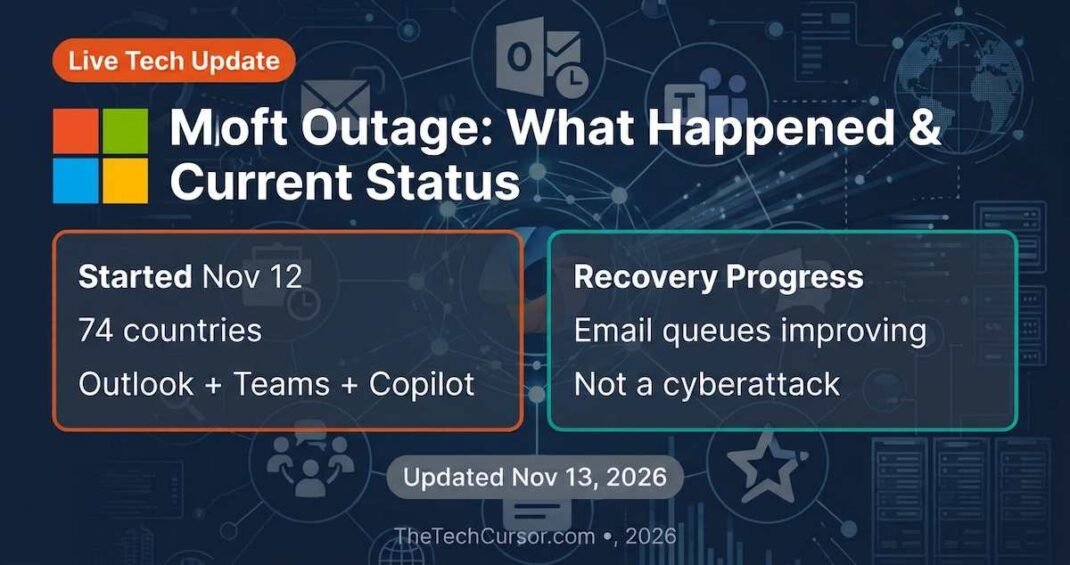
Microsoft confirmed the issue was not a cyberattack. Instead, servers failed automated health checks, became unavailable, and created elevated load that cascaded across infrastructure. Recovery has been gradual, with improving email queues and regional progress reported by Friday.
This article explains the timeline, cause, impact, and practical next steps in plain language.
1. What Happened in the Microsoft Outage
Problems first surfaced around midday Eastern Time on November 12 (approximately 16:00–17:00 GMT). Users reported inability to open Outlook mailboxes, delayed email delivery, Teams connection failures, and Copilot loading issues.
Within roughly one hour, Downdetector recorded reports from 74 countries and territories. Outlook complaints alone peaked well above 100,000 (some trackers cited peaks near 130,000). Microsoft initially focused its investigation on the Americas before confirming the outage could affect any region.
The disruption lasted more than 18–20 hours for many users, longer than typical Microsoft 365 incidents of this scale.
2. Affected Services
The core problem centered on Exchange Online and services that depend on it. Key impacts included:
- Outlook / Exchange Online — mailbox access failures across web, desktop, and mobile clients; significant email delays
- Microsoft Teams — intermittent chat and meeting connectivity
- Microsoft Copilot — difficulty loading responses or chat
- SharePoint Online, OneDrive, and related Microsoft 365 tools
- Parts of Defender XDR and admin centers
Microsoft 365 serves hundreds of millions of users (estimates exceed 430–450 million commercial subscriptions), amplifying the real-world effect even when only a portion of infrastructure was impacted.
3. Root Cause Explained
Microsoft ruled out malicious activity or a cyberattack.
The company stated that a portion of infrastructure experienced elevated load after many servers failed automated health checks and became unexpectedly unavailable. Remaining servers absorbed redirected traffic and became overloaded. The issue was not driven by a sudden spike in user demand. A process responsible for establishing secure connections became overwhelmed on affected servers.
Engineers applied configuration changes, restarted servers in phases, and managed traffic carefully. Early recovery attempts sometimes caused restarted servers to fail again under returning load, extending the timeline.
4. Global Impact and Scale
The outage affected:
- Businesses relying on email and collaboration tools
- Schools and universities (online classes and internal communications)
- Healthcare providers (including UK NHS and GP services that temporarily shifted to paper or phone)
- Government agencies (including reports involving the U.S. House of Representatives and Australian departments)
- Airlines (such as IndiGo, Akasa Air, and Air India, which experienced customer-support email disruptions)
- AI companies including OpenAI and Anthropic (Microsoft 365 connector issues)
Downdetector data showed rapid global spread. Exact user counts were not released by Microsoft, but the breadth of reports and the size of the Microsoft 365 user base indicate millions of people experienced disruption.
5. Current Recovery Status
As of Friday, November 13, Microsoft reported continued recovery progress:
- Broader improvements in service availability in North America
- Sustained improvements across much of Europe
- Encouraging recovery signals in Asia-Pacific
- Email queues significantly reduced and approaching normal levels
Microsoft’s service health status still noted some degradation, with intermittent access issues or delayed email delivery possible for remaining users. The company extended the email timeout window to 48 hours to protect delayed messages and has not given an exact full-restoration timeline. A full post-incident report with root-cause details is expected after complete mitigation.
6. What Users and Businesses Should Do
- Monitor the official Microsoft 365 Service Health dashboard and the Microsoft 365 Status account on X
- Use alternative communication channels (phone, secondary email, other messaging tools) when needed
- Avoid major local configuration changes (DNS, Outlook profile resets) during active recovery
- Expect delayed email to arrive once queues clear; the extended timeout helps prevent loss
- Document business impact for internal reporting and any service-level discussions
7. Lessons for Cloud Resilience
Large cloud platforms remain highly reliable overall, yet concentrated dependence creates single points of failure. Organizations benefit from:
- Documented fallback communication plans
- Clear internal status communication during incidents
- Periodic review of critical workflow dependencies on any single vendor
This event joins recent major cloud disruptions in highlighting the value of resilience planning alongside day-to-day productivity gains.
8. Bottom Line
The November 2026 Microsoft outage was caused by cascading server health-check failures that produced elevated load across Microsoft 365 infrastructure. It was not a cyberattack. Recovery advanced through Friday with measurable improvements in email delivery and regional availability, though some intermittent issues lingered.
Users should continue checking official Microsoft status channels for final confirmation of full restoration.
The Takeaway
Cloud outages of this scale are rare but impactful. Understanding the cause (infrastructure cascade, not attack), tracking official recovery signals, and maintaining simple backup communication methods reduce friction when the unexpected occurs.
9. Sources Reviewed
I reviewed the following sources on November 13, 2026. Details may continue to evolve as Microsoft releases its full post-incident report.
- Forbes: “Microsoft 365 Outage Continues: Company Says Email Improvements Are Being Made” (Antonio Pequeño IV and Siladitya Ray)
https://www.forbes.com/sites/antoniopequenoiv/2026/11/13/microsoft-365-outage-continues-company-says-email-improvements-are-being-made/ - The Wall Street Journal: “Microsoft Working to Fix Widespread Outage” / “Microsoft Outage Disrupts Outlook and Teams Services Globally”
https://www.wsj.com/tech/microsoft-working-to-fix-widespread-outage-8df67a4e - Al Jazeera: “Microsoft hit by global outages: What happened and why?”
https://www.aljazeera.com/news/2026/11/13/microsoft-hit-by-global-outages-what-happened-and-why - BBC: “What we know about the global Microsoft outage”
https://www.bbc.com/news/articles/cwvg238zrnm5o - The Guardian (Live coverage): “Microsoft outage live: millions still affected…”
https://www.theguardian.com/technology/live/2026/nov/13/microsoft-outage-down-today-live-update-outlook-teams-365-when-fixed-latest-status-cause-news - NBC News (Live blog): “Live updates: Microsoft scrambles to fix major outage…”
https://www.nbcnews.com/tech/tech-news/live-blog/microsoft-outage-outlook-teams-updates-fix-rcna609118 - Ars Technica: “Microsoft’s global outage may be worse than Amazon’s or CrowdStrike’s…”
https://arstechnica.com/tech-policy/2026/11/microsoft-blames-failed-server-health-checks-not-hackers-for-global-outage/ - CNN: “Massive Microsoft outage disrupts businesses, schools and governments…”
https://www.cnn.com/2026/11/12/tech/microsoft-outage-cripples-office-workers-nationwide - Microsoft 365 official Service Health status page and @MSFT365Status updates on X
- Downdetector user-reported data for Outlook and Microsoft 365