Published: July 20, 2026
Read time: 7 min
For as long as Digital Marketing has existed, two tribes have fought for budget, headcount, and strategic priority. SEO teams build organic visibility over months and years. Meanwhile, PPC teams buy immediate traffic with measurable, attributable spend. Both sides have made compelling cases — and neither has definitively won.
AI has ended the debate. However, it has not declared a winner. Instead, it has made the separation itself obsolete.
In 2026, the same AI system decides which organic pages to surface in search results. That same system also decides how to serve paid ads, who to target, and what creative to show. The system is Gemini. It reads your organic content signals and paid campaign data simultaneously — forming one unified picture of your brand across both channels.
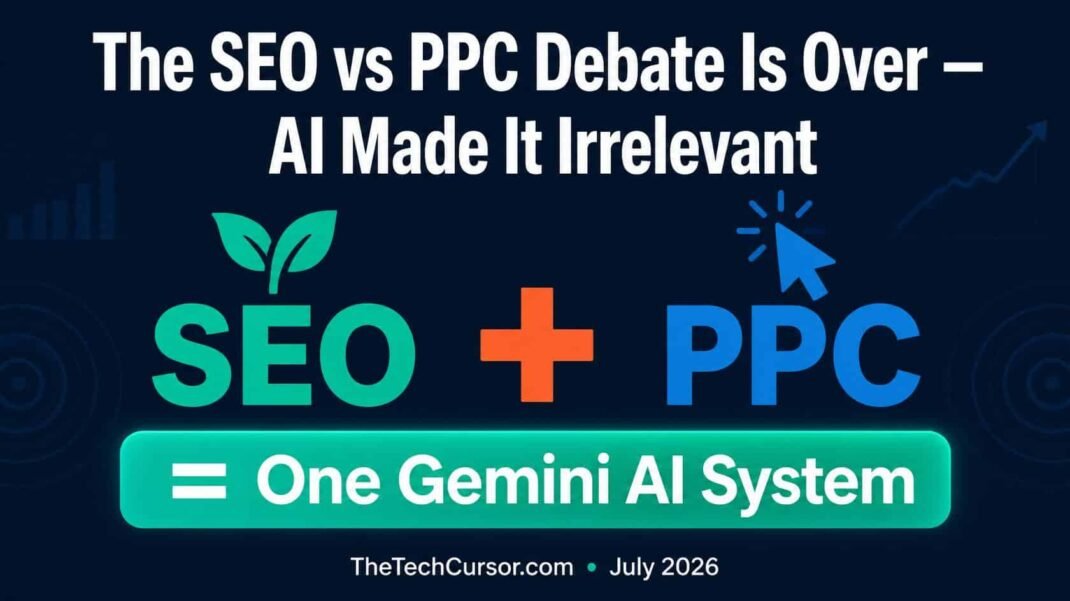
The SEO vs PPC debate assumes these are separate systems that compete for the same users. They are not. They are two interfaces into the same AI — and understanding that changes everything about how you should allocate your marketing investment.
Table of Contents
- The Debate That Wasted Decades of Marketing Budgets
- Why the Old Separation Made Sense — And Why It No Longer Does
- The Unified AI System Behind Both Channels
- How Paid Data Informs Organic Strategy
- How Organic Data Informs Paid Performance
- The Brand Signal That Powers Both
- What Integrated Strategy Actually Looks Like
- The Organizational Change This Requires
- Bottom Line
1. The Debate That Wasted Decades of Marketing Budgets
The SEO vs PPC debate has typically been framed as a question of efficiency. SEO is slower but compounds over time. PPC delivers immediate results but stops the moment you stop paying. Budget spent on one is budget not spent on the other.
This framing has led to genuinely wasteful decisions. Teams optimizing paid campaigns without SEO context consistently overbid for keywords their organic content already ranks for. Similarly, teams investing in SEO without paid data miss the audience signals and intent data that paid campaigns generate immediately.
Furthermore, it has created organizational structures where SEO and paid teams operate in separate silos. They use different tools, track different metrics, and report to different stakeholders — making decisions that frequently work against each other.
The cost of this misalignment has always been real. In 2026, it is becoming more expensive by the quarter.
2. Why the Old Separation Made Sense — And Why It No Longer Does
The SEO vs PPC separation made sense when the underlying systems were genuinely separate. Traditional organic search used a ranking algorithm that evaluated page quality, links, and keyword relevance. Traditional paid search used a bid auction that matched keywords to ads based on bid price and Quality Score. The two systems shared a results page but operated on fundamentally different logic.
That separation is no longer accurate. Both channels now run through Gemini. Specifically, Gemini powers organic search quality evaluation, AI Overviews, AI Mode, Performance Max, AI Max for Search, and the advertising auction simultaneously.
Furthermore, the information Gemini uses to evaluate your brand for organic visibility overlaps significantly with what it uses for paid performance. Brand authority signals, content quality, audience engagement, and entity understanding all feed into both systems.
As covered in TheTechCursor’s earlier analysis of how AI is merging paid and organic search, this means decisions made in your SEO program directly affect your paid performance — and vice versa — whether you intend them to or not.
3. The Unified AI System Behind Both Channels
Here is the core insight that makes the SEO vs PPC debate obsolete.
When a user submits a search query, Gemini evaluates several things simultaneously:
- Which organic pages are most relevant and authoritative for this query
- Which paid ads are most relevant for this user given their intent and history
- Whether there is an AI Overview opportunity and which sources to cite
- Which Shopping results are most appropriate if the query has commercial intent
All of these evaluations draw on overlapping signals. Your organic content quality affects how Gemini understands your brand’s expertise. Your paid campaign data provides explicit signals about which audiences convert for which offers. Moreover, your entity authority influences how confidently Gemini represents your brand across all surfaces.
Treating these as separate systems is like tuning a car engine by adjusting fuel injection and ignition timing independently — by different mechanics who never speak to each other. The systems are integrated. Therefore, the optimization needs to be integrated too.
4. How Paid Data Informs Organic Strategy
One of the most underutilized insights available to SEO teams is the audience and conversion data sitting in paid search campaigns.
Paid search generates something organic search cannot: explicit, tested data about which combinations of audience, intent, and offer actually convert. A paid search campaign for a specific keyword tells you not just that people search for that term — it tells you what percentage of those searchers convert, at what cost, with what message.
Three specific ways paid data should inform organic strategy:
Conversion-validated keyword prioritisation: Organic keyword prioritization typically uses volume and difficulty data. Paid data adds a third dimension: conversion probability. Keywords generating volume in paid campaigns at an efficient CPA are worth ranking for organically — not just theoretically valuable based on volume estimates alone.
Message-market fit signals: Ad copy testing reveals which value propositions resonate with specific audience segments. Consequently, these insights should inform the positioning in organic content targeting the same audiences — not stay siloed in a paid team’s campaign notes.
Audience segment discovery: Paid campaigns generate audience data that organic analytics rarely captures. Understanding which segments convert for which products provides the brief for organic content that serves those users at earlier funnel stages.
5. How Organic Data Informs Paid Performance
The information flow works in both directions. Organic performance data contains signals that should be feeding paid campaign decisions — but rarely does in organizations with siloed teams.
Three specific ways organic data should inform paid strategy:
High-performing page identification: Pages that generate strong organic engagement — long dwell time, low bounce rate, high assisted conversion attribution — are demonstrably effective at converting visitors who arrive with relevant intent. These pages should be the landing page destinations for paid campaigns targeting equivalent audiences, not generic home pages or category pages.
Topical authority mapping: Organic ranking patterns reveal where your site has established topical authority — and where it has not. Paid campaigns targeting topics where your organic authority is strong benefit from the brand familiarity that organic visibility creates. Paid campaigns targeting topics where organic authority is weak face a higher cost of trust-building with unfamiliar audiences.
Negative keyword intelligence: Organic search query reports reveal the full range of queries that lead users to your content — including queries that generate traffic but poor engagement. These low-relevance queries should inform negative keyword lists in paid campaigns, preventing budget waste on similar low-intent terms.
6. The Brand Signal That Powers Both
Beyond tactical data sharing, there is a strategic brand signal that now powers performance across both organic and paid channels simultaneously — and that neither team can build alone.
Gemini builds entity understanding by aggregating signals from organic content, third-party mentions, reviews, community discussions, and paid ad performance data. The clearer and more consistent that entity signal, the lower the friction Gemini faces when deciding to surface your brand. This applies whether in an organic result, an AI Overview, a paid ad, or a Shopping carousel.
Brand investment — content that builds topical authority, PR that generates mentions, community presence that creates brand discussions — therefore improves paid ad performance. It reduces the uncertainty Gemini has about your brand when evaluating ad relevance and Quality Score.
Conversely, paid campaign data that demonstrates strong conversion signals gives Gemini more confidence in your brand’s relevance. This can improve organic evaluation for related queries, too.
The brand signal is not an SEO asset or a paid asset. It is a shared asset that both channels draw on — and that neither team can build optimally alone.
7. What Integrated Strategy Actually Looks Like
An integrated SEO and paid strategy in 2026 is not just about sharing spreadsheets. It requires building workflows that genuinely connect the two disciplines at the decision-making level.
Shared keyword and audience intelligence: A single source of truth for keyword performance — combining organic rank data, paid impression data, organic CTR, paid conversion rate, and organic engagement metrics — enables investment decisions that optimize across both channels rather than within each channel independently.
Joint content and campaign planning: Content calendars and paid campaign calendars should be aligned — not synchronized after the fact. A content investment that builds topical authority in an area should be accompanied by paid campaigns that capture the high-intent audience at the bottom of the funnel, while organic content is warming at the top.
Unified landing page strategy: The disconnect between organic landing pages and paid landing pages — where SEO teams optimize for organic signals, and paid teams optimize for conversion rate in isolation — is one of the most expensive inefficiencies in digital marketing. A unified approach builds pages that serve both organic and paid traffic effectively.
Integrated reporting: A single performance dashboard that shows organic and paid contribution to each business outcome — by audience segment, by product category, by content topic — enables resource allocation decisions that reflect actual business value rather than channel-specific metrics.
8. The Organizational Change This Requires
Building an integrated SEO and paid strategy requires organizational alignment that most marketing teams do not currently have — and that is the hardest part of this transition.
The structural barriers are real. SEO and paid teams typically report to different managers. They use different tools, track different KPIs, and have different planning cycles. Bridging these divides requires either organizational restructuring — creating a unified search team — or establishing formal coordination mechanisms.
Neither path is easy. However, both are increasingly necessary as the underlying systems become more integrated.
The teams that break down these silos will consistently outperform those optimizing each channel in isolation. The AI system they both work with is already integrated. The question is simply whether the human teams managing it will be too.
9. Bottom Line
The SEO vs PPC debate is not just settled — it was always the wrong question. The right question is how to build a search marketing strategy that treats organic and paid as two interfaces into the same AI system, drawing on shared brand signals, audience intelligence, and content investments.
The teams winning in search in 2026 are not choosing between SEO and PPC. They are building integrated programs where paid data informs organic strategy, organic authority improves paid performance, and brand investment compounds across both channels simultaneously.
Stop debating which channel wins. Start building the integrated strategy that makes both channels win together.