
Read time: 7 min
Table of Contents
- What the Watermark Actually Does
- What Google Actually Said About AI Content
- The Spam Policy — Where the Real Line Is
- The SEO Heist That Proved the Point
- What Google Actually Rewards — Three Signals
- Commodity vs Non-Commodity Content — The Danny Sullivan Framework
- Information Gain — The Patent Behind the Principle
- Three Ways to Make Your Content Non-Commodity
- Where the Watermark Actually Bites
- Bottom Line
Anthropic confirmed in August 2026 that Claude’s text now carries an invisible watermark. Every model released since August 2 marks its own output. The watermark biases word choices toward a secret half of the vocabulary — measurable across a few hundred words, invisible in any single sentence, and impossible to strip by copying and pasting.
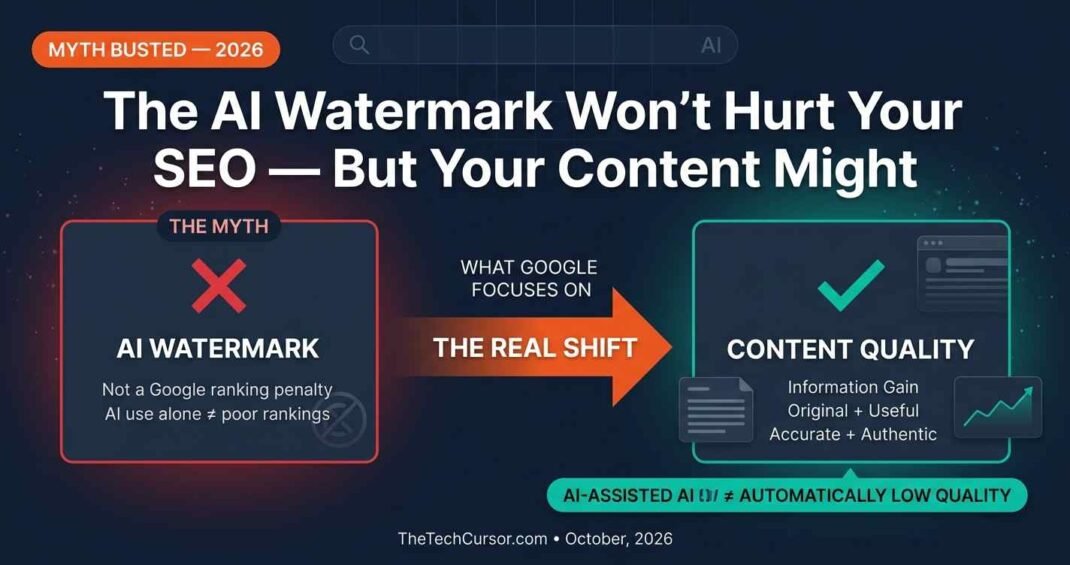
The natural concern for SEOs using AI to create content is obvious. If Google can detect the watermark, it could flag and penalize AI-generated pages.
That concern is misplaced. Google does not penalize content for being written by AI. However, the watermark has surfaced a more important question that every content team should be asking — and most are not.
1. What the Watermark Actually Does
The Claude watermark is a provenance mark. It answers one question: was a language model involved in producing this text?
It does not travel in file metadata that a CMS strips on upload. It lives in the word choices themselves. Copy the text from Claude, paste it into WordPress, and the signature comes with it. You cannot see it. You cannot easily remove it.
Anthropic is not acting alone here. The EU AI Act’s transparency code took effect on August 2, 2026. It requires AI-generated content to be marked so other systems can identify it. Other AI labs face the same obligation. Marking is becoming standard across the industry.
However, the question of whether Google will use that mark to penalize content has a clear answer — and it is not the one many SEOs fear.
2. What Google Actually Said About AI Content
Google published its position on AI-generated content in February 2023. Two statements from that post define everything that follows.
On whether AI content is against the rules: “Appropriate use of AI or automation is not against our guidelines.”
On whether it helps rankings: “Using AI doesn’t give content any special gains. It’s just content.”
Content is just content to Google. Rather than enter an arms race between AI detectors and AI generators — an arms race Google was unusually well-positioned to lose, given it wrote much of the foundational research the current models are built on — Google drew the line somewhere else entirely.
The line is not about how a page was made. It is about whether a page adds anything a searcher would find valuable.
3. The Spam Policy — Where the Real Line Is
Google’s spam policies contain 16 rules. Generative AI appears twice in the entire document.
The appearance that matters is inside the scaled content abuse policy. Two phrases define the violation:
“Scaled content abuse is when many pages are generated for the primary purpose of manipulating search rankings and not helping users.”
And: “[C]reating large amounts of unoriginal content that provides little to no value to users, no matter how it’s created.”
That last phrase is the critical one — “no matter how it’s created.” A hundred human freelancers producing thin pages triggers this rule exactly the way a prompt loop does. The pattern is the problem: many pages, no added value, built to move rankings.
AI is mentioned as one method of creating this pattern. It is not the method being penalized. The absence of value is.
4. The SEO Heist That Proved the Point
In November 2023, an SEO founder publicly described what he called an SEO heist. He had exported a competitor’s sitemap, turned that list of URLs into article titles, and generated approximately 1,800 articles from them at scale.
The results were initially dramatic. Millions of visits, hundreds of thousands per month, were taken from the competitor. The post describing the experiment got four million views. It reached Google CEO Sundar Pichai, who was shown the tweet on camera.
Then it came apart. Within months, the gains had largely evaporated. The site returned to roughly where it started.
Hold the experiment against the spam policy: many pages, no added value, built to manipulate rankings. Three for three. That is why it got hit — not because AI was involved, but because the content added nothing.
5. What Google Actually Rewards — Three Signals
If the watermark and AI itself are not the issue, what is Google rewarding? Three signals appear consistently across Google’s public guidance.
Effort: Google’s Search Quality Rater Guidelines define effort specifically: “Consider the extent to which a human being actively worked to create satisfying content.”
The guidelines then note that effort may go into designing page functionality or building systems that power a webpage. A calculator someone built counts as effort even though a machine does the work once it is live.
The counterexample is equally clear: automatically translating thousands of pages using existing software, without oversight or manual curation, does not count as effort regardless of the technical sophistication involved.
Commodity vs non-commodity content: At Search Central Live in Toronto in April 2026, Google’s Danny Sullivan split content into two columns — commodity and non-commodity — and asked the room to work out which side their own blog sat on. His definition of the good column was three words: unique, specific, and authentic.
Information gain: Google holds a patent on information gain as a ranking signal. The patent scores a document on “[A]dditional information that is included in the given document beyond information contained in other documents that were already presented to the user.”
In plain terms: if your page says what the other ten results already say, it does not matter how clean the prose is or who wrote it. It adds nothing. Consequently, it struggles to rank — and if it is already ranking, it decays over time.
6. Commodity vs Non-Commodity Content — The Danny Sullivan Framework
Sullivan’s Toronto presentation made the commodity distinction concrete through specific examples. Each pair illustrates exactly what separates rankable content from content that cannot hold its position.
Running store:
- Commodity: “Top 10 Things to Consider When Buying Running Shoes”
- Non-commodity: “Why This Customer’s Shoes Collapsed After 400 Miles” — a breakdown of how one runner’s gait caused the foam to fail at a specific point
Real estate agent:
- Commodity: “7 Tips for First-Time Homebuyers”
- Non-commodity: “Why We Waived the Inspection and Saved $15,000” — the agent explaining they crawled the sewer line themselves and saw it was PVC, not concrete
Interior designer:
- Commodity: “Kitchen Trends You Need to See”
- Non-commodity: “Why I Refused to Install Marble for a Family of Five” — with the grape juice and turmeric stain tests that proved the point
The commodity post could have come from anyone or any model. The non-commodity post could only have come from the person who was actually there. Furthermore, Sullivan was careful to note that commodity content is sometimes exactly what a page needs. However, it is not what earns the top positions when better alternatives exist.
7. Information Gain — The Patent Behind the Principle
The information gain concept has been part of Google’s thinking for years. It has a name and a patent — “Contextual estimation of link information gain.”
The patent scores a document on the additional information it includes beyond what other documents already presented to the user have covered. A page that summarizes what ten other results already say scores poorly on information gain. A page that contains something genuinely new — data from the author’s own experience, an analysis no competitor has made, a tool that solves a problem the words alone cannot — scores well.
This principle explains why some AI-generated content performs reasonably well, and other AI-generated content collapses in rankings. The variable is not the production method. It is whether the content adds something the competitive results do not already contain.
A study examining 42,000 blog posts found that at Position 1, pages came back 80.5% likely to be human-written and only about 10% likely to be AI. Human content took the top spot roughly eight times more often. However, the researchers noted that from position five downward, the gap between human- and AI-classified content is narrow. Furthermore, AI is now a standard part of production for most teams. The detector reads the finished product — not the process used to create it.
It is not that AI cannot rank. It is that content without genuine information gain cannot hold the top of the page.
8. Three Ways to Make Your Content Non-Commodity
The principles above translate into three practical approaches. None of them requires abandoning AI tools. Each ensures the content offers something the other ten results do not.
Add Something That Took Real Effort
The clearest example is an interactive tool. A calculator is proof of effort a model cannot fake from a prompt — a tax estimate on an accountant’s site, a sizing quiz on an ecommerce store, a repayment tool on a financial services page.
Building one with AI assistance now takes an afternoon. Consequently, the barrier is lower than ever. The point is not that it must be handwritten. It must exist and do something the ten blue links cannot.
Stop Publishing Only Text — Make the Visual
A page that is only words competes with every other page of words on the topic. A short video or an original chart built from your own data is a format most competitors never produce — and one that is far harder to mass-generate.
Original infographics and charts count as well, provided the data inside them is genuinely yours.
Put In Something Only You Know
Your own numbers, from your own work, or a view you would defend from your own experience.
A plumber who has replaced 400 hot water systems knows which brands return for repairs and how long they actually last. No competitor can reproduce those pages because nobody else has the job book. An ecommerce brand knows which styles get returned and what customers type in the reason box — a sizing guide no competitor can copy.
The specifics must be true and concrete enough that a reader can tell you were in the room. Then put a real name and face on it — an author with stated credentials — because most articles ship with no byline at all.
9. Where the Watermark Actually Bites
The Claude watermark does not bite in Google Search. Google’s ranking systems decided years ago that how content was made is not the question they rank on.
However, it does bite one layer up — at the platform level. LinkedIn now offers readers a “Seems like AI slop” option for reporting a post. That is a trust and reputation problem that every platform is navigating in its own way.
The watermark answers whether a model was involved. That question matters for platform trust, for regulatory compliance, and for user perception. It does not matter for Google’s ranking systems.
Burning effort scrubbing watermarks from content to satisfy a search penalty that does not exist is wasted effort. Pointing that same effort at the content — adding something new that the other results do not have — addresses the test that actually matters.
10. Bottom Line
The Claude watermark is a provenance mark. It tells you a model was involved. Google does not rank on that information. Consequently, the watermark is not an SEO risk.
The actual risk is the same one that existed before watermarks — content that adds nothing a searcher could not find in the other ten results. That has always been the line. SAFE’s deployment, covered in the Google SAFE AI spam detector article, makes that enforcement more effective. However, the standard itself has not changed.
The Test That Actually Matters
Before publishing any page — AI-assisted or otherwise — ask honestly: is this genuinely useful, is it unique, and is it valuable? The Google 14-point content quality checklist provides a structured way to answer that question.
If the answer is yes, an AI watermark is not the problem. If the answer is no, the watermark is the least of your concerns.