
Read time: 5 min
Table of Contents
- The Numbers Are Finally Out
- What Publishers Are Actually Earning
- How Google Calculates the Payments — Still Unknown
- Why 0.1% of Ad Revenue Matters
- The Bargaining Position Problem Gets Worse
- What This Means for Publishers Not in the Pilot
- Bottom Line
When Google announced its AI contribution pilot earlier this year, the key details were missing. How many publishers were involved? How much were they earning? The Information obtained those details — and the numbers are sobering.
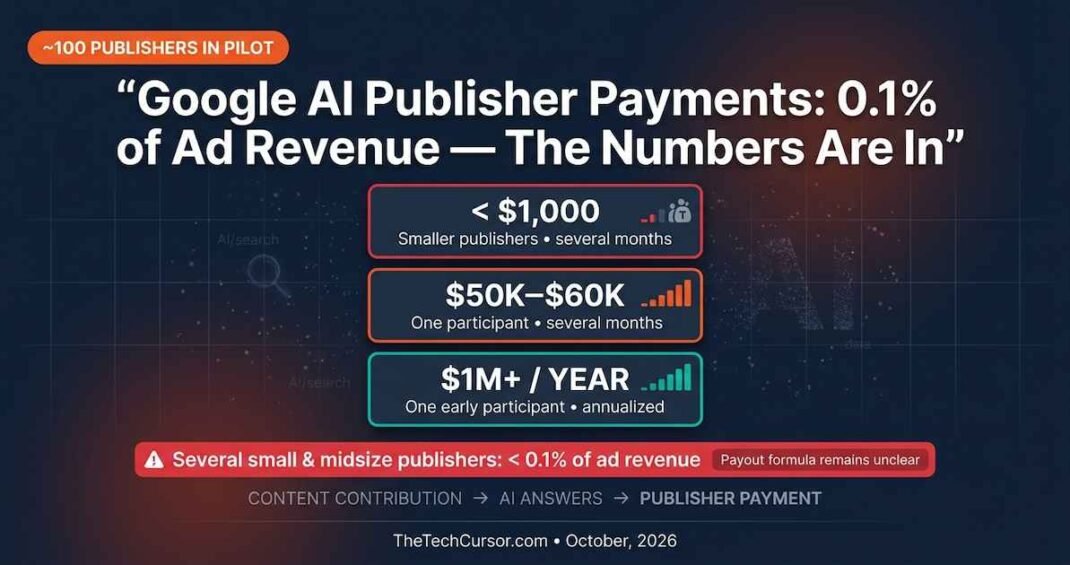
Approximately 100 publishers are in the pilot. Most are earning a small fraction of what they would make through advertising revenue from those same readers. For several small to midsize blogs and websites, the payments amount to less than one-tenth of 1% of their advertising revenue.
1. The Numbers Are Finally Out
(cite index=”8-1″>For several small to midsize blogs and websites testing the programs, the payments amount to less than one-tenth of 1% of their advertising revenue, according to people familiar with the payouts.</cite>
That 0.1% figure deserves context. A publisher earning $1 million annually in advertising revenue would receive approximately $1,000 per year from the AI contribution pilot at that rate. A publisher earning $10 million in ad revenue would receive approximately $10,000.
These are not supplementary revenue streams. They are rounding errors.
2. What Publishers Are Actually Earning
The range across the approximately 100 pilot publishers is wide — but the wide range is itself revealing.
(cite index=”8-1″>” One publisher that joined a few months ago has earned about $50,000 to $60,000 so far, which doesn’t represent that much of its business.”</cite>
(cite index=”8-1″>” Another that joined early on is earning more than $1 million a year, which represents a bigger slice of its revenue.”</cite>
(cite index=”8-1″>”Smaller sites have earned less than $1,000 over several months.”</cite>
The $1 million annual figure sounds significant. However, that publisher is described as one of the program’s best performers — and even for them, it represents only a meaningful slice of revenue, not a primary income source. For the majority of participants, the earnings are minimal.
Furthermore, the variation between publishers is itself a problem. Publishers in the pilot cannot understand why one site earns $1 million, and another earns $1,000. The calculation methodology remains entirely opaque.
3. How Google Calculates the Payments — Still Unknown
This is the most concerning aspect of the pilot for any publisher considering participation.
(cite index=”8-1″>Publishers are not clear on how Google decides how much to pay them. Some publishers told The Information that they have no idea how Google calculates these payouts. One month a publisher may make one amount, and the next month a completely different amount, but Google doesn’t tell them the reasoning for the different payments.</cite>
The black box problem identified in the original Google AI payment pilot analysis has not improved. Publishers still do not know whether payments are based on impressions, clicks, the percentage of AI content using their material, or some combination of these factors.
Without that transparency, publishers cannot evaluate whether the payment is fair. They cannot determine whether changes to their content strategy would increase their earnings. They cannot audit the calculation. They are simply receiving a number each month with no explanation of how it was derived.
4. Why 0.1% of Ad Revenue Matters
The 0.1% figure is not just a data point. It reveals a fundamental mismatch between what publishers contribute to Google’s AI products and what they receive in return.
Consider the economics from Google’s perspective. AI Overviews, AI Mode, and Gemini use publisher content to generate answers that keep users engaged with Google’s products. Those products generate advertising revenue for Google. Publishers provide the raw material. Google provides the infrastructure and the audience.
The question is how the value created by that combination should be distributed. The current pilot payments suggest Google’s answer is: approximately 0.1% to publishers, the remainder to Google.
For comparison, research confirmed that AI Overviews reduce clicks to publisher websites — the primary way publishers previously monetized Google-driven traffic. Publishers are therefore losing advertising revenue from reduced clicks while receiving 0.1% replacement payments from the AI contribution pilot.
That is not a sustainable commercial model for publishers.
5. The Bargaining Position Problem Gets Worse
The payment revelation makes the strategic concern about the pilot more acute.
When the pilot was first announced, the risk was theoretical: accepting small payments might weaken publishers’ legal and commercial arguments that Google uses their content without fair compensation. Now that the payment amounts are known, that risk has a number attached to it.
A publisher in the pilot who earns $50,000 over several months while losing significantly more in ad revenue from AI-driven click reduction has accepted a payment that is both inadequate and potentially prejudicial to future negotiations.
Furthermore, the payments are variable and unexplained. Accepting an unexplained payment of unknown basis is a poor commercial position in any negotiation. If Google ever faces legal or regulatory pressure to compensate publishers more fairly, having accepted these pilot payments — without understanding their basis — could complicate publishers’ ability to demonstrate harm.
Publishers who are part of industry negotiating coalitions or legal actions should specifically consult legal counsel before accepting or continuing to accept pilot payments. The $50,000 earned over several months may cost significantly more in negotiating leverage.
6. What This Means for Publishers Not in the Pilot
Most publishers are not in the pilot. For them, the payment revelations have a different implication.
The 0.1% figure establishes a data point for what Google currently believes publisher content is worth in the AI contribution context. That data point matters for any publisher making investment decisions about Google AI search visibility.
If this is the commercial model Google envisions — 0.1% payments to a small group of publishers while AI search reduces their click revenue — then the AI search visibility strategy cannot be built primarily around the assumption that AI citations will replace lost traffic revenue through direct payment.
Instead, publishers need to focus on what AI visibility actually delivers: brand awareness, entity authority, and downstream effects on branded search and direct traffic. These are valuable — but they require different measurement and different content strategies than click-based revenue optimization.
Furthermore, the pilot’s existence and its terms suggest that Google recognizes some obligation to compensate publishers for AI content use. The question is whether the current terms represent Google’s genuine assessment of fair value or an opening position in a longer negotiation. Given the 0.1% figure and the opacity of the calculation, the latter seems more likely.
7. Bottom Line
The Google AI contribution pilot has approximately 100 publishers. Most are earning less than one-tenth of 1% of their advertising revenue. The best performer earns over $1 million annually — which still represents a fraction of what they would earn if AI Overviews sent those users to their pages rather than answering their queries directly.
Three Takeaways for Publishers
First, the payments are inadequate as a replacement for click-based revenue at current rates. Publishers should not restructure their business models around AI contribution payments at these levels.
Second, the opaque calculation methodology means publishers cannot evaluate fairness, predict earnings, or optimize for higher payments. This is not a manageable commercial relationship.
Third, the 0.1% figure is likely a starting point rather than a settled rate. The commercial and regulatory pressure on Google to compensate publishers more fairly is growing. Publishers who maintain clear documentation of their AI content contribution — and who preserve their negotiating positions by understanding the terms before accepting — will be better positioned as those negotiations develop.