
Read time: 3 min
Table of Contents
- The Rollout Is Complete
- How Long It Took
- What to Do Now That the Rollout Is Finished
- If Your Site Was Affected
- If Your Site Was Not Affected
- Bottom Line
Google confirmed that the September 2026 spam update has finished rolling out. The update began on September 24, 2026 and completed on October 6, 2026 — a rollout period of approximately 12 days.
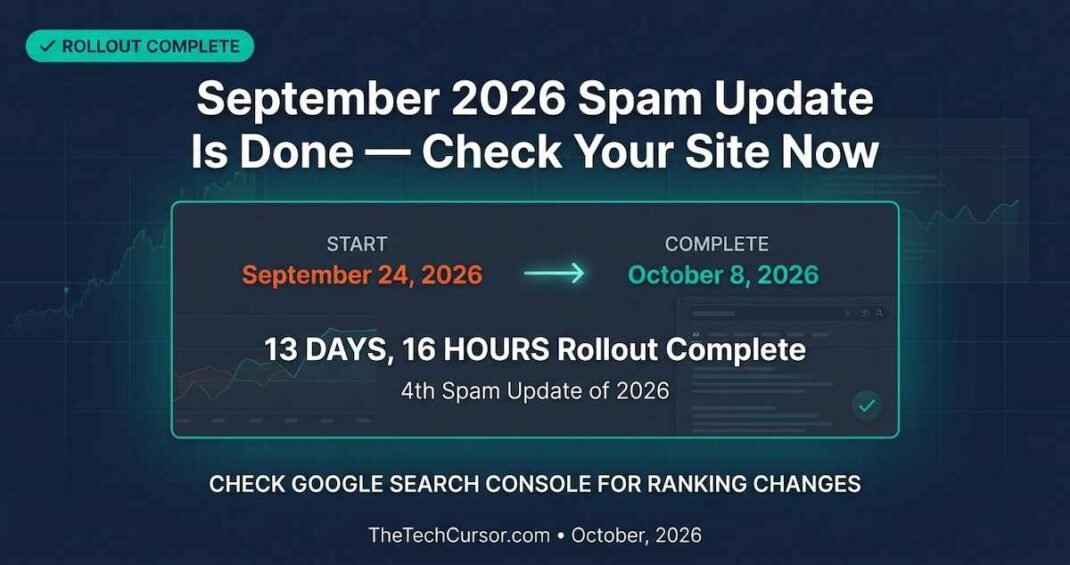
The September 2026 spam update was the fourth Google spam update of 2026. It applied globally and to all languages. Now that it is complete, the ranking changes it produced are final — and site owners can begin accurately assessing its impact.
1. The Rollout Is Complete
Google updated its Search Status Dashboard to mark the September 2026 spam update as complete. This confirmation is the signal that ranking changes from the update have been fully applied.
During a rollout, rankings fluctuate as the update is applied incrementally across Google’s index. Fluctuations during this period do not necessarily reflect the final outcome for any given site. Consequently, assessing a spam update’s impact before rollout completion produces unreliable conclusions.
Now that the rollout is confirmed complete, the rankings and traffic trends you observe in Search Console and GA4 reflect the update’s actual impact on your site.
2. How Long It Took
The September 2026 spam update took approximately 12 days to complete. Google had indicated the rollout could take up to two weeks. The actual timeline came in slightly under that estimate.
For context, the four 2026 spam updates and their rollout durations:
| Update | Start Date | End Date | Duration |
|---|---|---|---|
| March 2026 Spam | March 5, 2026 | March 18, 2026 | 13 days |
| May 2026 Spam | May 12, 2026 | May 25, 2026 | 13 days |
| August 2026 Spam | August 19, 2026 | August 30, 2026 | 11 days |
| September 2026 Spam | September 24, 2026 | October 6, 2026 | 12 days |
The pattern across 2026 shows consistent rollout durations between 11 and 13 days. Furthermore, the frequency of four spam updates in a single calendar year is unusual. It reflects Google’s increased investment in spam enforcement — connected to the deployment of the SAFE AI spam detection system covered earlier this year.
3. What to Do Now That the Rollout Is Finished
With the rollout complete, this is the right time to assess impact accurately.
Check Search Console performance data: Compare impressions, clicks, and average position in Google Search Console for the period before the update — say September 1 to 23 — against the period after the update settled — say September 30 to October 6. A clear decline that appeared during the rollout window and has persisted is a reliable signal of spam update impact.
Check for manual actions: Navigate to Security and Manual Actions in Search Console. A manual action notice confirms that a human reviewer identified a specific violation. Manual actions require explicit remediation and a reconsideration request. Furthermore, manual actions are separate from algorithmic impacts — a site can be affected by both simultaneously.
Check your coverage report: A significant drop in indexed pages during or after the rollout window may indicate that the update caused de-indexing of pages Google identified as low-quality or spammy.
4. If Your Site Was Affected
A persistent ranking or traffic decline that began during the September 24 to October 6 window and has not recovered since rollout completion indicates the update had a negative impact on your site.
The first step is identifying which content or link patterns may have triggered the impact. The primary spam categories Google’s updates target — scaled content abuse, link spam, cloaking, and site reputation abuse — each require different remediation approaches.
For sites that have published high volumes of AI-generated content without editorial oversight, the scaled content abuse category is the most likely concern. Recovery from this type of impact typically requires sustained content quality improvement over months — not a quick fix. The Google old low-value pages site recovery guide covers the recovery process in detail.
For sites affected by link spam signals, a thorough backlink audit and selective disavow of unnatural links is the appropriate starting point.
5. If Your Site Was Not Affected
A site that shows no meaningful ranking or traffic change during or after the rollout is a positive result — but not a reason to become complacent.
The September update is complete. However, Google’s increased investment in spam enforcement in 2026 — four spam updates in one year plus the deployment of the SAFE AI detection system — signals ongoing and accelerating enforcement activity. A site that passed the September update may face exposure in future updates if content or link practices do not align with Google’s spam policies.
The most durable protection against spam updates remains consistent: publish content that genuinely serves users, avoid manipulative link practices, and maintain technical site health. These are not one-time actions. They are ongoing practices.
6. Bottom Line
The September 2026 spam update is complete. Rankings and traffic trends from this point forward reflect the update’s settled impact.
If your site was affected, the investigation and recovery process starts now. If your site was not affected, use the post-update window to review your content and link practices against Google’s spam policies — before the next update arrives.
Given the 2026 pattern of four spam updates and the deployment of AI-powered detection systems, the next spam update is likely within the next two to three months.