
Read time: 7 min
Table of Contents
- What Google Just Launched
- How Universal Cart Actually Works
- The Four Things Universal Cart Does
- What Is the Universal Commerce Protocol?
- The Checkout Options — Google Pay vs Cart Transfer
- Which Retailers Are Participating?
- The UCP Timeline — How We Got Here
- What This Means for Ecommerce Brands
- The Bigger Strategic Picture
- Bottom Line
Google launched Universal Cart in the United States on October 15, 2026. It is now live across Google Search — including AI Mode — and the Gemini app. The launch represents the most significant change to how Google handles shopping since the introduction of Google Shopping more than a decade ago.
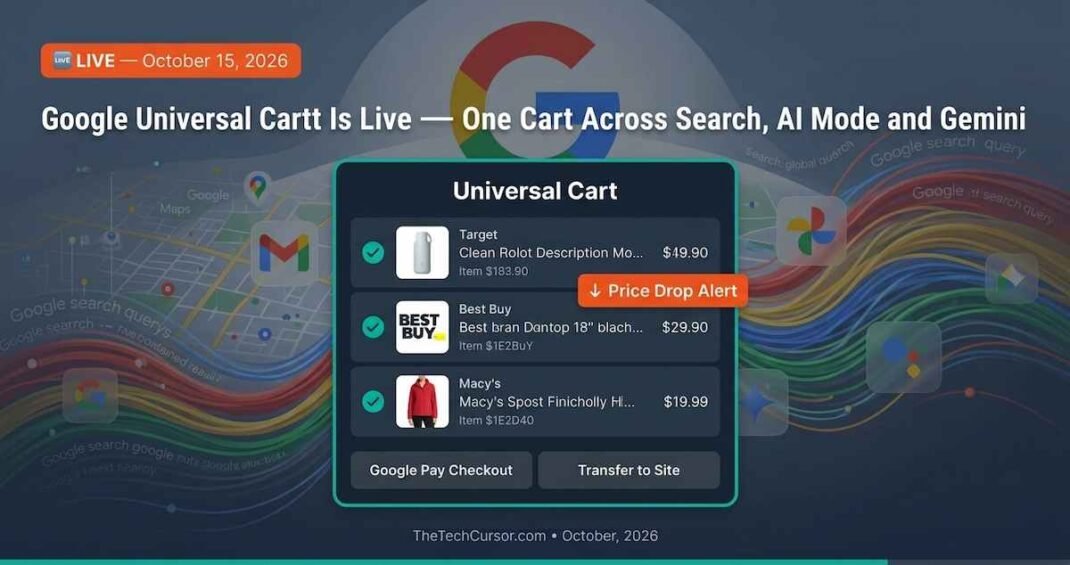
Universal Cart gives users a single, intelligent shopping cart that works across multiple retailers simultaneously. <cite index=”59-1″>It saves items from multiple retailers in one place, tracks price drops, identifies relevant promo codes, and suggests the best payment methods.</cite> Checkout is powered by the Universal Commerce Protocol — an open standard Google built with retail partners to enable AI-driven commerce at scale.
1. What Google Just Launched
<cite index=”52-1″>Google on October 15, 2026, launched Universal Cart in the U.S., rolling out the shopping cart it previewed at Google I/O 2026 in May across Google Search and the Gemini app.</cite>
The launch is significant for two reasons. First, it brings the shopping cart to the surfaces where product discovery already happens — Search results, AI Mode, and Gemini conversations. Second, it runs on an open protocol that any retailer can implement — not a proprietary Google system that only selected partners can access.
<cite index=”53-1″>Google launched it in the US on 15 October 2026 with price-drop and restock alerts, card-perk suggestions through Google Wallet, promo codes, and checkout through Google Pay or transfer to the merchant’s site.</cite>
2. How Universal Cart Actually Works
The cart operates as a layer across Google’s surfaces. When a user finds a product in Google Search, AI Mode, or Gemini, they can add it to their Universal Cart directly — without visiting the retailer’s site.
<cite index=”58-1″>Through Google products such as Search and Gemini, you can save products to the cart and also pull in promo codes and monitor for deals for items in the cart.</cite>
The cart then tracks those items. When a price drops, the user receives an alert. When an item comes back into stock, the user is notified. When a promo code applies to something in the cart, Google surfaces it automatically.
Multiple retailers can have products in the same cart simultaneously. This is the fundamental shift — a user can be comparing a product from Target, Walmart, and Newegg in a single view, with pricing and availability tracked across all three, without managing three separate browser tabs or three separate retailer apps.
3. The Four Things Universal Cart Does
The launch announcement identified four specific capabilities.
Multi-retailer organization: Users can save products from different stores in a single cart. Items from Amazon, Target, Walmart, and independent retailers all appear in one organized view. This replaces the messy browser tab approach that most people currently use when shopping across multiple sites.
Price tracking: The cart monitors prices on saved items and alerts users to drops. This was previously available as a standalone Google feature for individual products — Universal Cart extends it to the entire saved list automatically.
Promo code surfacing: Google identifies and applies relevant promotional codes to items in the cart. This is an area where AI assistance has genuine value — manually finding valid promo codes is time-consuming and frequently unsuccessful.
Streamlined checkout: Checkout runs through Google Pay or transfers items to the merchant’s site. The checkout path depends on whether the retailer has implemented native checkout through UCP or only cart transfer.
4. What Is the Universal Commerce Protocol?
<cite index=”60-1″>Checkout runs on Google’s Universal Commerce Protocol (UCP), an open standard launched earlier in 2026 to let AI agents and retailers transact together.</cite>
UCP is the technical infrastructure that makes Universal Cart possible at scale. Rather than building a proprietary integration with each retailer individually, Google created an open standard that any retailer can implement. Furthermore, any AI agent — not just Google’s own systems — can use UCP to facilitate commerce.
<cite index=”61-1″>UCP defines core commerce capabilities, including product discovery, cart management, checkout, and post-purchase workflows. The protocol includes a security architecture in which credential providers tokenize payment and identity information, and payment service providers handle transaction processing.</cite>
<cite index=”53-1″>Merchants publish a UCP profile at /.well-known/ucp that includes the cart capability. In the hub, merchants can select UCP capabilities such as cart transfer to the merchant site, native checkout on Google and identity linking.</cite>
The open standard approach is strategically important. If UCP becomes widely adopted, Google becomes the protocol layer for AI-driven commerce — not just a shopping destination. That position is significantly more valuable than operating a shopping platform.
5. The Checkout Options — Google Pay vs Cart Transfer
Two checkout paths exist depending on what the retailer has implemented.
Native checkout on Google: Some retailers allow users to complete the entire purchase within Google — paying through Google Pay without ever leaving Search or Gemini. Target and Walmart were among the first to implement this, having brought native checkout into Gemini and AI Mode in January 2026.
Cart transfer: Other retailers allow cart transfer — the user’s cart is transferred to the retailer’s own site to complete checkout there. <cite index=”53-1″>Google’s UCP Cart API guide says cart transfer is one-way via CreateCart, with no updating, deleting or syncing, and native checkout is not required.</cite>
Cart transfer is a lower-commitment implementation for retailers who are not yet ready to run checkout natively inside Google. It still provides the Universal Cart experience for item organization, price tracking, and promo codes — it simply hands off to the retailer’s own checkout at the end.
6. Which Retailers Are Participating?
<cite index=”53-1″>The same day, Target and Walmart announced checkout inside the Gemini app and AI Mode.</cite> Wayfair, Chewy, Quince, and select Shopify sellers were among the earliest integrations going back to November 2025. <cite index=”56-1″>In October, Newegg became one of the latest names to integrate Google’s Universal Commerce Protocol.</cite>
However, participation is not open to all retailers immediately. <cite index=”53-1″>Onboarding still depends on Google selecting the merchant.</cite> Retailers must apply through Merchant Center, wait for Google to grant access, and then complete technical validation of their UCP profile, cart transfer, and checkout APIs.
Consequently, the universal cart in Universal Cart is somewhat aspirational at launch. The cart works across the retailers that have been onboarded — which is growing but not yet comprehensive. For users whose preferred retailers are not yet participating, some products will be unavailable through the cart.
7. The UCP Timeline — How We Got Here
| Date | Milestone |
|---|---|
| November 2025 | Agentic checkout with Wayfair, Chewy, Quince, select Shopify sellers |
| January 2026 | Target and Walmart bring checkout into Gemini and AI Mode |
| March 2026 | Merchant Center help page sets UCP checkout requirements |
| May 2026 | Google I/O: Universal Cart previewed; UCP checkout appears in Search |
| October 6, 2026 | Merchant Center UCP hub goes live |
| October 15, 2026 | Universal Cart launches in US across Search and Gemini |
<cite index=”55-1″>The October 6 help page pushed Canada and Australia to 2027.</cite> The UK follows after that. YouTube is on the roadmap for UCP but has not launched with Universal Cart at this time.
8. What This Means for Ecommerce Brands
For ecommerce brands, Universal Cart creates both an opportunity and a risk — depending on whether they participate in UCP.
The opportunity for UCP-participating retailers: Retailers with UCP integration get visibility at the moment a shopper is actively building a purchase list. Price-drop alerts and promo code surfacing keep their products in front of the shopper during the consideration window. Native checkout reduces the friction between product discovery and transaction completion.
Furthermore, the ecommerce search trends data showed that organic Shopping converts at 2.4% — 60% higher than standard organic traffic. Universal Cart could amplify that advantage by keeping high-intent shoppers inside a Google surface through checkout.
The risk for non-participating retailers: A shopper using Universal Cart can compare products from participating retailers in a single view. Non-participating retailers are absent from that view entirely — even if their products rank well in traditional Google Shopping.
Consequently, a retailer with strong traditional Shopping presence but no UCP integration loses a growing share of shopping sessions that end in Universal Cart checkout. Furthermore, as cart adoption grows, the comparison disadvantage compounds.
The SEO and schema implications: Product structured data — specifically Product and Offer schema — becomes more important as Universal Cart uses this data to populate cart entries, track pricing, and surface promo codes. Retailers without comprehensive product schema are less reliably represented in the cart experience.
9. The Bigger Strategic Picture
<cite index=”54-1″>With the cart, Google positions itself as the orchestration layer above the transaction.</cite>
This framing captures the strategic ambition accurately. Universal Cart is not primarily a shopping feature. It is Google’s bid to own the commerce protocol layer — the infrastructure through which AI-driven purchasing flows.
<cite index=”60-1″>The thing to diligence here isn’t the UI; it’s UCP adoption: if several major retailers beyond Google’s launch partners integrate the protocol within two quarters, that’s a real platform signal worth building on. If adoption stays confined to Google Shopping partners, this is a feature, not infrastructure.</cite>
For digital marketers and SEO professionals tracking the intersection of AI search and ecommerce, Universal Cart represents the most concrete implementation of agentic commerce to date. The Google AI Overviews paid search strategy framework — Fight, Influence, Generate — now has a fourth dimension: Transact. Brands that want AI-driven shopping sessions to convert need to be inside the protocol, not just visible in the results.
10. Bottom Line
Google Universal Cart is live in the US as of October 15, 2026. It works across Search, AI Mode, and Gemini. It is powered by an open protocol — UCP — that any retailer can implement. It brings price tracking, promo codes, and agentic checkout into Google’s surfaces for the first time at scale.
For ecommerce brands, the immediate question is whether your products are available through participating retailers or directly through your own UCP integration. The medium-term question is whether UCP adoption spreads broadly enough to make the protocol a genuine industry standard — or whether it remains a Google-controlled feature set with limited independent retailer adoption.
Action Items for Ecommerce Brands
Check your Merchant Center account for UCP onboarding options. If you are not yet onboarded, apply now — the waitlist is growing as holiday shopping approaches.
Audit your product schema — Product and Offer structured data feeds directly into the Universal Cart experience. Ensure your schema is comprehensive and accurate.
Monitor your Shopping traffic for changes in click patterns as Universal Cart adoption grows among your target audience.
Watch the UCP adoption curve — if major retailers in your category integrate UCP in the next two quarters, that is a platform signal requiring immediate strategic response.
Pingback: AI and Local Search: New Rules of Visibility & ROI (2026) - The Tech Cursor