
Read time: 7 min
Table of Contents
- What Anthropic Told Investors
- The Revenue Trajectory — From Zero to $16.8B in Three Quarters
- Adjusted Profitability — What That Phrase Actually Means
- The $2 Trillion Target — And Why Some Investors Are Skeptical
- Why the IPO Is Timed for After the Midterms
- The $42 Billion Net Loss Nobody Is Talking About
- How Anthropic Compares to OpenAI
- What This Means for the AI Industry
- What This Means for Marketers and SEO Professionals
- Bottom Line
Anthropic held a closed pre-IPO investor meeting in San Francisco on October 14, 2026. The headline number was striking: <cite index=”70-1″>third-quarter revenue of $16.8 billion, up 45% from the prior quarter, along with a claim that the business is now profitable on an adjusted basis.</cite>
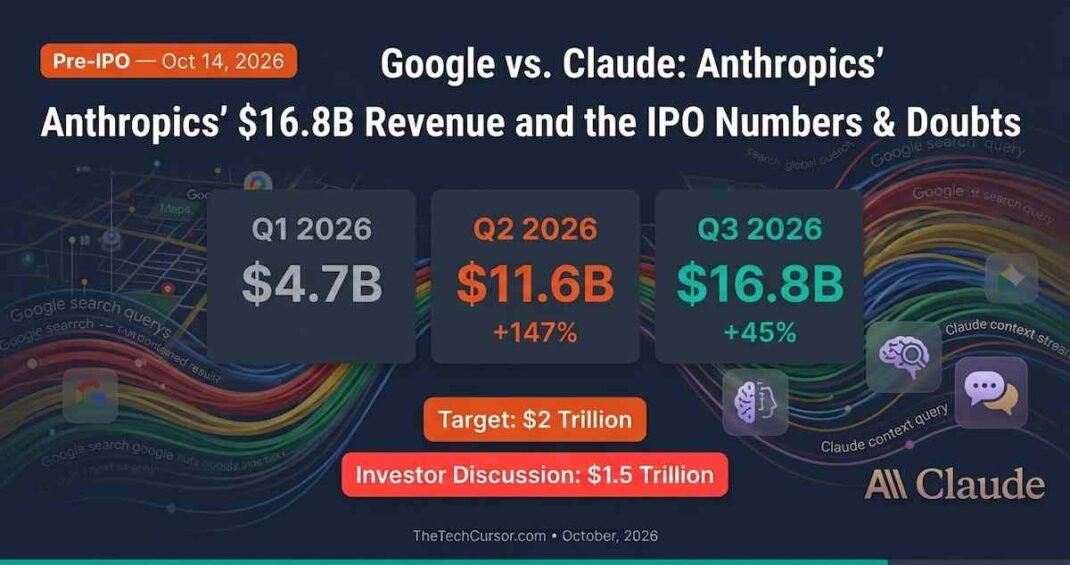
The company is targeting a valuation above $2 trillion for a planned November listing — more than double its last private valuation of $965 billion set in May 2026. However, the investor reaction to those numbers has been more complicated than the headline suggests.
1. What Anthropic Told Investors
<cite index=”67-1″>Anthropic told prospective investors at a pre-IPO meeting in San Francisco on October 14 that third-quarter revenue reached $16.8 billion, up 45% from $11.6 billion in the second quarter.</cite>
Three things were presented alongside the revenue number. First, adjusted profitability — the business is now profitable on a specific accounting basis. Second, a revenue trajectory showing consistent quarterly growth. Third, a $2 trillion IPO valuation target for a November listing.
The meeting was closed to the public. The numbers reached the press through investors who attended. Anthropic has not published a full prospectus — it filed confidentially with the SEC in June 2026 and has not yet made that filing public.
2. The Revenue Trajectory — From Zero to $16.8B in Three Quarters
The quarterly revenue progression is the most compelling element of Anthropic’s investor pitch.
<cite index=”69-1″>Revenue rose from $4.7 billion in the first quarter to $11.6 billion in the second and $16.8 billion in the third. Third-quarter revenue alone was more than three times the company’s total 2025 revenue.</cite>
To put that in context: <cite index=”65-1″>Anthropic’s annualized revenue run rate reportedly exceeded $65 billion by the end of July 2026, up from approximately $47 billion in May and about $9 billion at the end of 2025.</cite>
The growth rate across 2026 is exceptional by any standard. Q1 to Q2 was 147% growth. Q2 to Q3 was 45% — still strong, but a significant deceleration from the prior quarter’s pace. That deceleration is central to the investor skepticism that followed.
3. Adjusted Profitability — What That Phrase Actually Means
Anthropic’s claim to profitability requires specific scrutiny because of the accounting method it uses.
<cite index=”71-1″>Anthropic is bragging to investors that it was profitable — although only if you used a special accounting method that stripped out most of its expenses.</cite>
“Adjusted profitability” typically means operating profit calculated before subtracting specific expense categories — commonly stock-based compensation, depreciation on capital expenditures, and in Anthropic’s case, potentially compute costs or other significant operating items.
The full picture tells a different story. <cite index=”69-1″>The same document reported a net loss of about $42 billion.</cite> That is not a typo. The company that is reporting $16.8 billion in quarterly revenue also reported a $42 billion net loss for 2025. Approximately $34 billion of that loss was a non-cash convertible charge — an accounting artefact from its financing structure rather than cash burned. However, the remaining cash losses are still substantial.
Adjusted profitability is a real and commonly used metric in high-growth technology companies. However, investors who focus exclusively on it without examining the full loss structure are working with an incomplete picture.
4. The $2 Trillion Target — And Why Some Investors Are Skeptical
<cite index=”64-1″>The revenue figures prompted some current and prospective investors to reassess the company’s expected IPO valuation. People familiar with the discussions told Reuters that some investors discussed a valuation of approximately $1.5 trillion for the planned November share sale, down from the roughly $2 trillion that had previously been expected.</cite>
The skepticism is rooted in a specific mathematical problem. <cite index=”65-1″>The math only works if Anthropic delivers the $190 billion to $200 billion of 2028 revenue it is projecting, which would mean roughly quadrupling again from the July 2026 run rate.</cite>
At $16.8 billion in Q3 and a run rate somewhere around $65-70 billion annually, reaching $190 billion in 2028 requires roughly 3x growth in under two years. That is achievable — Anthropic achieved comparable growth rates in 2026. However, it requires everything to go right: continued Claude adoption, successful new product launches, stable competitive dynamics, and no major regulatory intervention.
<cite index=”71-1″>As investors immediately noticed, that $17 billion revenue figure is a drop in the bucket compared to the kind of growth needed to sustain the firm’s anticipated $2 trillion valuation.</cite>
Furthermore, the $1.5 trillion discussion represents investors discounting the $2 trillion target by approximately 25% — not abandoning the investment, but requiring a margin of safety before committing public-market capital at peak AI valuation multiples.
5. Why the IPO Is Timed for After the Midterms
<cite index=”69-1″>Anthropic is expected to pursue an initial public offering after the November 2026 US congressional elections, as the AI company targets a valuation above $2 trillion.</cite>
The post-election timing reflects a specific regulatory risk calculation. AI regulation is an active policy question in the US — and the makeup of the next Congress will shape the regulatory environment for large AI companies. Listing before an election outcome is known introduces regulatory uncertainty that investors would need to price in.
Furthermore, there may be demand-side considerations. Pre-election periods are typically characterized by reduced institutional investor activity as fund managers wait for policy clarity. Listing after the election — when the regulatory and fiscal environment is more predictable — may produce better demand and therefore better pricing.
<cite index=”63-1″>US investment banks Goldman Sachs and Morgan Stanley are reportedly leading the deal.</cite>
6. The $42 Billion Net Loss Nobody Is Talking About
The $42 billion net loss figure deserves more attention than it has received in most coverage of the Anthropic IPO story.
<cite index=”64-1″>Anthropic’s 2025 results: nearly $4.6 billion revenue, about $8 billion operating loss, $42 billion net loss. About $34 billion of the net loss was a convertible charge.</cite>
Stripping out the non-cash convertible charge leaves approximately $8 billion in operating losses against $4.6 billion in revenue in 2025. That is a loss ratio of roughly 174% — meaning for every dollar of revenue, the company lost $1.74 on an operating basis.
The 2026 revenue trajectory changes this picture significantly. At $16.8 billion in a single quarter and claimed adjusted profitability, the economics have transformed dramatically from the 2025 operating loss picture.
However, public market investors will examine both the 2025 baseline and the 2026 trajectory carefully. The question they will ask is whether the adjusted profitability in Q3 2026 is structural — reflecting a genuinely more efficient business — or temporary, reflecting a period where revenue growth temporarily outpaced the cost of acquiring it.
7. How Anthropic Compares to OpenAI
<cite index=”62-1″>Anthropic’s preliminary Q2 2026 revenue was more than $11.5 billion, ahead of OpenAI’s $6.7 billion.</cite>
This is a significant development. For most of its history, OpenAI was assumed to be the dominant revenue generator in frontier AI. Anthropic’s Q2 2026 revenue exceeding OpenAI’s by 71% — if both figures are accurate — represents a meaningful reversal of that assumption.
<cite index=”62-1″>Anthropic was valued at $965 billion after its Series H round in May 2026, making Anthropic more valuable than OpenAI, which was valued at $852 billion in March 2026.</cite>
The IPO will be the first true test of how public markets price frontier AI companies — with full transparency requirements that private valuations do not impose. How Anthropic prices will influence how OpenAI’s own expected 2027 listing is received. Furthermore, it will set a benchmark against which every other major AI company’s private valuation will be judged.
8. What This Means for the AI Industry
Anthropic’s IPO is the most significant test of AI company economics to reach public markets. Several outcomes will shape the industry regardless of where the final valuation lands.
If Anthropic lists above $1.5 trillion: It validates the private valuations of other frontier AI companies and signals that public markets are willing to price AI at growth multiples. This would accelerate other planned AI listings and potentially trigger a wave of AI company IPOs in 2027.
If Anthropic lists below $1.5 trillion: It represents a significant markdown from private valuations and signals that public markets are applying more conservative multiples to AI growth. This could delay or complicate OpenAI’s planned 2027 listing and may cause some private AI investors to reassess their portfolio valuations.
The adjusted profitability claim: If accepted by public market investors, it establishes a framework for how AI companies can present their economics during the growth phase — potentially making it easier for other pre-GAAP-profit AI companies to access public markets.
9. What This Means for Marketers and SEO Professionals
Anthropic’s revenue trajectory is directly relevant to every marketing and SEO professional who uses Claude or plans to use it.
A company generating $16.8 billion in quarterly revenue is not going away. Anthropic has the resources to continue model development, expand Claude’s capabilities, and invest in the tooling ecosystem around the API. The Claude Opus 5.5 prompting guide and the Anthropic power prompts article cover capabilities that will continue to evolve as Anthropic’s revenue funds further R&D.
Furthermore, an Anthropic IPO changes the company’s accountability structure. As a public company, Anthropic will face quarterly earnings pressure, governance requirements, and public disclosure obligations that private companies do not. That transparency may be beneficial for enterprise customers who need to assess the long-term viability of Claude as a platform dependency.
The AI search implications are also significant. Claude is one of the platforms that the AI visibility dashboard framework covers for prompt tracking. A well-funded, growing Anthropic means Claude’s market share in AI search is likely to continue expanding — making investment in Claude visibility more strategically relevant, not less.
10. Bottom Line
Anthropic’s Q3 2026 revenue of $16.8 billion — up 45% quarter-over-quarter — is a genuine business milestone. The growth trajectory from $4.7 billion in Q1 to $16.8 billion in Q3 is exceptional. The adjusted profitability claim, while requiring scrutiny, represents a meaningful shift from the 2025 operating loss structure.
The $2 trillion IPO target is ambitious — requiring $190-200 billion in 2028 revenue that implies roughly 3x further growth from current levels. Some investors are already pricing in a discount to $1.5 trillion, reflecting their assessment of the probability that the growth projections materialize.
The Three Things to Watch
First: The final IPO valuation when Anthropic lists in November. The gap between $1.5 trillion and $2 trillion reflects a genuine disagreement about how to price frontier AI growth. Where it prices will be a landmark data point for the entire AI industry.
Second: The Q4 2026 revenue figure. If growth continues at or above 45%, the $2 trillion case strengthens. If growth decelerates significantly from Q3’s 45% pace, investor skepticism about the valuation will grow.
Third: What happens to Claude’s market share after the IPO? Public company status brings resources but also scrutiny. Whether the IPO accelerates or disrupts Claude’s competitive momentum will shape AI search visibility strategy for every brand that depends on it.
Pingback: Anthropic IPO Filing: AI Self-Acceleration Threshold Nears ! - The Tech Cursor
Pingback: How Notable, GIC & Baillie Gifford Bet Big on Anthropic - TheTechCursor