
Read time: 6 min
Anthropic raised $81.3 billion in the largest IPO in history, according to a TechCrunch report published on November 22, 2026. Then its shares began trading the next day. The report looks back at why three major investors backed the company long before it listed.
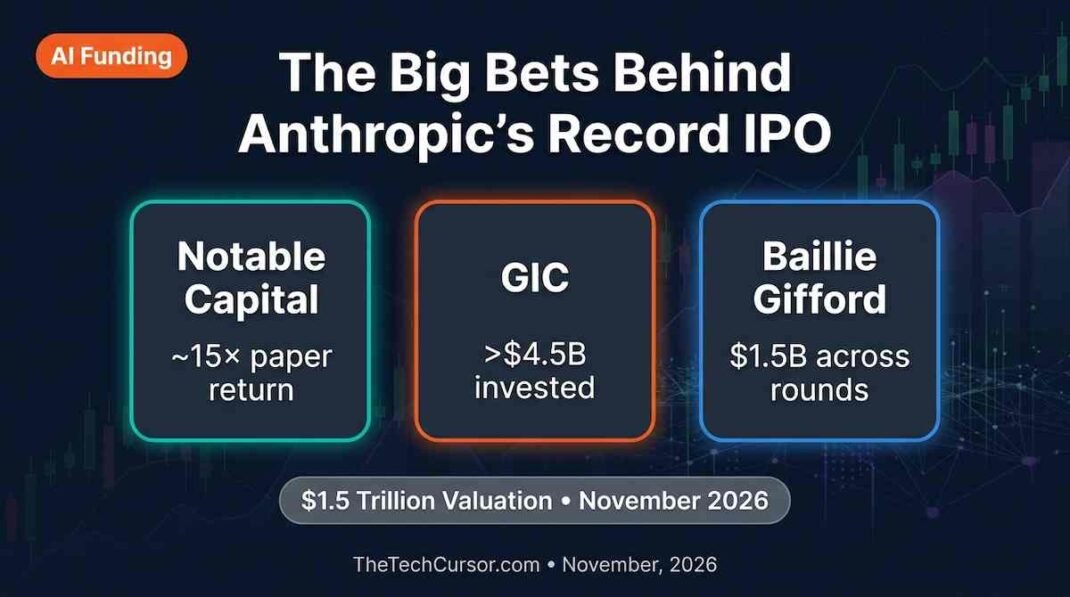
The story is useful beyond finance. Specifically, it shows what convinced experienced investors, and it raises questions for anyone who builds on AI tools.
What the Report Says
The report profiles three backers: Notable Capital, GIC, and Baillie Gifford. Each explained what gave them conviction to invest billions.
However, all three describe paper gains. The IPO priced Anthropic at a fully diluted valuation of about $1.5 trillion before trading began. That figure matches the lower number investors had discussed ahead of the listing, as the IPO revenue analysis described.
Notable Capital: The Developer Bet
Notable Capital, formerly GGV Capital, invested in Anthropic’s Series E. It put roughly 10% of the US portion of its fund, which exceeded $1 billion, into the round.
Many of its limited partners were puzzled at the time. For example, Anthropic still trailed its biggest rival, and a Chinese model had just raised fears about closed-source competitors. Moreover, the $61.5 billion valuation was the highest in the firm’s 25-year history.
Notable’s team studied developer behaviour. Notably, it found that developers were using Claude about 70% of the time, a reversal from the year before. One co-founder said developers are central to AI because they are early adopters. He also said the firm believed mission-critical work would need US-based, closed-source models.
The firm reports a paper return of roughly 15 times.
GIC: The Enterprise Adoption Bet
GIC, Singapore’s sovereign wealth fund, researched Anthropic throughout 2024. Its first investment came after a meeting between its head of tech investments and Anthropic’s CFO in early 2025.
The CFO showed how model improvements were driving enterprise adoption. As a result, GIC joined the Series F in September 2025 at a $183 billion valuation. At that point, it saw early signs that developers liked Claude Code.
GIC later led the Series G alongside Coatue at $380 billion. Then it co-led the pre-IPO round at $965 billion. In total, it invested more than $4.5 billion. According to a person familiar with its financials, that gives it roughly a 1% stake after the IPO.
Baillie Gifford: The Execution Bet
Baillie Gifford began studying Anthropic nearly two years before it invested in the Series F. Its US growth investing lead said the firm waited until Anthropic was clearly executing consistently. It also looked for strong revenue and compelling gross margins.
After the first investment, she said Anthropic kept delivering. Indeed, it expanded into areas such as legal services, life sciences, Cowork, and cybersecurity. Baillie Gifford invested a total of $1.5 billion across three rounds.
The Valuation Journey
The rounds mentioned in the report show how quickly the valuation climbed.
| Stage | Valuation |
|---|---|
| Series E | $61.5 billion |
| Series F (September 2025) | $183 billion |
| Series G | $380 billion |
| Pre-IPO round | $965 billion |
| IPO (fully diluted, before trading) | About $1.5 trillion |
Therefore, the path from $61.5 billion to $1.5 trillion took less than two years.
What Is Reported and What Is Not
Several cautions apply.
First, these are paper gains. They are not realized returns until investors sell. Second, the investors have a financial stake, so their explanations are also a form of advocacy. Third, some figures, such as GIC’s stake, come from an unnamed source.
Also, the report is a retrospective of three investors. Because it does not assess risks, readers should look elsewhere for them. The S-1 filing analysis shows that the company itself flagged significant risks to investors.
What It Means for Marketers and SEOs
The following points are analysis, not claims from the report.
Vendor viability. A well-funded AI vendor is less likely to disappear. However, size does not remove other risks, such as pricing changes or policy shifts.
Developer adoption drives the market. Investors cited developer usage as a key signal. Consequently, tools built on strong developer ecosystems may improve faster.
Public-company scrutiny. Public status brings regular disclosures. Consequently, that may help customers judge vendor stability.
Stay flexible. Do not depend on a single model. The GDPx benchmark article shows how leaders differ by task. Also, the Claude Opus 5.5 prompting guide helps you get the most from current tools.
Bottom Line
Three major investors backed Anthropic for different reasons: developer adoption, enterprise demand, and consistent execution. Their early bets now show large paper gains after a record IPO at about $1.5 trillion.
The Takeaway
Treat investor stories as context, not proof of future results. Therefore, watch the company’s disclosures, keep your AI workflows flexible, and judge tools by results.