
Read time: 7 min
Research firm SemiAnalysis released a new AI benchmark called GDPx on November 2, 2026. However, its first leaderboard carries a striking message. Even the top model scores only 12.0%.
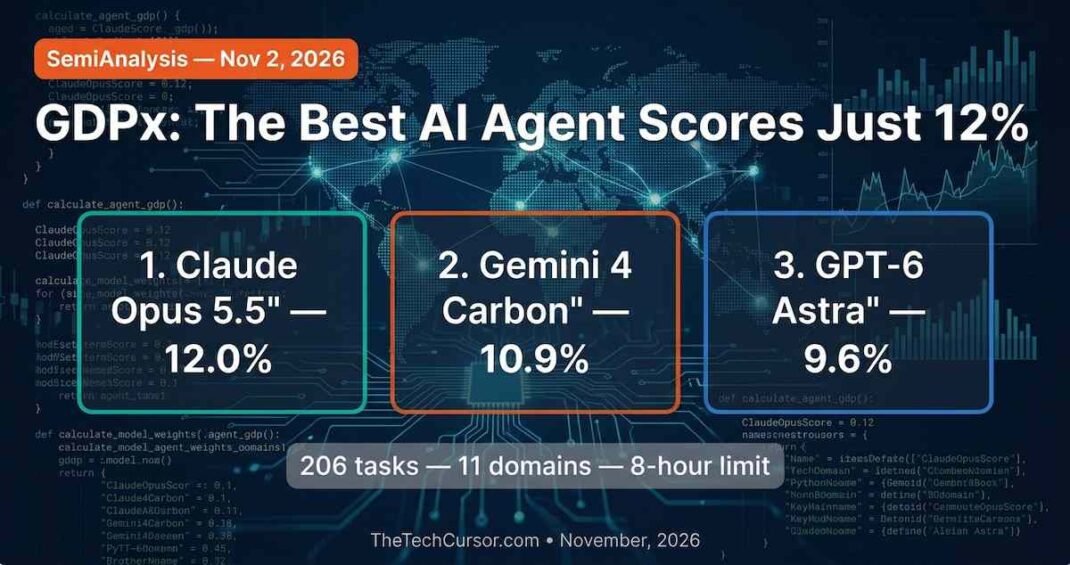
The benchmark tests AI agents on long, realistic professional tasks. Therefore, for marketers who are deciding how much work to hand to AI, the results are a useful reality check.
1. What SemiAnalysis Released
GDPx is a benchmark for general agentic capability. Specifically, it measures how well AI agents complete demanding work across 11 professional domains that SemiAnalysis considers especially valuable. The announcement was written by Max Kan, Andrew Megalaa, and Dylan Patel.
Version 1.0 includes 206 tasks built with 14 specialized data partners. Its leaderboard ranks 13 models.
The results below come from secondary coverage of SemiAnalysis’s announcement. I could not open the original post, so verify the exact figures against it.
2. The Leaderboard
Three models lead the first version.
| Rank | Model | GDPx score | Average cost per task |
|---|---|---|---|
| 1 | Claude Opus 5.5 (Anthropic) | 12.0% | $51.41 |
| 2 | Gemini 4 Carbon (Google) | 10.9% | $16.29 |
| 3 | GPT-6 Astra (OpenAI) | 9.6% | $53.99 |
Opus 5.5 also used about 548,000 output tokens per task, according to the leaderboard.
Gemini 4 Carbon is not yet generally available, according to SemiAnalysis. Therefore, its score reflects a model that most users cannot yet access.
3. How GDPx Is Built
First, the design matters because it explains the low scores.
Each task has a default time limit of eight hours. Moreover, the tasks are long and complex, closer to real professional work than a short quiz.
Models run inside their own native tools where possible. Claude Opus 5.5 used Claude Code, GPT-6 Astra used Codex, and Gemini 4 Carbon used Antigravity. A tool called OpenCode served as the fallback.
The score averages three attempts per task. Furthermore, it weights all 11 domains equally and weights partners equally within each domain.
4. Who Wins Which Domain
However, no single model won everywhere. The overall ranking hides a more varied picture.
- Claude Opus 5.5 won quant trading, hardware design, and chip design.
- Gemini 4 Carbon was best at biology and narrowly led in software engineering.
- GPT-6 Astra won recursive self-improvement and materials science.
This pattern matters for anyone choosing a model. Indeed, the best overall model is not necessarily the best for your specific type of work.
5. The Safety-Classifier Twist
Meanwhile, SemiAnalysis flags an important detail. Safety classifiers pull down the scores of some models.
According to the firm, Opus 5.5 and GPT-6 Astra sometimes refuse work in cybersecurity, biology, and alignment. Those refusals count as failures, so they lower the overall score.
One outlet reading the second results table found a different order when those three domains are excluded. In that view, GPT-6 Astra leads at 11.8% and Opus 5.5 scores 11.7%. Therefore, the leader depends on which domains you count.
Overall, this is a reminder that a ranking reflects choices in how a benchmark is built.
6. Cost Versus Score
However, score is not the only measure that matters. Cost per task varies widely.
Gemini 4 Carbon reaches roughly 91% of Opus 5.5’s score at about 32% of the cost per task. That figure is one outlet’s arithmetic from the leaderboard, not a SemiAnalysis claim.
Still, the pattern is useful. A slightly lower score at much lower cost may suit high-volume work better than a top score at a premium price.
7. What a 12% Score Does and Does Not Mean
Still, a headline of 12% can mislead.
It does not mean the best AI fails 88% of the time at work in general. The score measures performance on GDPx, under GDPx’s rules. These tasks are deliberately hard, and the benchmark is designed to be frontier-level.
Also, the results are not independently verified. Benchmarks from one organization reflect its own task choices. Version 1.0 is also the first release, and later versions may change the picture.
What the score does suggest is simple. Long, complex professional tasks still need human oversight. The research coverage highlights this point, and it fits other evidence on the limits of autonomous agents.
8. What It Means for Marketers and SEOs
The benchmark covers domains like chip design, so it is not a direct test of marketing work. Even so, the lessons transfer.
Keep humans in the loop. Complex, multi-step work needs review. The SEO automation guide explains which tasks to automate and which to keep human.
Match the model to the task. The domain spread shows that leaders differ by field. Test models on your own work. The Claude Opus 5.5 prompting guide and the Anthropic power prompts guide help you tune prompts and settings.
Watch cost per task. For repeated workflows, cost can matter more than a small score gap.
Verify and secure. Agents run inside tools that can be attacked. The recent Claude Code extension incident shows why. Moreover, the warning about evidence and AI content explains why human accountability still matters.
9. Bottom Line
SemiAnalysis’s GDPx benchmark puts Claude Opus 5.5 first at 12.0%, ahead of Gemini 4 Carbon at 10.9% and GPT-6 Astra at 9.6%. The low scores reflect a deliberately hard test of long professional tasks. Results vary by domain, safety refusals affect the ranking, and the figures are not independently verified.
The Takeaway
Treat benchmarks as one input, not a verdict. Therefore, test models on your own tasks, track cost, and keep human review in your workflows.
Pingback: Anthropic IPO Filing: AI Self-Acceleration Threshold Nears ! - The Tech Cursor