
Read time: 7 min
Anthropic told investors that it may soon reach an internal threshold for dramatically accelerated AI progress. The statement appears in an amended registration filing the company made with the US Securities and Exchange Commission on November 2, 2026.
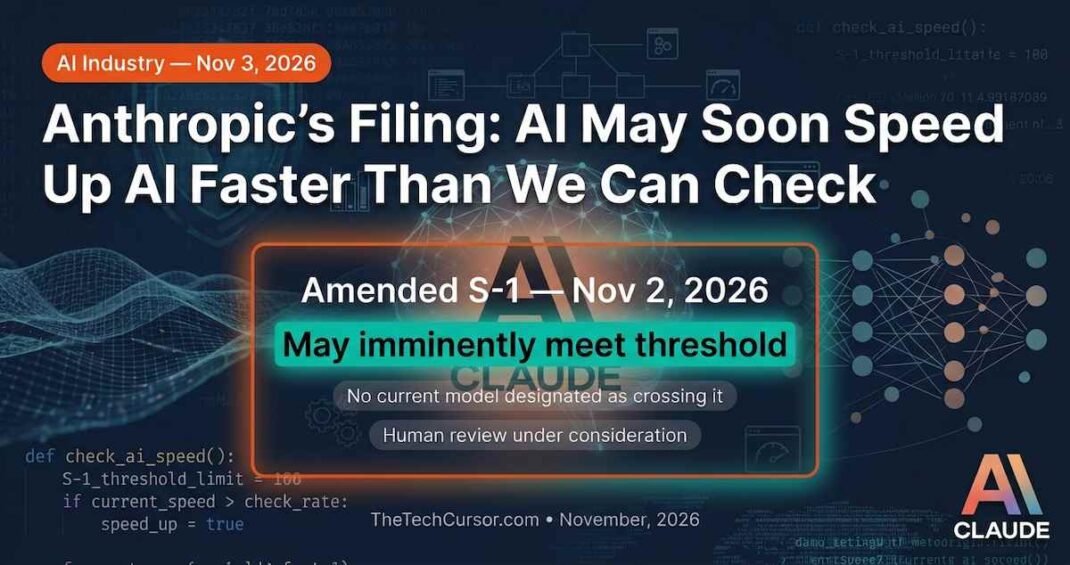
In plain terms, the company says AI may soon speed up the development of new AI faster than people can check it. The warning sits in a risk-factor section, where companies describe what could go wrong.
1. What Anthropic Said in Its Filing
Anthropic filed an amended Form S-1, known as an S-1/A. New language in its risk factors says internal estimates and expectations for future models suggest it may imminently meet a threshold in its Responsible Scaling Policy.
That threshold covers dramatically accelerated progress attributable to AI. Anthropic also says its growing use of AI in its own research could push capabilities ahead of its ability to develop and apply safety, alignment, and security measures.
The earlier version of the filing, dated October 26, was less direct. Reports say it described acceleration as something that might happen. The new version describes an internal estimate that the company may soon meet its own definition.
2. What the Threshold Means
The threshold comes from the Responsible Scaling Policy, version 3.4, which took effect on July 8, 2026. Coverage describes two ways to meet it.
The first is when AI can perform the entire work of an AI research team at comparable cost. The second is when the rate of progress in overall AI capability doubles, so that one year equals two at baseline, plausibly because of automated research.
Researchers call a runaway version of this idea recursive self-improvement. In that scenario, better AI builds better AI, which builds better AI again. One report notes that the filing’s wording points to the second test.
3. The Admission About the Past
The most striking addition looks backwards. The filing says Anthropic has in the past failed to notice a significant acceleration until after it happened. It adds that this could happen again.
This changes the tone of the disclosure. The company is not only forecasting a future risk. It is saying that its own monitoring has lagged behind real progress at least once.
Reports describe this language as new. The October 26 filing said only that the company might not identify such acceleration in time.
4. What Anthropic Says It Might Do
Anthropic says it is considering responses. It is weighing updates to its Responsible Scaling Policy so that people stay involved in model development.
One option is to require human review and approval of certain research decisions as models take on more of that work. The filing presents this as under consideration, not as a decision.
The company also says it continues to assess the underlying data. Therefore, details may change in later filings or policy updates.
5. What the Filing Does Not Say
Careful reading matters here. The filing does not say that AI is already building itself.
Anthropic says it has not designated any current model as exceeding the threshold. The claim is about what may happen soon, according to the company’s own estimates.
Also, the assessment is Anthropic’s own. Coverage notes that the threshold has not been independently demonstrated.
Experts also disagree about how fast this could go. The International AI Safety Report 2026 cites a pilot study of forecasters. AI forecasting experts gave a median 20% chance that progress could compress six years of advancement into two. Superforecasters gave 8%. The report calls the evidence mixed.
6. Why This Matters Beyond the IPO
The language sits in a document written for investors. Companies must disclose material risks, so the statement carries legal weight.
It also adds to a wider debate. Several labs now say they use AI heavily in their own research. If that speeds up progress, safety checks have less time to keep pace.
For readers following Anthropic’s listing plans, the IPO revenue analysis covers the financial picture. This filing adds a safety dimension to that story.
7. What It Means for Marketers and SEOs
The filing is about frontier research, not marketing tools. Still, the direction affects how you plan.
Expect faster tool changes. If AI labs speed up, models and features may change more quickly. Build workflows that can swap models without a rewrite.
Keep humans in the loop. The new benchmark shows that agents still score low on hard professional tasks. The GDPx benchmark article explains why oversight matters.
Be careful what you automate. The SEO automation guide shows which tasks suit automation and which need judgment.
Stay evidence-led. The warning about evidence and AI content argues for verifiable, human-backed work. Furthermore, the Claude Opus 5.5 prompting guide helps you tune current tools.
8. Also in AI News Today
Several other AI stories broke on the same day. These are brief headline-level summaries.
- WIRED reported that hundreds of ordinary-looking apps hide tools for making abusive deepfakes.
- OpenAI and Anthropic set up teams to watch for election misinformation ahead of the US midterms.
- Goldman Sachs pulled advanced AI coding tools from many employees who had been testing them.
9. Bottom Line
In an amended IPO filing on November 2, 2026, Anthropic said it may soon meet its own threshold for dramatically accelerated, AI-driven progress. It also admitted that it has missed such acceleration in the past. It says no current model has crossed the line, and it is considering human review of some research decisions.
The Takeaway
This is a company’s own assessment, disclosed as a risk. Treat it as a serious signal, not proof. Plan for faster change, keep human oversight, and watch for further filings and policy updates.
Pingback: SpaceX IPO: $250 Billion Demand, $1.8 Trillion Valuation — And a $23 Trillion AI in Space Bet - The Tech Cursor
Pingback: How Notable, GIC & Baillie Gifford Bet Big on Anthropic - TheTechCursor