
Category: Tech News | AI | SpaceX | IPO
Published: June 13, 2026
Read time: 6 min

The numbers are staggering. Investors have thrown over $250 billion at SpaceX’s initial public offering — roughly three to four times the $75 billion the company actually hopes to raise. If the deal prices as expected on Thursday, it will become the biggest stock market debut in history, surpassing Saudi Aramco’s 2019 record.
But the SpaceX IPO is not just a rocket and satellite story. At its core, it is an AI infrastructure play — and one of the most ambitious bets on the future of computing ever pitched to public markets.
The Numbers Behind the Hype
SpaceX plans to sell approximately 555.6 million shares at $135 each, valuing the company at nearly $1.8 trillion. To put that in perspective:
| Company | IPO Valuation |
|---|---|
| Saudi Aramco (2019 — previous record) | ~$1.7 trillion |
| SpaceX (2026 — if priced as planned) | ~$1.8 trillion |
| Anthropic (confidential S-1 filed) | ~$965 billion |
The oversubscription rate has jumped sharply over the past week. Long-only institutional funds — the most stable, serious class of investors — are placing sizable orders. Elon Musk himself joined several Zoom calls with prospective backers during the roadshow.
However, nothing is final yet. Demand figures at this stage represent indications of interest, not firm allocations. Those get locked in at pricing, expected Thursday afternoon.
The AI Angle — A $23 Trillion Opportunity
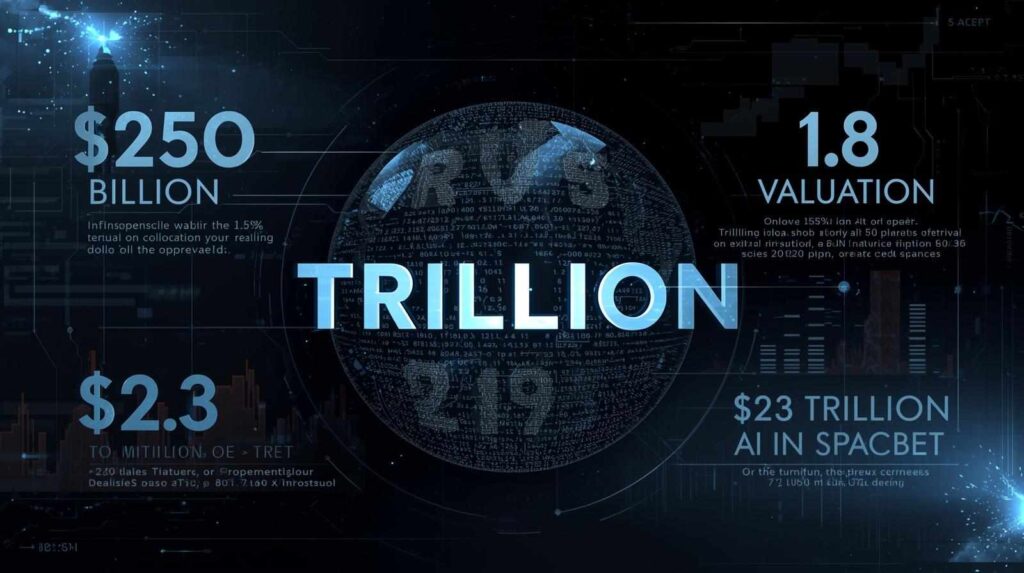
Here is what makes SpaceX’s IPO pitch genuinely different from a traditional aerospace offering. The company is not just selling rockets and Starlink internet. It is pitching a $23 trillion AI computing opportunity — and arguing it is the only company on Earth positioned to capture it.
The argument goes like this:
- Demand for AI computing capacity is growing faster than Earth-based infrastructure can keep up with
- Building data centers on the ground faces enormous obstacles — land constraints, permitting, power grid limitations, and geopolitical risk
- SpaceX, by dramatically reducing the cost of reaching orbit, can do what no other company can: launch AI computing infrastructure into space
“By dramatically reducing the cost of access to space, we have been able to expand our mission to address some of the Earth’s most pressing challenges,” SpaceX said in its roadshow materials — including connecting over three billion currently unconnected people to the internet via Starlink.
Furthermore, SpaceX directly addressed the infrastructure gap in its pitch, arguing that U.S. electricity generation and computing capacity have fallen behind China’s. The solution, in SpaceX’s telling, is not to fight through domestic regulatory obstacles — but to launch computing capacity into orbit aboard its own rockets.
Why Markets Are Nervous — And Bitcoin Is Falling
The timing of the SpaceX IPO is creating unusual turbulence across financial markets. The Nasdaq composite slid again on Tuesday after its worst single day in over a year on Friday. Bitcoin dropped 2.8%, sitting 37% below its January peak.
A theory gaining traction among market analysts: investors are selling other holdings to free up cash for the SpaceX deal. Bitwise adviser Jeff Park argued that bitcoin specifically was being tapped to fund the rush into SpaceX and other sought-after names, rather than weakening on its own fundamentals.
The scale helps explain the nervousness. Strategy chairman Michael Saylor estimated that markets absorbed around $400 billion over six months to fund AI infrastructure buildouts. SpaceX’s $75 billion raise — on top of capital flowing toward OpenAI and Anthropic IPOs — represents an enormous amount of money chasing a concentrated set of AI and space bets simultaneously.
Starlink + Rockets + AI — Three Business Engines
SpaceX’s roadshow materials highlight three distinct revenue engines:
1. Rockets — The Monopoly on Mass to Orbit SpaceX carried the bulk of all mass sent into orbit over the past three years. No other company comes close. This operational monopoly on affordable launch capacity is the foundation on which everything else is built.
2. Starlink — The Growing Internet Business Starlink’s subscriber base continues to grow, providing recurring revenue from satellite internet service across markets that terrestrial internet cannot reach. This is SpaceX’s most predictable cash flow engine.
3. AI Computing in Space — The $23 Trillion Bet. This is the new and most speculative element of the pitch. SpaceX is positioning itself as the infrastructure provider for orbital AI computing — data centers and computing hardware launched into space, freed from earthbound constraints. It is an audacious claim, but one that is proving compelling to institutional investors.
The Broader IPO Wave — SpaceX, OpenAI, Anthropic
SpaceX’s listing does not exist in isolation. It is part of a broader wave of AI-era IPOs that is reshaping how capital flows across global markets.
Anthropic confidentially filed its S-1 with the SEC on June 1, 2026 — the same day GitHub Copilot switched to token-based billing. With a valuation near $965 billion and a revenue run-rate of approximately $47 billion, Anthropic’s eventual public listing will be another landmark event.
OpenAI is also widely expected to pursue a public listing. Together, SpaceX, Anthropic, and OpenAI represent perhaps the three most anticipated public market debuts of the decade — and they are all converging in the same narrow window of time.
Consequently, capital is rotating hard toward AI and space ventures, draining liquidity from other asset classes in the process. The market turbulence of the past week is, in part, a direct reflection of this historic concentration of investor appetite.
What This Means for the Tech and AI Landscape
For the broader technology industry, SpaceX’s IPO signals several important things:
AI infrastructure is the investment theme of the decade. The fact that SpaceX — a rocket company — is pitching a $23 trillion AI opportunity and receiving $250 billion in demand tells you everything about where institutional capital thinks the biggest returns will come from.
The space-AI convergence is real. Orbital computing is not science fiction anymore. It is now a serious investment thesis backed by one of the world’s most credible engineering organizations.
The IPO window is open. After years of private-market dominance, the most valuable AI and technology companies are moving toward public listings. This creates new opportunities — and new volatility — for markets worldwide.
Capital concentration risk is growing. With hundreds of billions flowing toward a handful of AI-adjacent IPOs simultaneously, the ripple effects across other asset classes — equities, crypto, bonds — will be significant and unpredictable.
Bottom Line
SpaceX’s IPO is one of the most remarkable capital market events in years — not just because of its scale, but because of what it represents. A company built on rockets is now pitching the future of AI computing. Investors are responding with $250 billion in demand.
The deal prices Thursday. Whether it becomes the largest IPO in history or the market shifts before then, one thing is already clear: the convergence of AI, space, and global capital markets is here — and it is moving faster than almost anyone predicted.
Stay updated with the latest in AI, technology, and digital innovation — only on TheTechCursor.Reviewed & published by TheTechCursor Editorial Team