
Read time: 8 min
AI data centers have become a visible issue in the US midterm elections on November 3, 2026. Voters in several states will decide measures that range from new rules for developers to outright bans on construction.
However, the topic matters beyond politics. These facilities power the AI tools that marketers and businesses now use daily. Public opinion about them could shape the cost, speed, and location of AI growth.
1. What Is on the Ballot
Trackers count ballot measures differently, so the totals vary.
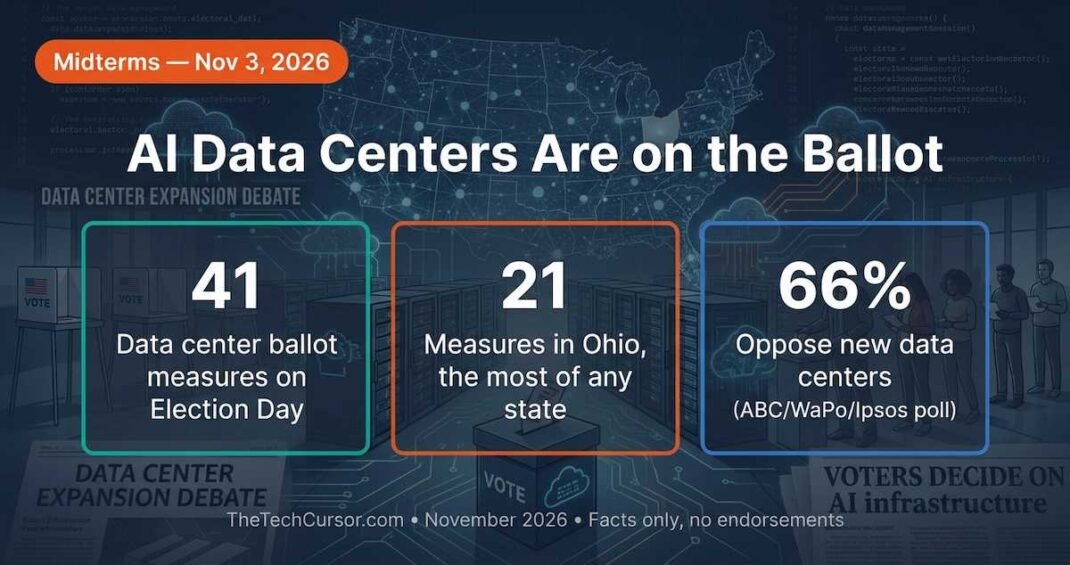
Ballotpedia counts 41 data-center-related measures that voters will decide on Election Day, across 10 states. Another tracker, cited by one business outlet, counts 49 measures through the end of 2026 across 13 states. About 84% of those 49 fall on the November ballot.
Ohio has the most measures by far. It has 21, followed by Illinois with 7 and Maine with 4. Other states include Wisconsin, Kansas, California, Arkansas, and New Hampshire.
Most of these are local measures. Indeed, many come from towns and cities rather than statewide votes. A citizen effort to place a statewide Ohio ban on the ballot fell short in June, according to one report.
2. Examples of Local Measures
First, the measures differ widely in what they would do.
- Moratoria. Voters in Bloomington, Illinois, and in the Maine towns of Peru, Wells, and Wiscasset will decide new moratoria.
- Size-based limits. A measure in Sunbury, Ohio, would ban new data centers above a set power threshold.
- Full bans. Some initiatives would ban new data centers entirely. Alhambra, California, is voting on one. Monterey Park approved a moratorium in June.
- Advisory votes. Monroeville, Ohio, is holding a measure that gauges opinion without changing any law.
New York enacted a one-year moratorium on very large data centers in July, the first state to do so.
3. What the Polls Show
Several national polls show broad skepticism, though the numbers differ.
An ABC News, Washington Post, and Ipsos poll found 66% of Americans oppose new data centers. It also found 57% say AI is bad for society, and 67% say the government is not doing enough to regulate AI.
An NBC poll from September found 69% would oppose a new data center opening in their community. Meanwhile, a Politico poll in October reportedly found opposition among 65% of Democratic voters and 36% of Republican voters.
Therefore, opposition appears across both parties, but at different levels. Question wording and timing also affect results.
4. Why Data Centers Became a Campaign Issue
Concerns focus on electricity, water, and local impact.
The International Energy Agency has reported that a typical AI data center uses as much electricity in a year as about 100,000 households. Separately, a Bloomberg analysis found that wholesale electricity prices rose as much as 267% from 2020 to 2025. That was in areas with significant data center activity.
Price changes can have several causes. The figure shows a pattern in those areas, not a single proven cause.
Local residents also raise noise, water use, and land concerns. Furthermore, one political scientist quoted by a news outlet argued that AI companies have done a poor job explaining the benefits to ordinary people. That is one expert’s view.
5. What Supporters Say
However, supporters make a different case. They argue that data centers are needed for the United States to compete in AI, including with China.
Many candidates also take conditional positions rather than outright ones. A survey of candidates in 36 governor’s races found views from full support to conditional approval to temporary moratoria, according to a policy-tracking firm.
In some states, candidates from both major parties support some form of moratorium. In others, candidates favour projects only if they meet conditions on electricity costs, taxes, and environmental protection.
6. Policy Options Being Debated
Beyond moratoria, several tools are under discussion.
- Ratepayer protection. Rules that make data centers pay for grid expansion, so household bills do not rise.
- Tax incentives. Several states are reassessing breaks they once offered.
- Transparency. Proposals to limit nondisclosure agreements and require public disclosure.
- Utility regulation. In Georgia, two seats on the commission that regulates the state’s main utility are on the ballot, which could affect how data centers pay for power.
State moratorium bills were introduced in 11 states in 2026 but have faced resistance, according to a policy tracker. Meanwhile, dozens of municipalities have paused construction locally.
7. What Happens Next
Results will come in over the coming days. Meanwhile, a few points are worth watching.
Ballotpedia reported that all six data center measures decided earlier this year, in New Hampshire, Wisconsin, Michigan, and California, went against development. That is an early pattern, not a prediction for Tuesday.
Also watch for supply-side effects. One industry data firm reported that Texas project approvals fell 5% in the third quarter as the bottleneck shifted toward the power grid.
8. What It Means for Marketers and SEOs
The effect is indirect but real. Therefore, the following points are an analysis.
Costs and capacity. Data center limits could affect how fast AI services scale. The Alphabet earnings analysis and the Meta ad revenue comparison show how heavily big companies are spending on AI infrastructure.
Returns on AI spending. Investors are already questioning the payoff, as the AI Mode monetization article explains.
Public sentiment. If many people distrust AI, brand messaging about AI may need care. The warning about evidence and AI content argues for verifiable, human-backed claims.
Pace of change. The Anthropic filing analysis shows labs expect faster progress, which adds to public debate.
9. Bottom Line
AI data centers are on the ballot in 2026. About 41 measures in 10 states will be decided on Election Day, with Ohio leading. National polls show broad skepticism, while supporters point to competitiveness and many candidates take conditional positions.
The Takeaway
Results will show how far local opposition goes. Therefore, follow the outcomes, watch for changes in AI capacity and costs, and treat any single poll as a snapshot.
10. Sources Reviewed
The figures in this article come from the reports below. Each was reviewed during research. Trackers and polls count differently, so check any specific number against the original poll or tracker before you rely on it. Primary sources such as Ballotpedia, ABC News, The Washington Post, Ipsos poll, and the International Energy Agency were not opened directly for this article.
- Fast Company — Midterm elections 2026: AI data centers could decide races in these states
- Forbes — Here’s the Full List of Data Center Bans on Midterm Ballots
- Axios — AI data center backlash shapes 2026 midterm elections
- Gizmodo — America’s AI Backlash Is Coming to the Ballot Box
- Multistate — State Data Center Policy 101: 2026 Legislative Guide
- Bisnow — The Data Center Election That Matters Isn’t In Congress
- Design News — The Tech Issue Making This Midterm Election Different
- Yahoo Tech — There was little fuss about data centers in the last election. Now they could sway the midterms.
- Explainx — Data Center Midterms 2026: Where 10 Races Stand on a Pause