
Read time: 7 min
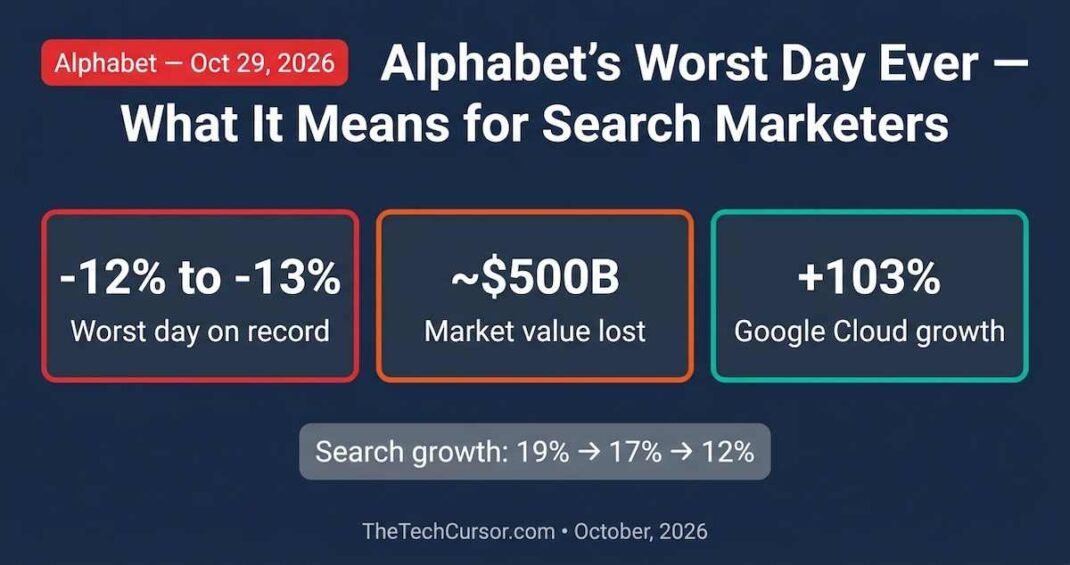
Alphabet had the worst trading day in its history on Thursday, October 29, 2026. Shares fell roughly 12% to 13%. About $500 billion of market value disappeared in one session.
The trigger was the company’s Q3 earnings report. However, for search marketers, the story is bigger than a stock chart. It shows how investors now judge the link between AI and Google’s core search business.
1. What Happened on October 29
Alphabet reported results on October 28. Then the market reacted the next day. Reports describe the fall as the steepest since the company listed in 2004.
The previous record one-day drop came on March 16, 2020, during the pandemic crash. That fall was about 11.6%. Therefore, Thursday’s move was larger.
Moreover, the loss of around $500 billion also ranks among the biggest one-day value losses ever for a US-listed company. Reports place it second only to Nvidia’s drop in January 2025.
2. The Numbers Behind the Selloff
However, the report mixed strong growth with several disappointments.
| Metric | Reported figure |
|---|---|
| Total revenue | $127.6 billion, up 25% (slightly below estimates) |
| Earnings per share | $2.12, against a $3.02 consensus |
| Search and other revenue | About $63.35 billion, up 12% |
| Search growth in earlier quarters | 19% in Q1, 17% in Q2 |
| Google Cloud revenue | $30.7 billion, up 103% |
| Quarterly capital spending | $51.4 billion |
| Free cash flow | Negative $9.1 billion |
Reported share-price moves differ slightly by source, because some figures reflect intraday trading and others reflect the close. Treat “12% to 13%” as the reliable range.
3. Why Investors Reacted — Three Worries
Overall, three concerns drove the selling.
Search growth is slowing. Growth fell from 19% to 17% to 12% across three quarters. Search still produces about half of Alphabet’s total revenue, so the trend matters. That share comes from dividing the reported search figure by total revenue.
AI spending is heavy. Capital spending more than doubled to $51.4 billion in the quarter. Also, the CFO said capex will rise significantly in 2027. Investors want proof that the spending pays off.
Cash flow turned negative. Free cash flow was negative for a second straight quarter. Notably, Google had not posted a negative quarter before this year.
Furthermore, the fear underneath all three is simple. Will consumers using AI chatbots, including Google’s own, weaken the search ads business?
4. The Part Search Marketers Should Notice
Google’s Chief Business Officer tied the search slowdown partly to lower monetization in AI Mode. The AI Mode monetization article covers that admission in detail.
This connects the stock story to everyday marketing work. First, Google is shifting users toward AI Mode. However, AI Mode currently earns less per query. Consequently, Google has a strong financial reason to fix that gap.
The company already said it will scale ads in AI Mode and AI Overviews. Investors now watch whether that works.
5. What This Does Not Mean
A record one-day drop invites dramatic conclusions. Still, a few cautions apply.
Search is not collapsing. Search revenue still grew 12% to roughly $63 billion. Google also reported its fastest search query growth in five years.
Cloud is strong. Google Cloud revenue more than doubled, and its operating income rose sharply. The selloff reflects spending and search worries, not a failing business.
One day is one data point. Markets overreact in both directions. Analyst opinions on whether AI is a net positive or negative for Google differ widely.
The market was broadly weak. Other tech names also fell on spending concerns that day. Alphabet’s drop was the sharpest, but it was not alone.
6. How This Could Shape Google’s Behaviour
The following points are analysis, not confirmed plans.
Pressure from investors often changes product priorities. If search growth keeps slowing, Google may push harder on ad formats inside AI surfaces. Therefore, marketers could see more ads, more shopping placements, and new formats in AI Mode.
Additionally, Google may also protect its core business more aggressively. That could affect how much traffic flows to websites. The AI Mode clicks research already showed fewer visits from AI Mode.
Meanwhile, expect continued investment in AI features. Capex is rising, and Google needs those features to justify it.
7. What Marketers Should Do Now
Therefore, the practical response is calm and specific.
- Watch your paid data. Review search and shopping campaigns for changes in cost and conversion. The paid search strategy framework helps decide where to fight, influence, or generate demand.
- Diversify your visibility. Do not rely on one platform. Track how your brand appears across several AI systems with the AI visibility dashboard.
- Protect budget conversations. Executives will read the headlines. The SEO budget justification guide helps explain what you fund and why.
- Keep reporting on business outcomes. The State of Search 2027 data showed conversions often hold when traffic falls.
8. Bottom Line
Alphabet’s record drop reflects investor doubt about three things: slowing search growth, heavy AI spending, and negative cash flow. It does not mean search is dying. It does mean Google faces real pressure to make AI search pay.
What to Remember
For marketers, the lesson is not to guess Google’s next move from a stock chart. Instead, prepare for more ads in AI surfaces, keep measuring business outcomes, and spread your visibility across channels.
Consequently, Google’s priorities will keep shifting as the financial pressure grows. Teams that stay flexible will adapt fastest.
Pingback: Meta Ads +26% vs Google Search +12%: What Marketers Learn - The Tech Cursor
Pingback: AI Data Centers on the Ballot: What Voters Decided in the 2026 Midterm Elections - The Tech Cursor