
Read time: 7 min
Google has admitted something that many marketers suspected. AI Mode makes less money per query than traditional Search. The admission came on the company’s Q3 2026 earnings call on October 28.
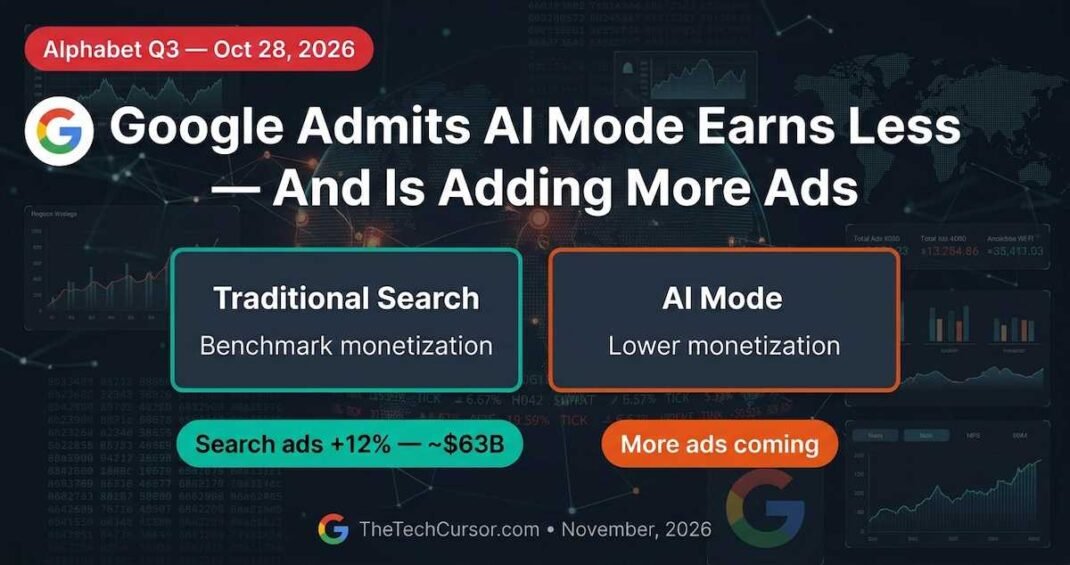
However, the same call also revealed Google’s response. It plans to scale ads across AI Mode and AI Overviews to more users and more queries. For advertisers and SEOs, that combination shapes the next year of search.
1. What Google Said on the Q3 Call
An analyst asked why faster query growth was not producing faster Search revenue growth. Philipp Schindler, Google’s Chief Business Officer, gave a direct answer.
He said the strong growth in AI Mode queries had an impact because of the “lower monetization” Google was seeing in AI Mode. In other words, more searches were happening, but each one earned less.
Google has not published a revenue comparison between AI Mode and traditional search. Therefore, the size of the gap remains unknown. Only the direction is confirmed.
2. The Numbers Behind the Admission
The headline figures show a company growing, but not as fast as the market hoped.
| Metric | Reported figure |
|---|---|
| Search and other advertising revenue | About $63 billion, up 12% |
| Total advertising revenue | $82.0 billion, below the $83.4 billion analyst consensus |
| Google Services revenue | $96.3 billion, up 11% |
| Search query growth | Fastest year-over-year pace in five years |
| AI Mode query length | About three times longer than traditional searches |
Additionally, Sundar Pichai said one in five AI Mode searches now use voice, images, or documents. Furthermore, Google reported more than 50 billion visual searches a month.
Schindler named other factors behind the slowdown as well. These included currency moves and softer retail spending in some regions. Still, he tied part of the slowdown directly to AI Mode.
Alphabet shares then fell about 12% to 13% in Thursday’s session, the largest one-day drop in the company’s history. Reports tied the fall to weaker-than-expected Q3 results overall, including slower search growth and heavy AI spending, not to AI Mode alone.
3. Why AI Mode May Earn Less Per Query
Google did not give a detailed explanation. Analysts offer a few plausible reasons. These are interpretations, not Google statements.
A long conversational answer leaves less room for paid links than a page of results. Moreover, many AI Mode queries are exploratory. They tend to lead to fewer direct purchases than a focused shopping search, so advertisers may pay less for them.
AI Mode also encourages more searching. Consequently, more queries happen inside one session, but each query may carry fewer ad opportunities today.
4. Google’s Fix — More Ads in AI Mode
Consequently, Google’s answer is to add inventory. On the call, it said its ad experiments in AI Mode and AI Overviews had produced promising results. It is now scaling ads to more users and more queries.
Several details stand out:
- Multiturn ads. US users will start to see ads in follow-up queries inside AI Mode.
- International expansion. Google announced a wider rollout of ads in AI Mode beyond its first markets.
- Strong click-through for product ads. Google reportedly said sponsored product listings in AI Mode now earn click-through rates similar to organic results.
- Limited placement control. One report said eligible advertisers cannot opt out of these placements.
Google also said Gemini models helped advertisers create more than 1.5 billion campaign assets in Q3. That figure was more than seven times the year-earlier total.
5. What the Admission Does Not Mean
However, some headlines have gone further than the evidence. A few clarifications help.
First, the comparison is with traditional Search ads. It is not a comparison with organic results. Organic listings do not earn ad revenue, so “AI search earns less than organic” would be a category error.
Second, the finding is specific to AI Mode. Google previously said ads in AI Overviews earn about the same as search without them. Those two claims do not conflict.
Third, Google says more ads will help close the gap. That is a claim, not a result. No data yet shows that it will work.
6. What This Means for PPC Advertisers
The ad inventory in AI Mode is growing fast. Therefore, advertisers should prepare in a few ways. These recommendations are analysis, not Google guidance.
Expect more AI Mode impressions. Even without opt-out control, your ads may appear there. Therefore, watch placement and conversion data closely.
Test, do not assume. If AI Mode queries convert less directly, your cost per acquisition may shift. Compare performance with your usual search traffic.
Revisit your strategy. The Fight, Influence, Generate framework still applies. Moreover, commerce is moving fast. The Universal Cart launch shows where shopping ads may head next.
7. What This Means for SEO and Publishers
Google needs AI Mode to pay. That pressure may shape how the product evolves.
If monetization is the goal, expect more commercial formats. The study on AI Mode product links already suggests that shopping answers lean toward Google’s own surfaces. Additional ads could push organic results further down.
Meanwhile, click behaviour remains a concern. The AI Mode clicks research found fewer visits to websites from AI Mode. Together, fewer organic clicks and more paid placements make direct audience building more valuable.
Track your own exposure. The AI visibility dashboard guide shows how to measure AI search visibility alongside traditional metrics.
8. Bottom Line
Google has confirmed that AI Mode earns less per query than traditional Search ads. It also confirmed that it will respond by scaling ads across AI Mode and AI Overviews. The size of the monetization gap is undisclosed, and Google’s fix is not yet proven.
What to Do This Week
First, check whether your ads appear in AI Mode and how they perform. Then review your shopping and brand campaigns for shifts in conversion. Strengthen channels that do not depend on Google’s ad format, such as email and direct traffic.
The more Google leans on ads to monetize AI search, the more important it becomes to own your audience.
Pingback: AI Data Centers on the Ballot: What Voters Decided in the 2026 Midterm Elections - The Tech Cursor