
Read time: 8 min
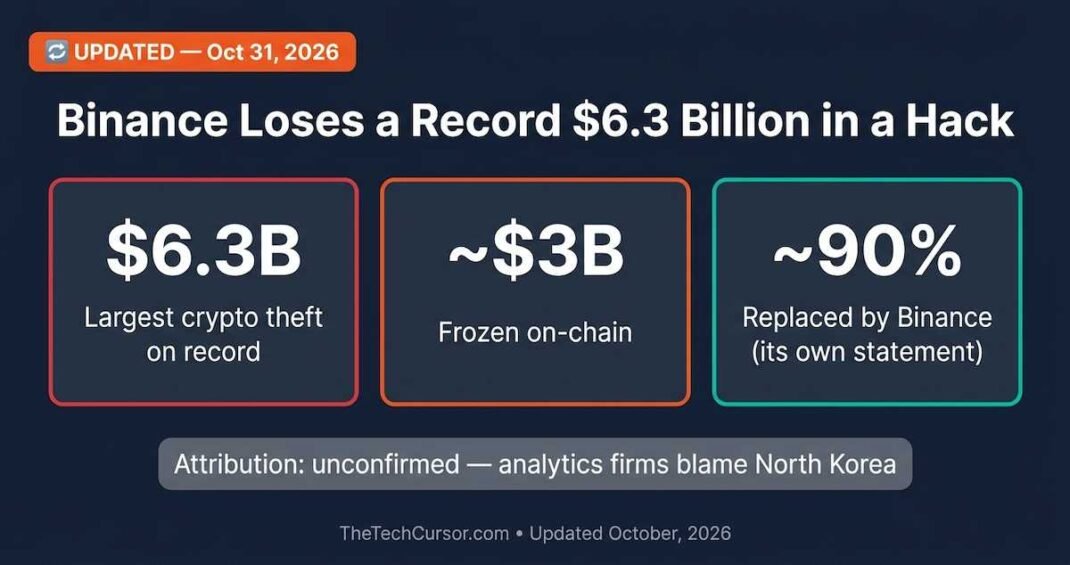
Binance, the world’s largest crypto exchange by trading volume, lost about $6.3 billion in a hack on October 29, 2026. Analysts call it the largest crypto theft on record.
The story is still developing. Therefore, several key facts remain unconfirmed. This article separates what is reported from what is claimed, and then draws practical lessons for anyone who manages valuable accounts. It is news coverage, not financial advice.
1. What Happened
An attacker moved funds out of Binance wallets on ten blockchains on the night of October 29. Most of the money left within about 20 minutes, starting at 20:05 UTC, according to blockchain analytics firm TRM Labs.
Binance confirmed a security incident and called it a complex attack. It also paused withdrawals while it investigated, according to early reports.
2. Latest Update — October 31
Binance has since shared several updates. The main points are below.
Losses are being replaced. Binance says it has replenished about 90% of the stolen assets. An earlier update put the figure near 80%. The exchange says the remaining tokens are less liquid and harder to source.
Customer balances are reported as backed. Binance says holdings in Bitcoin, Ether, USDT, BNB, Solana, USDC, XRP, and several other assets are now fully backed. It has also reserved more than $6.34 billion of company funds.
Binance says it, not users, bears the loss. It plans to use corporate funds, futures reserves, and its SAFU emergency reserve. It also plans to rebuild SAFU to about $1 billion.
Withdrawals may restart Sunday. Binance targets November 1, in phases, after security checks. A proof-of-reserves update is expected, with a fuller report on Monday.
An important caution applies. Replacing assets is not the same as recovering them from the attacker. These figures come from Binance’s own statements.
3. The Numbers at a Glance
Figures differ slightly between Binance and the analytics firms.
| Item | Reported figure |
|---|---|
| Amount stolen | About $6.3 billion (Binance); $6.36 billion (TRM Labs) |
| Time to move most funds | About 20 minutes |
| Blockchains affected | Ten |
| Funds frozen on-chain | About $3 billion |
| Company funds reserved | More than $6.34 billion |
| Stolen assets replaced | About 90% (Binance statement) |
| Previous record | $1.5 billion (Bybit, February 2025) |
The theft is roughly four times larger than the Bybit hack, according to TRM Labs.
4. How the Attackers Got In — What Binance Says
Binance’s first update pointed to a compromised laptop. The exchange said a DevOps engineer’s machine may have let the attacker reach a service container and submit unauthorized withdrawals.
Later, Binance’s co-CEO Richard Teng changed that account. He said investigators had found additional points of breach but had not yet determined the full sequence of events. The laptop may still have been an entry point.
Teng also said the attack targeted Binance’s own hot wallet, not customer funds. Binance is reviewing its cloud systems, employee devices, private-key management, and transaction-signing procedures.
TRM Labs noted that Binance has not published a full root cause. Therefore, treat the technical explanation as preliminary.
5. Who Is Blamed, and How Confident the Evidence Is
TRM Labs attributes the attack with high confidence to TraderTraitor, a North Korean state-backed unit also tracked as Lazarus Group. Chainalysis said it reached the same conclusion with a high degree of confidence. Elliptic also attributed it to North Korea.
The firms point to similarities with earlier heists, including the Bybit hack and an April 2026 incident. These include small Tornado Cash withdrawals funding an operator wallet. They also include signatures obtained in advance and then used in one burst. Moreover, TRM said preparation began at least 36 hours earlier.
However, this is attribution by private firms. Reports note it has not been confirmed by Binance or by law enforcement. One report says the FBI and Secret Service are involved in the response, but no formal attribution has appeared yet.
6. Frozen Funds and Customer Balances
About half the stolen amount has been frozen as it moved across chains. That is a significant partial success.
However, freezing is not the same as recovery. A TRM Labs executive explained that freezing stops assets from being transferred, but returning them requires a separate legal process.
Binance’s pledge to cover losses has now become more specific. It says it is using its own reserves to restore backing for customer balances. That addresses a possible shortfall for customers. Still, it does not mean the stolen money has come back.
7. How the Market Reacted
Early reports described a broad market drop. One report put total crypto market value down about 3.7% to around $2.67 trillion. Another said stablecoin issuers froze more than $2 billion in tokens linked to the incident.
By October 31, markets had steadied somewhat. Total crypto market value sat near $2.7 trillion, though sentiment indicators still showed fear. Market moves in a developing crisis can reverse quickly. Consequently, treat these figures as snapshots, not lasting verdicts.
8. Lessons for Anyone With Privileged Access
The first reported entry point was an ordinary work laptop. Investigators now say more than one weakness was involved. Even so, the lesson applies far beyond crypto. The following points are general security practices, not findings from the Binance investigation.
SEO professionals and agency owners also hold valuable access. They manage client analytics, Search Console, ad accounts, hosting, and CMS logins. A single compromised device could expose all of them.
- Use hardware security keys. Prefer them over SMS codes for important accounts.
- Separate admin work. Do sensitive tasks on a clean, dedicated device when possible.
- Apply least privilege. Give people and tools only the access they need. The SEO client onboarding guide explains how to define access and responsibilities from day one.
- Review automations. Scripts and tools often hold API keys. The SEO automation guide covers what to automate and what to keep human.
- Plan for an incident. Know who revokes access, and how quickly.
Defenders are also using AI. Google’s SAFE spam detection system shows how AI agents now investigate coordinated abuse at scale.
9. What Is Still Unknown
Several questions remain open.
First, Binance has not published a full root cause or the complete sequence of the attack. Second, whether authorities will formally confirm the North Korea attribution is not known. Third, Binance’s restart plan is a target, not a completed fact. It has not said whether all networks will return at once.
Finally, the process and timeline for recovering frozen funds are undefined. The proof-of-reserves results due this weekend should add detail.
Expect these facts to change over the coming days. Meanwhile, the same week also brought Alphabet’s record one-day selloff.
10. Bottom Line
Binance lost a record $6.3 billion in about 20 minutes. About $3 billion was frozen. Binance says it has replaced around 90% of the stolen assets from its own reserves and plans to restart withdrawals in phases. Blockchain analytics firms blame North Korea’s TraderTraitor group, though that is not yet officially confirmed.
The Takeaway
Even the largest organizations can fall to attacks that begin with a single weak point. Therefore, treat every privileged account and the device behind it as part of your security perimeter.
Pingback: Trojanized Claude Code Extension on Cursor: What to Do - The Tech Cursor