
Read time: 7 min
A tampered build of the Claude Code extension spread through Cursor’s extension marketplace on October 29, 2026. It tried to plant a hidden remote-access backdoor on the computers of anyone who installed it.
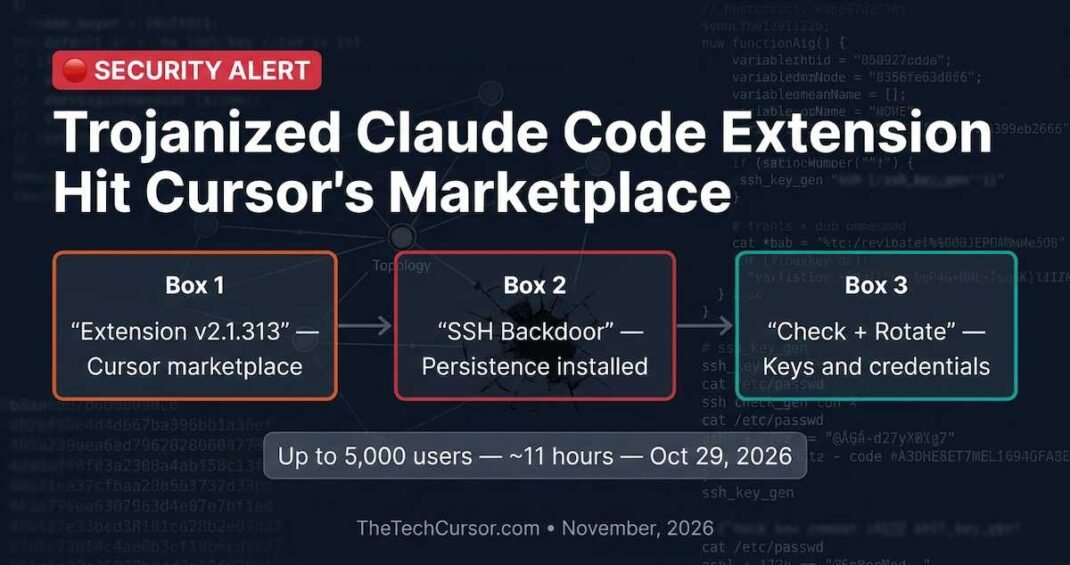
Cursor says up to 5,000 users could have been affected. However, security researchers say that removing the extension is not enough to clean up. The story is still developing, and early reports contained errors. This article separates the settled facts from the disputed ones.
1. What Happened
A malicious build labelled version 2.1.313 of the Claude Code extension appeared in Cursor’s marketplace on October 29. It stayed there for just over 11 hours.
Cursor told security researchers that its marketplace listing had suffered some form of compromise. Moreover, Cursor’s notice says Anthropic did not develop the malicious build. Cursor has removed it.
This incident concerns an extension listing. Therefore, it does not involve the Claude models themselves. For model guidance, see the Claude Opus 5.5 prompting guide.
2. The Timeline
| Time | Event |
|---|---|
| Oct 29, 09:27 UTC | Malicious build appears in Cursor’s marketplace |
| Oct 29, 20:35 UTC | Build removed after about 11 hours |
| Oct 30, early | First public reports; some wrongly name Open VSX |
| Oct 30, 01:07 UTC | Clean version 2.1.314 published on Open VSX |
| Oct 30 | Cursor publishes a security notice |
Pacific time was reported as 2:27 to 13:35 on October 29. Meanwhile, Anthropic skipped version 2.1.313 and moved straight to 2.1.314 to avoid confusion.
3. What the Malicious Code Does
Researchers describe a short loader that runs before the real extension code. Specifically, its actions are reported as follows:
- It adds an attacker’s SSH key to the machine. The key carries the comment svc-telemetry.
- It enables remote login and opens a reverse SSH tunnel to a server the attacker controls.
- It installs persistence, disguised as a system component, so the access survives restarts.
- It targets macOS and Windows, according to most reports. One report also lists Linux.
However, the persistence is the key problem. Cursor said that removal alone may not be enough, because the payload drops standalone scripts that keep running. Therefore, uninstalling the extension does not undo the damage.
4. Who Was Affected
First, the exposed group is anyone who installed or auto-updated the Claude Code extension in Cursor during that window. Cursor puts the reach at 5,000 users at most.
Second, reports indicate that other distribution channels were not affected. The Microsoft VS Code extension and the npm package for Claude Code in the terminal were reported as not malicious. However, these checks come from third-party researchers, not from a full audit.
Also, an extension folder for version 2.1.313 on your machine is a sign that you downloaded the tampered build.
5. The Open VSX Confusion — What Was Corrected
Early reports said the malicious build was on Open VSX, the open registry many VS Code forks use. Several write-ups repeated that claim. It was later disputed and revised.
However, Anthropic staff said publicly that version 2.1.313 was never published to Open VSX or Microsoft’s marketplace. Researchers who checked the registries found no 2.1.313 there. The sequence jumps from 2.1.312 to 2.1.314.
Additionally, one security firm confirmed that the 2.1.312 build on Open VSX was clean. It noted that a different, malicious 2.1.312 may exist only in Cursor’s marketplace. Version numbers alone can mislead, so compare the source of your install.
6. What to Do If You Installed It
The steps below combine researcher and vendor advice. Check Cursor’s own notice for the latest guidance.
- Look for the planted key. Check your SSH authorized keys file for an entry labelled svc-telemetry. On Windows, also check the administrators authorized keys file under ProgramData.
- Check for persistence. Look for unfamiliar startup items or small scripts in your user config folders.
- Check network indicators. Researchers published an attacker address, 134[.]209[.]82[.]225, used for the reverse tunnel.
- Rotate credentials. Change SSH keys, API tokens, cloud keys, and passwords that were present on the machine.
- Consider a clean rebuild. If you cannot confirm the machine is clean, rebuilding it is the safest route. Involve your security team if you have one.
Be careful with cleanup scripts posted online. Verify any tool before you run it.
7. Why This Matters Beyond Developers
Many SEO professionals now use editors like Cursor. They write scripts, work with APIs, and manage client sites. Consequently, their machines often hold valuable secrets.
Those secrets include Search Console and analytics access, ad account tokens, CMS logins, and server keys. A hidden backdoor on that machine could expose all of them.
Furthermore, the incident echoes a wider pattern. The Binance hack began, according to early reports, with a compromised work laptop. Both cases show how one weak point on a trusted device can reach valuable systems.
Still, practical habits help. Review automations and the keys they hold, as the SEO automation guide explains. Limit who has access to what, as the SEO client onboarding guide recommends. Moreover, install only the extensions you need, and review updates for tools with broad permissions.
8. What Is Still Unknown
Several questions remain open in the sources reviewed.
First, how the tampered build reached Cursor’s marketplace has not been explained. Second, no public attribution to a specific attacker has appeared. Third, the exact reach is an estimate, since Cursor cites a ceiling of 5,000 users.
Finally, a full statement from Anthropic and a complete post-incident report from Cursor would clarify the remaining gaps. Expect details to change as researchers publish more.
9. Bottom Line
A trojanized Claude Code extension spent about 11 hours in Cursor’s marketplace on October 29. It tried to install a persistent SSH backdoor. Cursor says up to 5,000 users could be affected. Uninstalling is not enough, so affected users should check for the planted key, remove persistence, and rotate credentials.
The Takeaway
Trusted tools can ship malicious builds through marketplaces. Therefore, treat extensions as part of your attack surface. Keep secrets off machines where you can, rotate keys regularly, and act quickly when a vendor issues a notice.