
Read time: 6 min
Marketing teams are building more with AI. For example, some create landing pages and tools from plain-language prompts. Others use AI to run campaigns and workflows.
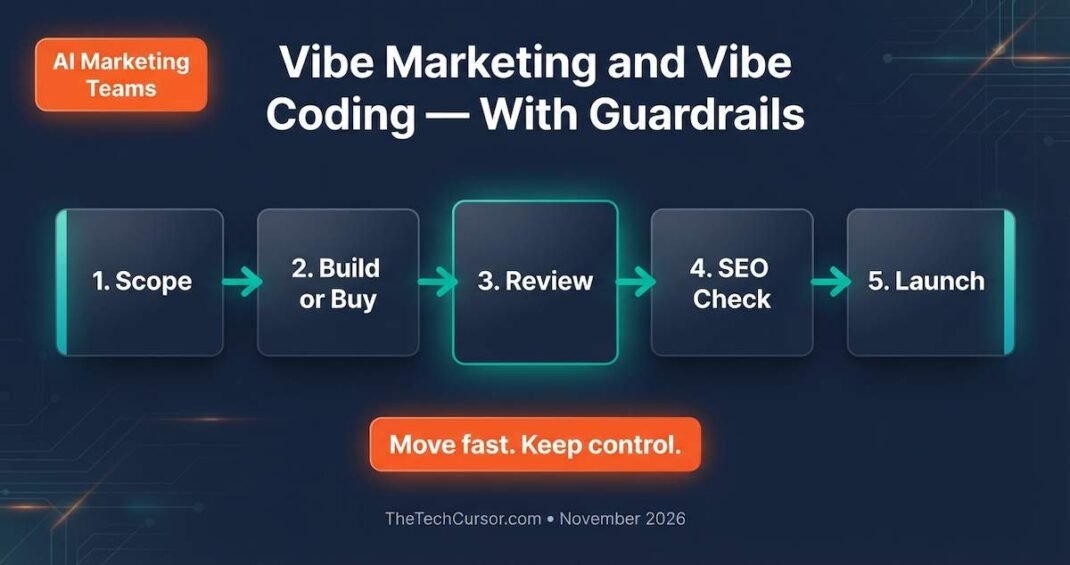
The speed is real, but so are the risks. Therefore, this guide explains the terms and offers practical guardrails for teams that want to move fast without creating a mess.
What Vibe Coding and Vibe Marketing Mean
Vibe coding means describing what you want in plain language and letting AI write the code. First, the phrase moved from developer slang into mainstream use. Collins Dictionary named it Word of the Year for 2025.
Vibe marketing applies the same approach to campaigns. Here, a marketer describes an outcome, and AI drafts assets, picks audiences, and helps ship the work. One source says marketers keep ownership of strategy, taste, and judgment while AI handles execution.
However, sources draw the line differently. One vendor blog says vibe coding builds things, such as tools and dashboards. In that view, vibe marketing connects existing systems through workflow tools. Therefore, treat these definitions as loose, since the terms are still settling.
What Marketers Are Building
Practitioners describe a few common uses.
- Campaign landing pages and calculators
- Lead-capture apps and quizzes
- Dashboards and internal tools
- Small automations between existing systems
One industry source says marketers use vibe coding mostly for the software gaps between their existing tools. That framing is useful. Indeed, it suggests AI-built tools work best as small, specific additions, not as replacements for core systems.
Sources name tools such as Lovable, Bolt, Replit, Webflow AI, and Make.com. These are examples from the reports, not endorsements.
The Build-Versus-Buy Test
A simple test also helps teams decide what to build themselves.
Single-function tools with simple logic are good candidates for building. For example, these include a pricing calculator or a campaign microsite.
Systems of record, however, stay with vendors. The same applies to anything that handles sensitive data. Customer databases, payment flows, and consent management belong in this group.
Therefore, ask two questions before building. How complex is the logic? How sensitive is the data? Low on both means a good build candidate.
Pair Builders With Reviewers
AI-generated code can contain security and quality problems that non-developers miss. Therefore, one source recommends a light technical review of AI-built code, especially anything public-facing.
The review does not need to be heavy. Instead, a developer or technical colleague can check authentication, data handling, dependencies, and error pages. Furthermore, they can confirm that secrets and keys are not exposed in the code.
Security risks also reach the tools themselves. The recent Claude Code extension incident shows why teams should vet the extensions and plugins they install.
Set Guardrails Early
Without rules, ad-hoc building can turn into chaos. In fact, one marketing publication warns that if everyone builds their own widgets, quality suffers.
It suggests guidelines for brand consistency, data quality, and security. Together, these rules let teams keep the freedom of no-code tools without the downsides.
A short policy can cover a few points.
- Who can publish. Decide who may launch AI-built pages.
- What data is allowed. Define which data can enter AI tools.
- How to review. Set a standard checklist for launch.
- Where assets live. Keep an inventory of what has been built.
Where SEO Fits In
AI-built pages still need search basics. Otherwise, a page can look finished and still be invisible.
The technical SEO checklist for vibe-coded websites explains what to verify before launch, including rendering, crawlability, and indexing.
Content quality matters too. Although AI speeds up production, it does not add original information. The AI watermark and Google SEO article explain why specific, original content outperforms generic output.
Moreover, teams that automate routine marketing tasks should decide what stays human. The SEO automation guide covers that line.
A Simple Team Workflow
This workflow is my suggestion, not a standard.
- Scope. Define the goal, the data involved, and the owner.
- Build or buy. Apply the build-versus-buy test.
- Build. Create it with AI, keeping the prompt history.
- Review. A technical colleague checks security and quality.
- SEO check. Verify rendering, metadata, and indexing.
- Launch. Publish with a rollback plan.
- Monitor. Watch performance and errors after release.
Because each step is light, speed stays high while risk drops.
Bottom Line
Vibe coding and vibe marketing let marketing teams build faster. The best results come from using AI for small, specific tools and campaigns. Also, teams should keep sensitive systems with vendors, review public-facing code, and set clear rules.
The Takeaway
Move fast, but keep control. Therefore, adopt a build-versus-buy test, pair builders with reviewers, and add SEO and security checks before launch.
Sources Reviewed
- Link provided for the original article (not accessed)
- eMarketer — FAQ on vibe coding for marketers: Building tools, pages, and workflows without engineers
- MarTech — The rise of vibe marketing and what it means for marketers
- CDP Institute — Vibe marketing: the AI-native strategy marketers are using to increase creative production
- CMSWire — The Rise of Vibe Coding: Where Marketing Meets Engineering Halfway
- Hashmeta — Vibe Coding a Website: What Marketers Need to Know (vendor blog)