
Read time: 8 min
Some longtime Google advertisers are cutting their search ad spend. They say costs are rising and their ads are less prominent. A New York Times report relayed these accounts, and trade coverage followed.
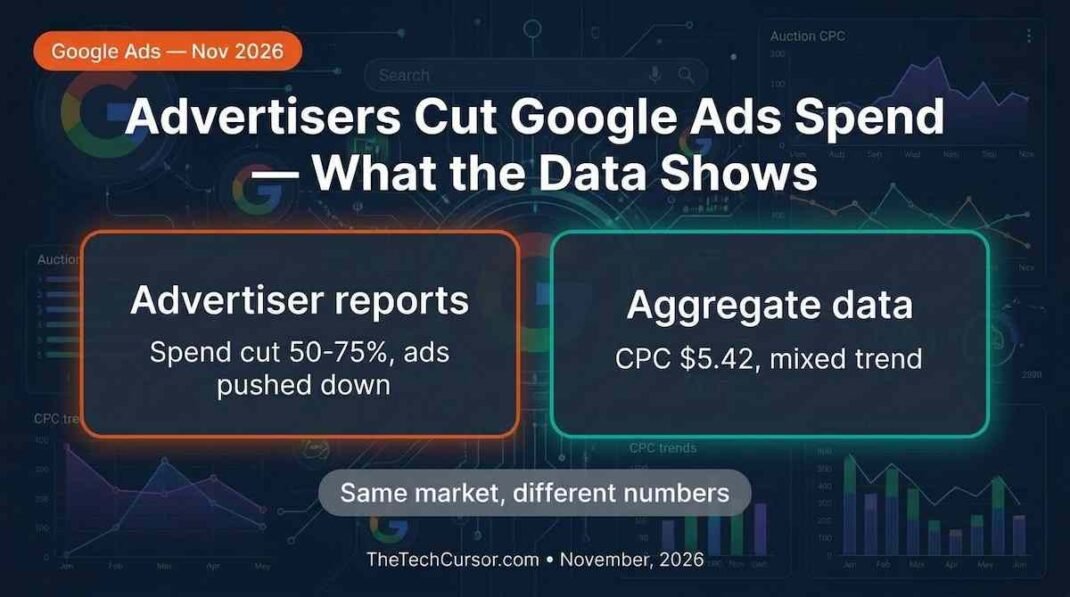
The story fits a wider debate about AI and paid search. However, the data is mixed. This article separates anecdotes from measurements and explains why the numbers disagree.
What Advertisers Told the Press
The accounts come from individual advertisers, so treat them as examples, not averages.
A North Carolina marketer who has managed Google search ads for small businesses for more than a decade said he has moved spending away from Google over the past six months. He has shifted money toward Tubi, Bing, Reddit, and Nextdoor.
The CEO of a company called OnlyFinder said his ads sometimes do not appear at all, or appear below AI Overviews. He has cut his Google Ads spending to roughly half its earlier level and continues to reduce it as costs rise.
Other marketers quoted in coverage reported larger changes. One cut a client’s monthly spend by 75%. Another said costs had tripled or quadrupled over three years.
Why Ads Are Less Visible
Advertisers say AI Overviews push traditional search ads farther down the page or out of view. When an answer appears at the top of the results, fewer users scroll to the ads.
Google also does not offer advertisers guaranteed placement in AI Overviews. Consequently, it is hard to predict when an ad will appear there.
Google says it focuses on user experience and is experimenting with how to monetize AI features. It has not promised any particular placement for advertisers.
What the Cost Data Says — A Mixed Picture
Several datasets exist, and they tell different stories.
| Source | Finding | Caveat |
|---|---|---|
| WordStream benchmark, 13,474 US search campaigns | Average CPC $5.42; conversion rate 8.18%; cost per lead $66.69 | Aggregate across industries |
| Grey Matter study, 14 B2B advertisers | Same non-brand keyword cost about 21% more, April to September 2026 versus 2025 | Small sample; B2B only |
| Same study, including advertisers’ own changes | Typical account’s non-brand CPC rose 36% | Includes budget and bid decisions |
| Alphabet filing, Q3 | Paid clicks up 8%, cost per click up 4% | Google’s own measure |
| One benchmark report | CPC up 12% across industries | Described as the steepest rise since 2021 |
| Another analysis | CPC up about 3%; cost per lead fell for the first time since 2020 | A different calculation |
These figures do not agree. Therefore, avoid quoting one number as the whole truth.
Why the Numbers Disagree
Several factors explain the gap.
Different definitions. Google’s reported cost per click is an average across its whole business. An individual advertiser’s cost depends on its keywords and competition.
Different segments. The Grey Matter study looked at non-brand B2B keywords. Costs there may behave differently from the whole market.
Different methods. Some studies strip out advertisers’ own bid and budget changes. Others include them.
Different time frames. Benchmarks cover April 2025 to March 2026. The Grey Matter study covers April to September 2026.
Different incentives. Many sources are agencies or vendors. Their studies can serve their own marketing.
Where Budgets Are Moving
The advertisers quoted named several destinations.
- Microsoft Advertising (Bing)
- Nextdoor
- Connected TV networks such as Tubi
These are individual choices, not a market-wide shift. Google remains the dominant paid search platform. Even so, the examples show where some small advertisers are testing alternatives.
Google’s Own Challenge
The story also touches Google’s business. AI Mode earns less ad revenue per query than traditional Search, as Google’s own executives acknowledged. The AI Mode monetization article covers that admission.
Google is scaling ads in AI surfaces to close the gap. However, advertisers’ doubts about value could complicate that plan. The Alphabet earnings analysis explains why investors watch this closely.
Meanwhile, Meta’s ad business grew faster than Google Search this quarter, as the Meta ad revenue comparison shows.
What Advertisers Should Do
The steps below are analysis, not Google guidance.
- Segment your data. Separate brand from non-brand, and group by product line. Averages hide the real story.
- Track cost per lead, not only cost per click. A rising CPC matters less if leads still convert at the same cost.
- Test incrementality. Use holdout tests to learn what the spend truly adds.
- Check AI Overview exposure. Find out how often your key queries trigger one, and how your ads behave there.
- Run controlled tests elsewhere. Move a small share of budget to other channels, and measure results fairly.
- Protect brand terms. They often convert best.
The paid search strategy framework helps decide where to fight, influence, or generate demand.
Bottom Line
Some advertisers are cutting Google Ads spend because of rising costs and less visible placements. Aggregate data shows a mixed picture, with some studies reporting steep increases and others modest ones. Google has not guaranteed placement in AI Overviews, and AI Mode earns less per query.
The Takeaway
Do not react to headlines. Therefore, segment your own data, judge by cost per lead, and test other channels carefully. Report on business outcomes, as the executive reporting guide recommends.
Sources Reviewed
- Advertisers cut Google Ads spending amid rising costs, AI changes (excerpt only)
- SEOteric — Advertisers Reevaluate Google Ads Budgets Amid Rising Costs and AI Influence
- PPC Land — Nothing changed but the price: B2B Google clicks cost 21% more
- Focus Digital — Average Google Ads Cost per Click by Industry: 2026 Report
- Top GEO Agencies — Average Google Ads CPC: 2026 Cost per Click by Industry Since AI Overviews
- Excella PPC — Are Google Ads Still Worth It in 2026?
- Vynce Digital — Why Google Ads CPC Is Rising in 2026
- Angarum Media — The 2026 Google Ads Performance Report