
Google’s Content Advice: Replace Generic Listicles With Expertise
Read time: 9 min
Google’s Think with Google account posted a blunt message to CMOs on November 19, 2026:
“AI didn’t make your brand invisible in Search. Your content did.”
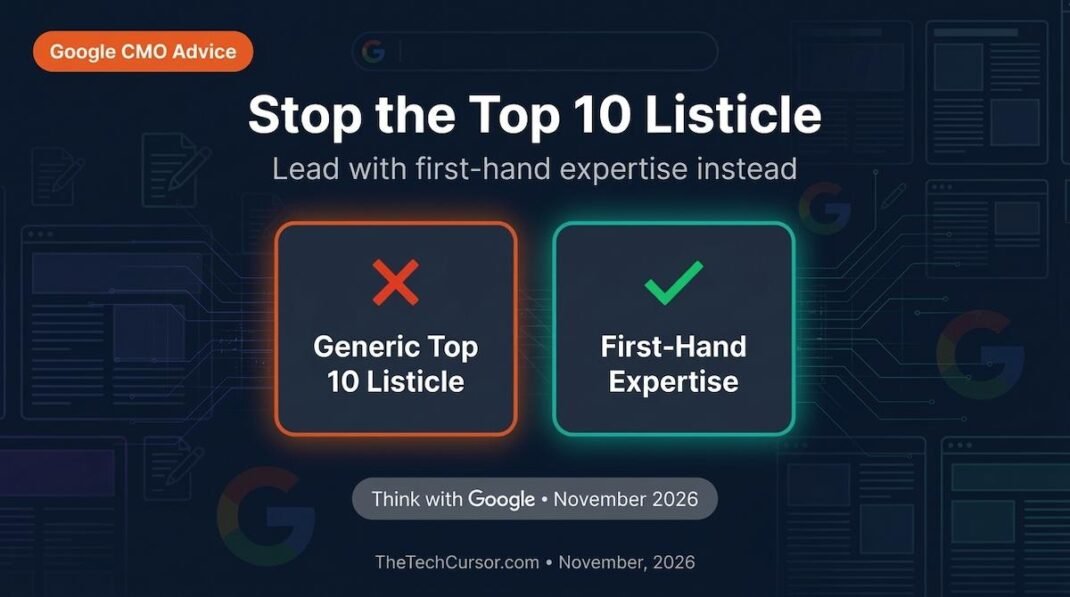
The post then offered three clear moves. The second one quickly became the most discussed:
Stop the “Top 10” listicle → start leading with first-hand expertise.
This is not a new ranking algorithm announcement. It is, however, one of the clearest public signals Google has given marketers about the kind of content it believes will struggle in both traditional search and AI-powered experiences.
What Google Actually Said
The November 19 social post was based on an October 14 article written by Brendon Kraham, Google’s VP of Search & Commerce Global Ads Solutions, published on Think with Google.
In that article, Kraham argues that brands are losing visibility not primarily because of AI Overviews or AI Mode, but because too much of their content is generic. He points out that AI Search journeys involve more touchpoints (around 12 on average in the data Google cited) and that queries are significantly longer and more specific.
Generic listicles that restate common knowledge cannot answer those longer, more precise questions well. As a result, brands that rely heavily on this style of content feel “invisible” even when search volume itself has not disappeared.
The three moves Google highlighted were:
- Stop chasing keywords → start answering conversations
- Stop the “Top 10” listicle → start leading with first-hand expertise
- Stop trusting proxy scores → start measuring real outcomes (leads, sales, etc.)
The second point is the one that generated the most reaction in the SEO community.
The Exact Example Google Used
Google used a simple but effective example of a running store:
Instead of publishing a generic “Top 10 Things to Consider” article, the store could create a deep-dive video analyzing exactly why a specific customer’s running shoes collapsed.
That piece of content is highly specific. It is based on real-world observation. It contains insight that only someone who deals with customers and products daily would have. It is not something an AI tool (or a competing site) could easily recreate from public information alone.
Google’s message is that this kind of unique, experience-based content is a brand advantage.
Why This Message Matters Right Now
This advice lands at a sensitive time. The Google November 2026 Core Update is still rolling out (day 11 as of November 21). Many sites are watching rankings closely ahead of Black Friday.
At the same time, AI Overviews and AI Mode continue to expand. Users are asking longer, more conversational questions. Brands that only publish surface-level tips content are finding it harder to appear in those answers or to earn meaningful traffic from them.
Google is essentially telling content teams: if your pages could have been written by almost anyone with access to the same public information, they are becoming less competitive.
This aligns with years of guidance around E-E-A-T (Experience, Expertise, Authoritativeness, Trustworthiness), especially the “Experience” element that Google has emphasized more strongly since 2022–2023.
Commodity Content vs First-Hand Expertise
It is useful to separate two types of list-style content:
Commodity / Generic listicles
- “Top 10 Tips for Beginners”
- “7 Things to Consider When Buying X”
- Content that restates widely available advice
- Little or no original data, testing, or personal/brand experience
- Could be generated or rewritten by almost any site (or AI) in the niche
First-hand / Experience-based content
- Case studies drawn from real customers
- Detailed analysis of failures or successes the brand has actually seen
- Original tests, data, or experiments
- Stories and lessons that only the brand’s team could tell
- Specific enough that a competitor would struggle to copy it accurately
Google is not saying every numbered list is bad. It is saying that the generic version of those lists is weak.
A well-executed listicle that is built on original testing, proprietary data, or deep first-hand experience can still perform. A thin, rewritten “Top 10” post that adds no unique value is the problem.
How This Fits With AI Search and Core Updates
AI Search systems tend to favour content that demonstrates clear experience and specificity. When an AI Overview or AI Mode answer needs to cite or draw from sources, pages that contain unique details, real examples, and demonstrated expertise are more useful than pages that simply restate common knowledge.
This is also consistent with the direction of recent core updates. Google has repeatedly said core updates aim to better surface helpful, reliable, people-first content. Commodity content that exists mainly to capture search traffic without adding new value sits on the wrong side of that goal.
For a deeper look at the current update, see our earlier coverage:
Google November 2026 Core Update: What We Know So Far
and the more recent status update:
Google November 2026 Core Update – Day 10 Status.
Practical Steps Content Teams Should Take
Here is a practical way to act on Google’s advice:
1. Audit existing listicles and tips posts
Review your highest-traffic or most important “Top X” and “Tips for” pages. For each one, ask:
- Does this contain information only we could know?
- Is there a real customer story, original test, or proprietary insight?
- Would an AI tool produce almost the same article from public sources?
2. Upgrade or replace weak pages
Pages that fail the test should either be substantially rewritten with first-hand material or consolidated/redirected if they no longer deserve to rank.
3. Change the brief for new content
When commissioning or planning new articles, require at least one of the following:
- Original data or testing
- A specific customer or client example
- A clear point of view based on real experience
- Details that a competitor would find difficult to replicate
4. Prefer depth over volume on competitive topics
One strong, experience-rich piece will usually outperform three thin listicles in both traditional rankings and AI visibility over time.
5. Measure real outcomes
Google’s third point in the CMO message was to stop relying only on proxy metrics. Track leads, sales, assisted conversions, and brand searches — not just rankings and traffic.
What This Does Not Mean
A few important clarifications:
- Google did not announce a ranking penalty specifically for listicles.
- Numbered lists and structured content are still useful for readers and for AI systems that parse information.
- “Best of” and comparison content can still work when it is based on real testing and clear criteria.
- This is guidance aimed primarily at brand and marketing content strategy, not a new technical ranking factor.
The practical takeaway is about quality and originality of insight, not about the list format itself.
Bottom Line
Google’s message to CMOs is straightforward: generic “Top 10” listicles that restate common knowledge are becoming a liability. In an environment of longer queries and AI-generated answers, first-hand expertise is the differentiator.
Content teams should treat this as a prompt to audit their tips and listicle content, upgrade the weakest pages with real experience and original insight, and raise the bar for new briefs.
The brands that win over the next 12–18 months will be the ones that publish content only they could have created.