
Category: Google Ads | E-Commerce | Digital Marketing
Read time: 6 min
Imagine a shopper searching for “best running shoes for flat feet under $100.” Instead of seeing a generic product listing, they instantly see your exact product — with a clear, AI-written explanation of why it is the perfect match for their needs, in plain language they understand.
That is not the future. That is what Google’s new AI-powered Shopping ads do — right now.
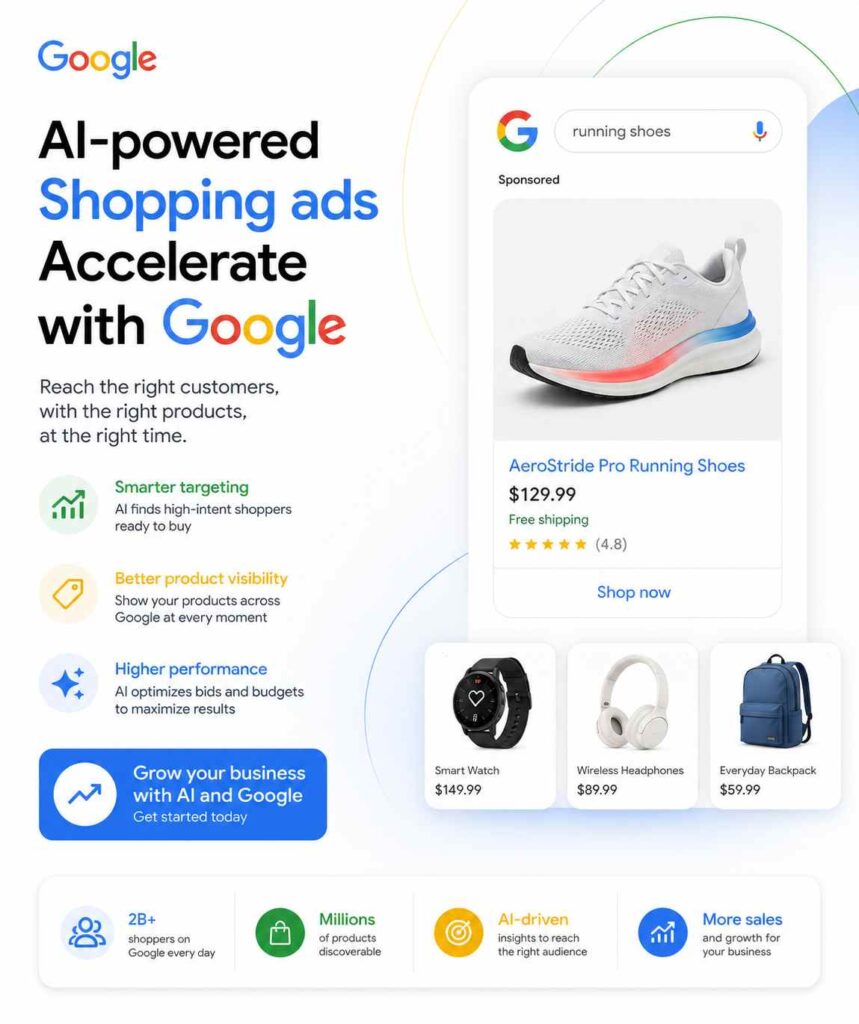
Announced at Google Marketing Live 2026, these new Shopping ads represent the biggest upgrade to retail advertising on Google in years. Here is everything you need to know — and how to take full advantage before your competitors do.
Why Google Had to Change Shopping Ads
Traditional Google Shopping ads had a fundamental problem: they showed products, but they did not explain them.
A shopper searching for a laptop would see a grid of products with prices and star ratings. But they still had to click through multiple listings, compare specs, and figure out for themselves which one actually suited their needs. The research burden was entirely on the buyer.
In 2026, with AI Mode and conversational Search becoming mainstream, shoppers now expect answers — not just listings. They want to know why a product is right for them, not just that the product exists.
Google’s new AI Shopping ads are built to close exactly this gap.
The 3 Core AI Upgrades — Explained Simply
1. Intelligent Product Identification
The old way: Your product appeared when someone searched keywords that matched your product title or description.
The new way: Google’s AI understands the shopper’s actual intent — what they need, what problem they are solving — and surfaces your most relevant product automatically, even if their search words do not exactly match your listing.
Real example: A search for “shoes that won’t hurt my knees on long walks” can now surface your orthopaedic walking shoe — even if your product title says “ergonomic comfort walkers.”
This means more of the right shoppers seeing your products — and fewer irrelevant impressions wasting your budget.
2. Expert Feature Summaries
The old way: Shoppers saw raw specs — “Memory foam insole, 12mm heel drop, EVA midsole” — and had to figure out what that meant for them.
The new way: Google’s AI automatically translates your technical specifications into simple, benefit-focused language that shoppers actually understand and find persuasive.
| What Your Feed Says | What the AI Shows Shoppers |
|---|---|
| 16GB RAM, Intel Core i7 | Fast enough for multitasking and gaming |
| 10,000mAh battery | All-day battery — no charging mid-trip |
| Memory foam insole, EVA midsole | Cushioned support for long hours on your feet |
| IPX7 waterproof rating | Fully waterproof — safe in rain and splashes |
You no longer need to write perfect ad copy for every product variation. Google’s AI does the translation automatically — at scale, across your entire product feed.
3. Immediate Decision Confidence
The old way: Shoppers had to do their own research to feel confident about a purchase — comparing multiple products, reading reviews, visiting multiple pages.
The new way: Google’s AI provides the “why” behind every recommendation directly in the ad — giving shoppers a clear, specific reason why this product matches their need at the exact moment they are deciding.
This dramatically shortens the path from search to purchase. When a shopper already understands why your product is right for them before they click, they arrive at your product page far closer to buying — not just browsing.
Where These Ads Appear
Google’s AI Shopping ads are rolling out across two key campaign types:
Performance Max is Google’s all-in-one campaign type that reaches shoppers across Search, Shopping, YouTube, Gmail, and the Display Network. The new AI creative capabilities are being built directly into Performance Max — so your existing campaigns become significantly smarter without a complete rebuild.
AI Max for Shopping Campaigns: A dedicated campaign type for Shopping that brings advanced AI targeting and creative optimization specifically to your product ads. Key features include:
- Text Customization — AI rewrites and optimizes your product titles and descriptions to be more relevant for each search, including new surfaces like AI Overviews
- Final URL Expansion — Unlocks text ads powered directly from your Merchant Center feed, helping you appear for research-based searches you would otherwise miss
What This Means for Small and Medium Businesses
Large retailers with big creative teams and massive ad budgets have always had an advantage on Google Shopping. AI-powered Shopping ads begin to level that playing field.
Why? Because the AI handles the creative work that used to require copywriters, product marketers, and large teams:
- Writing compelling product descriptions — AI does it
- Matching products to the right shopper intent — AI does it
- Explaining product benefits in buyer-friendly language — AI does it
What you still need to provide: a complete, accurate, well-structured Google Merchant Center feed. The AI can only work as well as the data you give it. Think of your product feed as the raw ingredient — the AI is the chef.
How to Prepare Your Campaigns Right Now
Step 1: Audit your Merchant Center feed. Check that every product has a complete title, accurate description, correct pricing, and high-quality images. Missing or inaccurate data limits what the AI can do for your products.
Step 2: Add detailed product attributes. The more information Google has about your products — materials, use cases, dimensions, compatibility — the better the AI can match them to the right shoppers and write accurate feature summaries.
Step 3: Enable Performance, Max if you have not already. AI Shopping ad features are rolling out through Performance Max first. If you are still running only Standard Shopping campaigns, now is the time to test PMax alongside them.
Step 4: Explore AI Max for Shopping If you want more control alongside AI optimization, AI Max for Shopping offers a middle ground — AI-enhanced creative with more campaign-level transparency than standard Performance Max.
Step 5: Monitor and provide feedback signals. These AI systems learn from performance data. The more conversion data you feed back into your campaigns — purchases, add-to-carts, engagement — the smarter the AI gets at optimizing for your specific products and audience.
The Competitive Reality
Here is the truth: these features are rolling out to every advertiser. The advantage does not come from simply having access — it comes from using them well, faster than your competitors.
The retailers who invest time in feed quality, embrace the new campaign structures early, and provide clear business objectives to Google’s AI will see stronger results sooner. Those who wait and rely on outdated campaign setups will find themselves increasingly outperformed by competitors whose AI-powered ads are simply more helpful and more relevant to shoppers.
Bottom Line
Google’s AI-powered Shopping ads are not a minor feature update. They fundamentally change how your products are presented to shoppers — from static listings to intelligent, personalized recommendations with built-in explanations.
For online retailers, this is one of the most significant advertising opportunities of 2026. The technology does the heavy creative lifting. Your job is to give it great data to work with — and to move quickly.
The shoppers are ready for a better experience. Is your store?
Stay updated with the latest in Google Ads, e-commerce, and digital marketing — Reviewed & published by TheTechCursor Editorial Team.