
Category: SEO | E-E-A-T | AI Search | Entity SEO
Published: June 24, 2026
Read time: 8 min
Site: TheTechCursor
E-E-A-T — Experience, Expertise, Authoritativeness, and Trust — has been part of Google’s quality evaluation framework since 2014. Most SEO professionals are familiar with the basics. However, in 2026, something fundamental has changed about how E-E-A-T works — and most brands are not fully adapting to it.
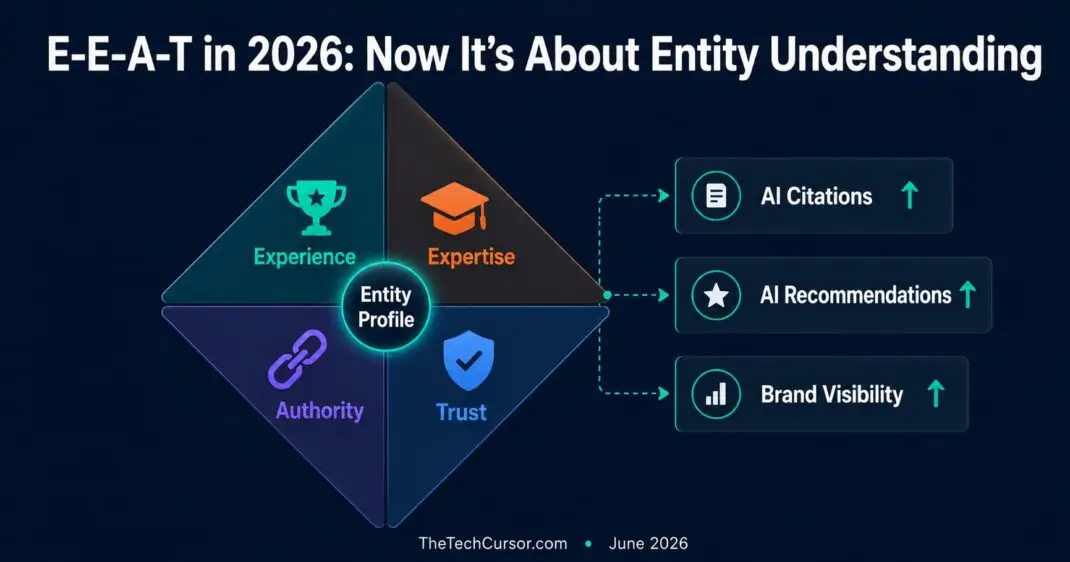
The change is this: E-E-A-T is no longer just a content quality framework. It has become the primary input into how Google’s AI systems build entity understanding — the holistic profiles of businesses, brands, and people that power AI Overviews, AI Mode, and every other AI-driven search experience.
If you want to understand why your brand appears or disappears in AI-generated answers, E-E-A-T is the lens that explains it. Here is a complete, updated breakdown of what E-E-A-T means in 2026 — and how it connects to the AI search visibility challenges every brand is now navigating.
What E-E-A-T Actually Means — A Quick Recap
Before getting to what is new, the foundation matters:
Experience — First-hand, lived experience with the subject matter. An article about running a marathon written by someone who has run twenty marathons carries more weight than one written by someone who has only researched the topic. AI cannot replicate genuine experience — which is precisely why Google added the first “E” in December 2022, shortly after ChatGPT launched.
Expertise — The depth of knowledge demonstrated in the content and by the content creator. Credentials, qualifications, demonstrated track record, and topical depth all contribute to expertise signals.
Authoritativeness — Recognition by others in the field as a credible, reliable source. Backlinks from authoritative sources, citations in industry publications, mentions by recognized experts, and a strong topical content footprint all build authority.
Trust — The aggregate of the above, plus additional signals: site security, accurate information, clear contact details, transparent business identity, and consistency between what is claimed and what is verifiable.
Google is direct about one thing: Trust is the most important component. Experience, expertise, and authority all contribute to trust — but content does not need to demonstrate all four simultaneously to be considered high quality.
The 2026 Shift: E-E-A-T Feeds Entity Understanding
Here is where 2026 changes the picture significantly.
In previous years, E-E-A-T was primarily a content-level evaluation — applied to individual pages, individual authors, individual pieces of content. Strong E-E-A-T helped pages rank. Weak E-E-A-T hurt rankings. The unit of evaluation was the page.
As covered in TheTechCursor’s breakdown of Google’s “Data extraction using LLMs” patent, Google’s AI systems are now building entity-level profiles — holistic characterizations of businesses, brands, products, and people — by aggregating and interpreting signals from websites, reviews, business listings, job postings, social media, and other public sources.
E-E-A-T signals are the primary inputs into these entity profiles. Consequently, E-E-A-T is no longer just about whether an individual page ranks. It is about whether Google’s AI systems develop a sufficiently clear, credible, and trustworthy understanding of your entity to recommend it, cite it, or surface it in AI-generated responses.
This is a meaningful shift. A brand can have technically strong individual pages — well-written, properly structured, keyword-optimized — while still being absent from AI-generated answers because its entity-level E-E-A-T signals are weak, inconsistent, or missing.
How E-E-A-T Maps to AI Search Visibility
Each component of E-E-A-T now maps to specific AI search visibility outcomes:
Experience → First-hand content that AI cannot replicate AI systems can generate generic summaries of any topic. What they cannot replicate is genuinely unique, first-hand experience. Case studies with real client outcomes, original research with proprietary data, first-person accounts of specific processes — these are the content types that AI systems identify as genuinely valuable sources rather than commodity content.
Furthermore, this is exactly why the research showing that content with original statistics and data receives 30-40% higher AI citation rates matters. Unique data is, by definition, something AI cannot generate from its training data alone.
Expertise → Named authors with verifiable credentials Research from LinkedIn and multiple industry studies consistently shows that content published under a named author with verifiable credentials and an established professional presence earns faster AI citation gains than equivalent content published under a generic brand page.
Google’s entity understanding patent specifically references extracting information about the people associated with an organization. Named authors with Person schema, active professional profiles, and visible credentials give AI systems an entity to attach authority to — which translates directly into citation and recommendation probability.
Authoritativeness → Third-party citation patterns As covered in TheTechCursor’s article on topic-specific authority, AI search systems do not trust every domain equally for every topic. They build topic-specific trusted source sets — and the brands that appear in those source sets consistently are the ones earning AI recommendations.
Building authoritativeness in 2026 means earning placements in the specific publications, platforms, and expert communities that AI systems already trust for your topic — not just accumulating general high-authority backlinks. The research is clear: three placements in a genuinely top-tier, topic-relevant source move AI visibility more than a dozen scattered across lower-authority sites.
Trust → Consistency across the full entity footprint Trust in the AI search era is measured across every source Google’s systems can access — not just your website. Business listings, review platforms, social profiles, press coverage, job postings, and third-party mentions all contribute to the trust component of your entity profile.
Inconsistency is particularly damaging. When your website describes your business one way, your Google Business Profile describes it differently, and third-party review sites surface a different picture entirely, AI systems encounter conflicting signals — which reduces confidence in your entity and lowers citation and recommendation probability.
YMYL — Where E-E-A-T Matters Most
One important dimension of E-E-A-T that becomes more critical in the AI search era is YMYL — “Your Money or Your Life” — a category Google uses to describe topics that could significantly impact a person’s health, financial stability, safety, or societal wellbeing.
For YMYL topics — medical advice, financial planning, legal guidance, safety information — Google applies significantly higher E-E-A-T standards. In AI-generated responses on these topics, the bar for citation is considerably higher than for general informational content.
For brands operating in YMYL categories, building genuine, verifiable expertise and trust signals is not optional — it is a prerequisite for AI search visibility. Generic, AI-generated content on YMYL topics is particularly vulnerable, as AI systems actively seek authoritative, credentialed sources for these high-stakes queries.
Practical E-E-A-T Actions for 2026
Given the connection between E-E-A-T and entity understanding, the most impactful actions in 2026 are those that strengthen your entity-level signals — not just individual page optimizations.
1. Build named author profiles with full credentials Every piece of content should have a named author with a detailed bio, relevant credentials, links to their professional profiles, and Person schema markup. This gives AI systems an entity to attach expertise to — and makes your content significantly more citable.
2. Create first-hand, experience-driven content Case studies with specific outcomes, original research with proprietary data, first-person process documentation, and expert commentary on real situations — these content types signal experience that AI cannot replicate and therefore actively seeks out as citation sources.
3. Audit your entity footprint for consistency Check how your business is described across your website, Google Business Profile, LinkedIn, industry directories, review platforms, and press coverage. Where you find inconsistency — different descriptions, different positioning, different claimed expertise areas — standardize the messaging while maintaining natural variation in tone.
4. Earn topic-specific third-party coverage Identify the publications, platforms, and communities that AI systems already trust for your specific topic area. Guest posts, expert quotes, original research cited by others, and earned media placements in these venues build the topic-specific authority that translates into AI citation probability.
5. Strengthen schema and structured data Organization schema, Person schema for team members and authors, Article schema for content, and Review/AggregateRating schema for testimonials all help AI systems understand your entity structure and verify your claims. The sameAs property is particularly valuable — use it to connect your entity across platforms and confirm that different profiles and mentions refer to the same organization.
6. Encourage and respond to reviews Customer reviews contribute reputation signals to your entity profile. Platforms where reviews appear — Google Business Profile, industry-specific review sites, professional directories — are among the external sources Google’s AI systems use when building entity understanding. A consistent pattern of positive, specific reviews reinforces the expertise and trust components of your E-E-A-T.
Measuring E-E-A-T Progress in 2026
E-E-A-T has never been directly measurable as a single score. However, several quantifiable indicators correlate strongly with improving E-E-A-T:
- AI citation frequency — how often your brand appears as a cited source in AI-generated responses across major platforms
- Brand mention share of voice — your share of mentions relative to competitors in AI responses for your core topic queries
- Third-party domain coverage — the number and authority of external sites referencing your brand in your topic area
- Named author coverage — the percentage of your content published under named, credentialed authors
- Schema implementation rate — the percentage of relevant pages with appropriate structured data in place
- Review volume and sentiment — the quantity and quality of customer reviews across major review platforms
None of these individually constitutes E-E-A-T — but together, they provide a measurable picture of whether your entity-level trust signals are improving over time.
The Bigger Picture — E-E-A-T as Brand Strategy
The most important insight from understanding E-E-A-T in 2026 is this: it has become indistinguishable from good brand strategy. Building genuine expertise, demonstrating real experience, earning recognition from credible sources, and maintaining consistency and trustworthiness across every touchpoint — these are not SEO tactics. They are the fundamentals of building a credible, recognizable brand.
The brands that have invested in these fundamentals over years — building real expertise, earning real recognition, serving real customers well — are the ones finding the AI search transition most straightforward. The brands that treated content as an algorithm game rather than a trust-building exercise are finding the transition hardest.
In 2026, E-E-A-T is the answer to the question: “Why does Google’s AI recommend some brands and ignore others?” It is not a mystery. It is trust, built consistently, across every signal Google’s AI systems can read.
Pingback: Why International SEO Needs Machine-Recognizable E-E-A-T — The Authority Translation Framework - The Tech Cursor
Pingback: Google's John Mueller Says You Don't Need to Do Anything Special for GEO — Here's What He Actually Means - The Tech Cursor